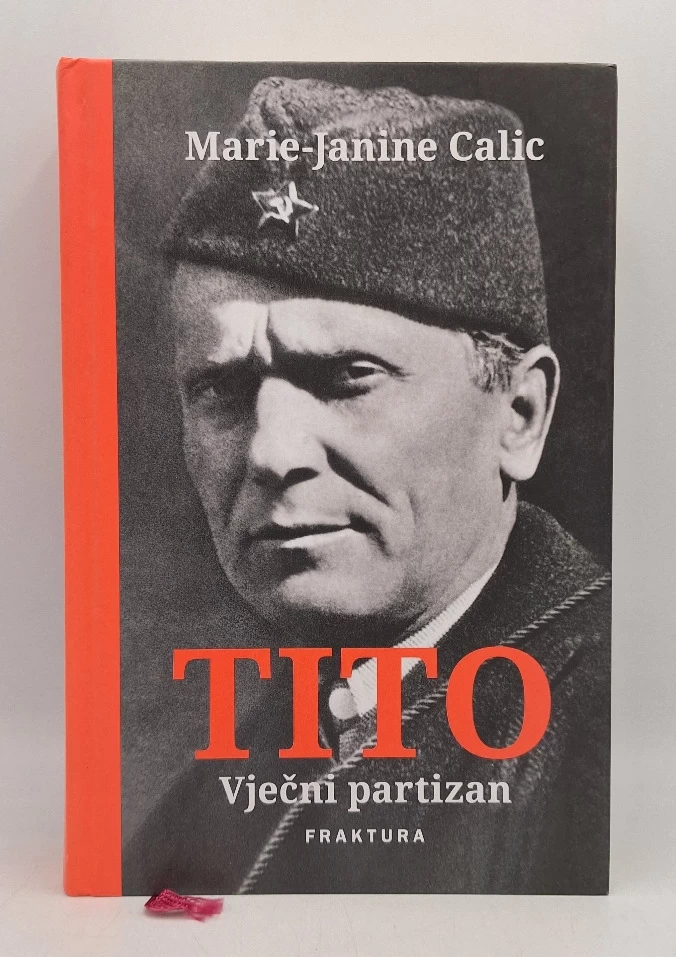

Calic Marie-Janine: Tito vječni partizan
€ 24,00
Free delivery in Croatia for orders over EUR 70
Basic information
- Author: Calic Marie-Janine
- Publisher: Fraktura d.o.o.
- Availability: Available
- Condition: Odlično
- Code: 77135
Shipping options
GLS Croatia
5€
Delivery
0€
Personal collection at the antique store
0€
GLS parcel machine
3€
Payment methods
Pay on pickup
CorvusPay
By general payment / Virman / Internet banking
Cash on delivery
Tito vječni partizan
Calic Marie-Janine
Summary
Marie-Janine Calic: Tito the eternal partisan
It is difficult to write about Josip Broz Tito. To the left and to the right there are gorges of tasteless apologies and even less tasteful political challenges. Historian Marie-Janine Calic faced this challenge after several published and influential works on the history of Yugoslavia and Southeast Europe. The facts of Tito's biography are more or less common knowledge. There are no new big revelations, except perhaps about Lucie Bauer's relatively unknown wife. Only interpretations can be new. The very title of the book, Tito – The Eternal Partisan, summarizes the central determinant of Broz's life, but also the contradictions of his personality, the contradictions between his unscrupulousness and his vision of a humane society, between his Stalinism and anti-Stalinism, between emancipatory foreign policy and mild, in some periods less mild, and immediately after the war, harsh authoritarianism in the country. Josip Broz Tito was not only a partisan during the Second World War, but remained so even after the war, for the rest of his life - an eternal partisan permanently torn between the need to be a fighter for peace and a respected world statesman (in which he mostly succeeded) and a Bolshevik revolutionary who was sometimes ready to deny himself the present in the name of communist utopia and the distant future. In the book Tito – The Eternal Partisan, Marie-Janine Calic puts Josip Broz in the context of his time and reminds us that he was capable of doing both good and evil, because, above all, he was human.
Additional information
- Author: Calic Marie-Janine
- Publisher: Fraktura d.o.o.
- Year of publication:2020
- Place of publication:Zagreb
- Pages:417
- Dimensions:16x24 cm
- Script:Latinica
- Condition:Odlično
- Binding:Tvrdi
You may also like


Recently viewed




Biblos Newsletter
For book lovers who enjoy finding the rare
New titles, special copies and quiet recommendations from the antiquarian bookshop.