
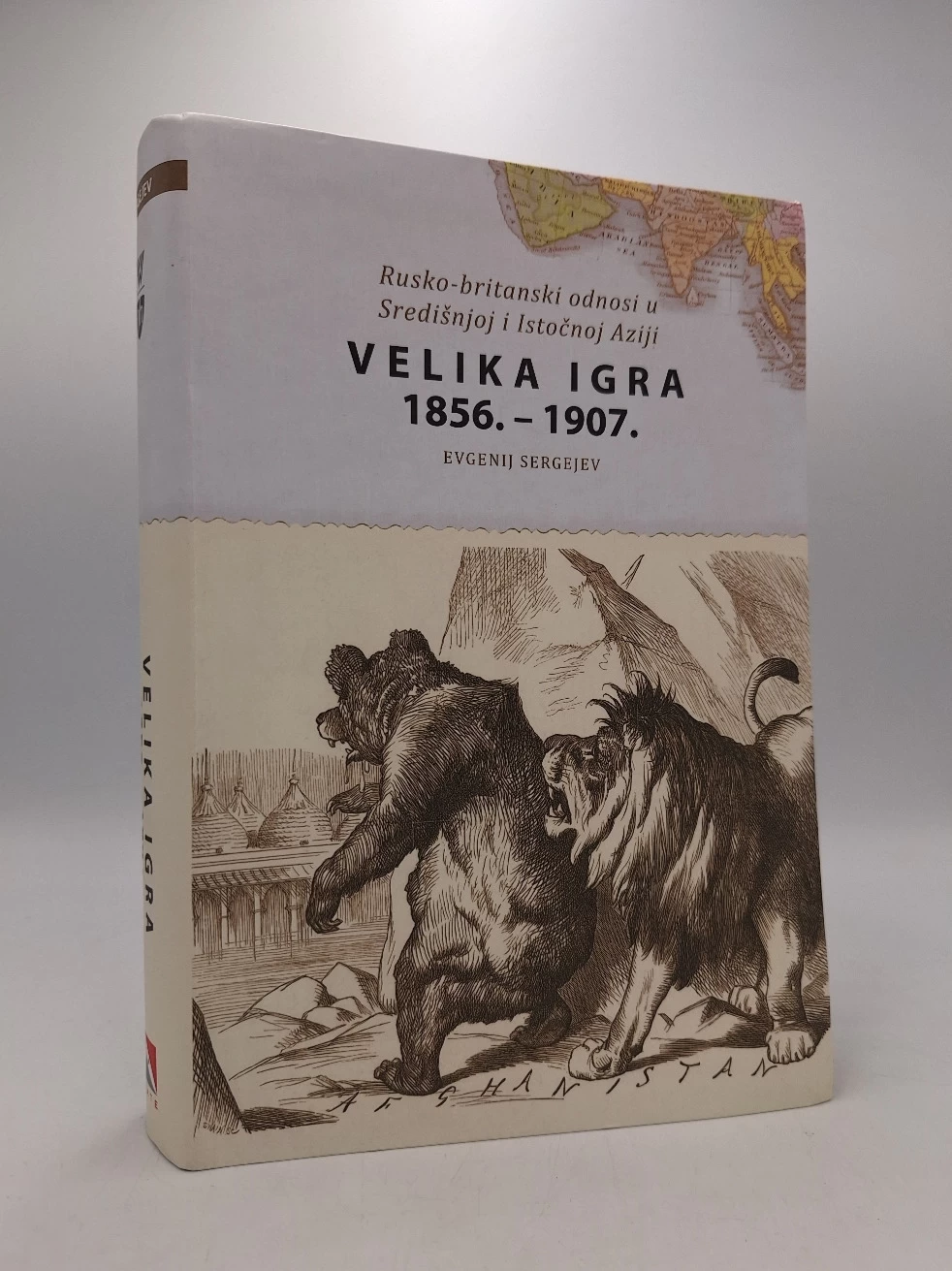
Velika igra 1856. - 1907.
Basic information
- Author: Sergejev Evgenij
- Publisher: MATE d.o.o.
- Availability: Available
- Condition: Excellent
- Code: 54065
Shipping options
Payment methods
Explore more
Velika igra 1856. - 1907.
Sergejev Evgenij
Summary
Evgenij Sergeev: The Great Game 1856 - 1907v
Russian - British relations in Central and East Asia The author has collected official documents, parliamentary papers, political pamphlets, memoirs, contemporary newspaper articles as well as unpublished sources from Russian, British, Indian, Georgian, Uzbekistan and Turkmenistan archives. Ever since the vague prehistoric times, the human race has known countless conflicts that have divided people. However, parallel to the bloody clashes, cooperation between individuals, social groups and states in general was also developing. This entanglement of mutual repulsion and tolerance, hatred and preference, has accompanied human beings for more than five thousand years of recorded history. As a paragon of this dialectical circuit, the "Great Game" played by both the great European powers and the local rulers in Central and East Asia in the second half of the 19th century, historians must re-examine from time, geography, socio-political, economic and cultural points of view. If the ordinary reader, eager to understand the "secret motives" behind historical events, were asked to explain how he views the Great Game, the answer could easily be predicted. Most likely, the reader would say that this definition refers to the geostrategic rivalry, primarily between the British Empire and the Russian Empire, for the control of Central Asia in the nineteenth century, when, faced with the challenge posed by the latter empire to the former, London had to harness both diplomatic and military means to achieve the triple aim: to maintain the balance of power in Europe, to expand its possessions in India, and to secure commercial routes from the Mediterranean to India, that is, the Pacific Ocean. The book takes an in-depth look at the Great Game in relation to the development of Russian-British relations during the Victorian and post-Victorian periods. Its purpose is to dispel myths and correct obvious inaccuracies in our understanding of how pre-industrial states and people were incorporated into modern civilization thanks to the great power competition for dominance in Asia.
Additional information
- Author: Sergejev Evgenij
- Publisher: MATE d.o.o.
- Year of publication:2018
- Place of publication:Zagreb
- Pages:530
- Dimensions:17x24 cm
- Script:Latin script
- Condition:Excellent
- Binding:Hardcover
Reviews
0 reviewsWrite a review
Share your experience and help other readers choose.
This item has no reviews yet. Be the first to share your experience.
More books from MATE d.o.o.


You may also like