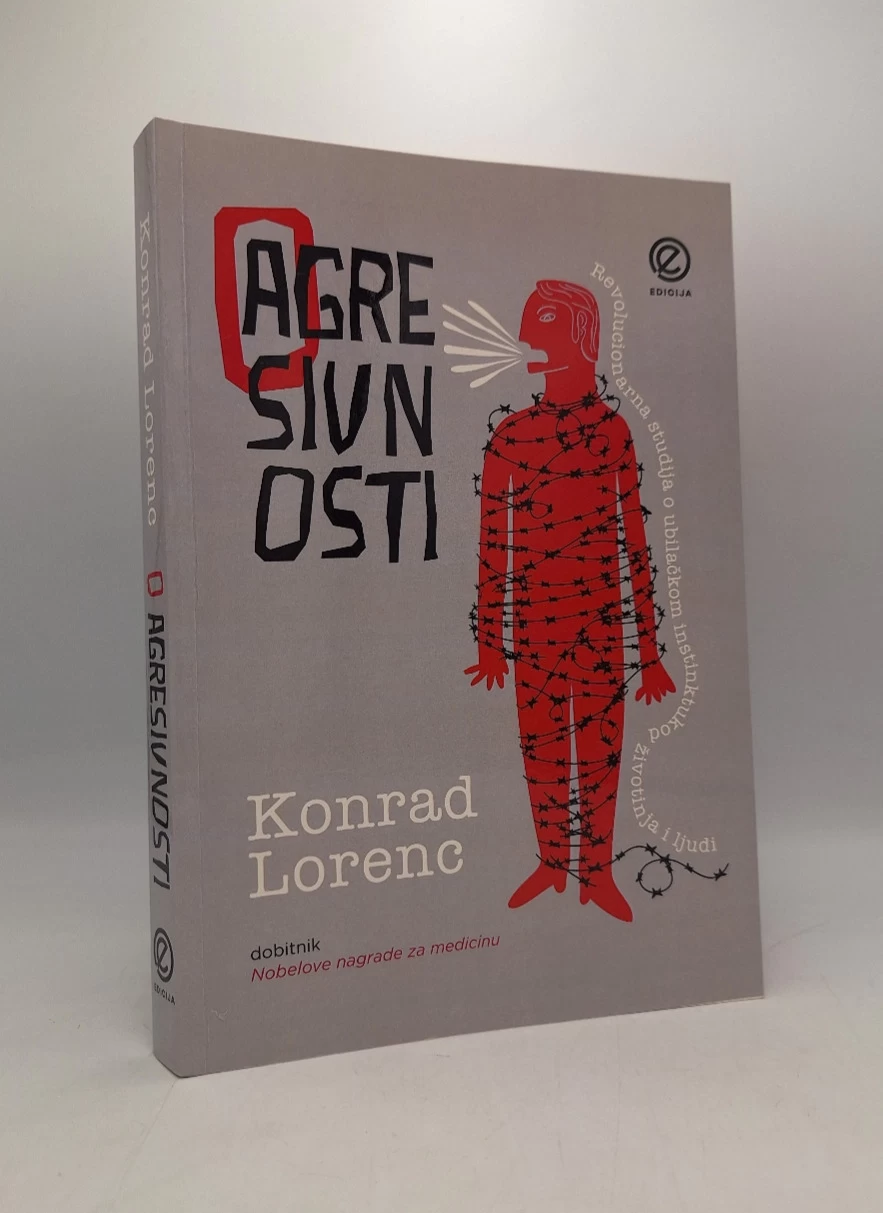

Lorenz Konrad: Agresivnost
€ 14,00
Free delivery in Croatia for orders over EUR 70
Basic information
- Author: Lorenz Konrad
- Publisher: Edicija
- Availability: Available
- Condition: Nova knjiga
- Code: 80195
Shipping options
GLS Croatia
5€
Delivery
0€
Personal collection at the antique store
0€
GLS parcel machine
3€
Payment methods
Pay on pickup
CorvusPay
By general payment / Virman / Internet banking
Cash on delivery
Agresivnost
Lorenz Konrad
Summary
Konrad Lorenz: Aggressiveness
The famous Austrian biologist and zoologist Konrad Lorenz in his work On Aggressiveness, published in 1963, explains aggressiveness based on long-term research into the behavior of animal packs, especially wolves and gorillas. He believes that the source of the aggressive behavior of people and animals is the innate aggressive instinct, which is very strong and important for the preservation of the individual and the species.
Konrad Lorenz explains aggressiveness by the accumulation of energy in the neuron centers, which leads to an explosion, regardless of external conditions. Aggressive behavior that has its origin in instinct also exists in humans. He believes that people do not fight each other because they belong to different, opposing groups, but create such groups so that they can fight.
Human aggression is incomparably greater than that of primates. The historical fact of man's aggressiveness towards members of his human community cannot even be compared to the aggressiveness of wild animals towards members of their own species. In humans, bloodlust, cannibalism, murder and torture of other humans were manifested in many communities during prehistoric times. Therefore, neither the aggressiveness of the hunter, nor the aggressiveness towards other people, can be considered as a legacy of primate ancestors, because they do not have it. Aggressiveness of the human species is a human heritage, probably created at the same time as culture, i.e. the use of tools.
Additional information
- Author: Lorenz Konrad
- Publisher: Edicija
- Year of publication:2021
- Place of publication:Novi Banovci
- Pages:258
- Dimensions:16x23 cm
- Script:Latinica
- Condition:Nova knjiga
- Binding:Meki
You may also like














Recently viewed










Biblos Newsletter
For book lovers who enjoy finding the rare
New titles, special copies and quiet recommendations from the antiquarian bookshop.