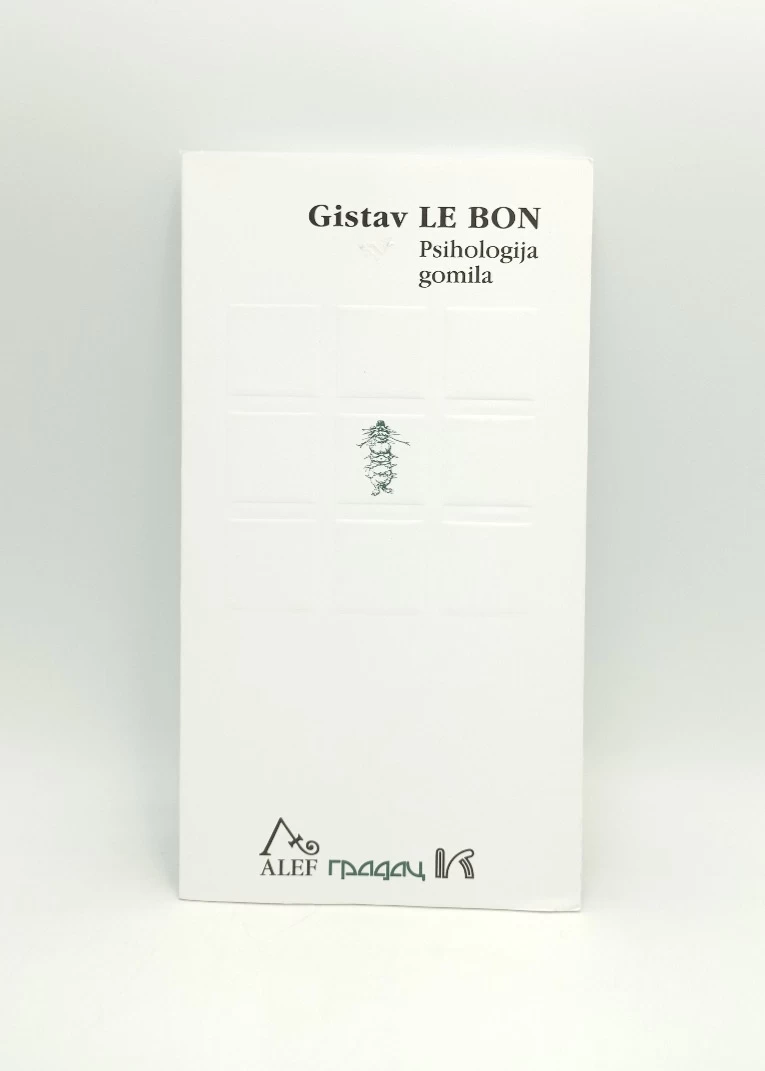

Le Bon Gustav: Psihologija gomila
€ 14,00
Free delivery in Croatia for orders over EUR 70
Basic information
- Author: Le Bon Gustav
- Publisher: Gradac
- Availability: Available
- Condition: Nova knjiga
- Code: 48146
Shipping options
GLS Croatia
5€
Delivery
0€
Personal collection at the antique store
0€
GLS parcel machine
3€
Payment methods
Pay on pickup
CorvusPay
By general payment / Virman / Internet banking
Cash on delivery
Psihologija gomila
Le Bon Gustav
Summary
Gustave Le Bon: Crowd Psychology
Crowd Psychology, written in 1895, is the best-known and most widely read book by Gustave Le Bon (1841-1931), a French social psychologist and amateur physicist. - By crowd, he meant an organized social creation, in which collective consciousness is formed and in which the individuality of the individual is potentially lost... In the crowd, individuals merge into the average, and because of this, it is never able to approach works that require high intellectual efforts. The crowd is impulsive, susceptible to suggestion, unreliable, prone to insults and exaggeration, as well as false feelings, intolerant and dictatorial. Le Bon was among the first to explore the relationship between the crowd and the masses and political institutions, parliamentarism, democracy and leaders, emphasizing that the crowds must be led, directed, giving many prescriptions from the psychology of the masses that would serve this purpose. He marked an epoch in the field of psychology and sociology of the masses - (Trivo Inđić, Rise of the masses). Le Bon enjoyed a high reputation in French intellectual circles. Evenings were organized in his home on Wednesdays where important social and scientific issues were discussed, where guests were, among others, A. Poenkare, physicist, R. Poenkare, later president of France, Henri Bergson and Paul Valeri. His theory of mass psychology was used by all famous dictators and leaders, from Lenin and Hitler to today, as well as all media and public opinion manipulators. Le Bon's more famous works are: Psychology of the People (1902), Opinion and Belief (1911), The French Revolution and the Psychology of the Revolution (1912), The First Consequences of the War (1916), Psychology of the New Age (1920), Psychology of Politics (1921), Imbalance of the World (1923), Scientific Basis of the Psychology of History (1931).
Additional information
- Author: Le Bon Gustav
- Publisher: Gradac
- Year of publication:2007
- Place of publication:Čačak
- Pages:136
- Dimensions:12x23 cm
- Script:Latinica
- Condition:Nova knjiga
- Binding:Meki
You may also like














Recently viewed












Biblos Newsletter
For book lovers who enjoy finding the rare
New titles, special copies and quiet recommendations from the antiquarian bookshop.