
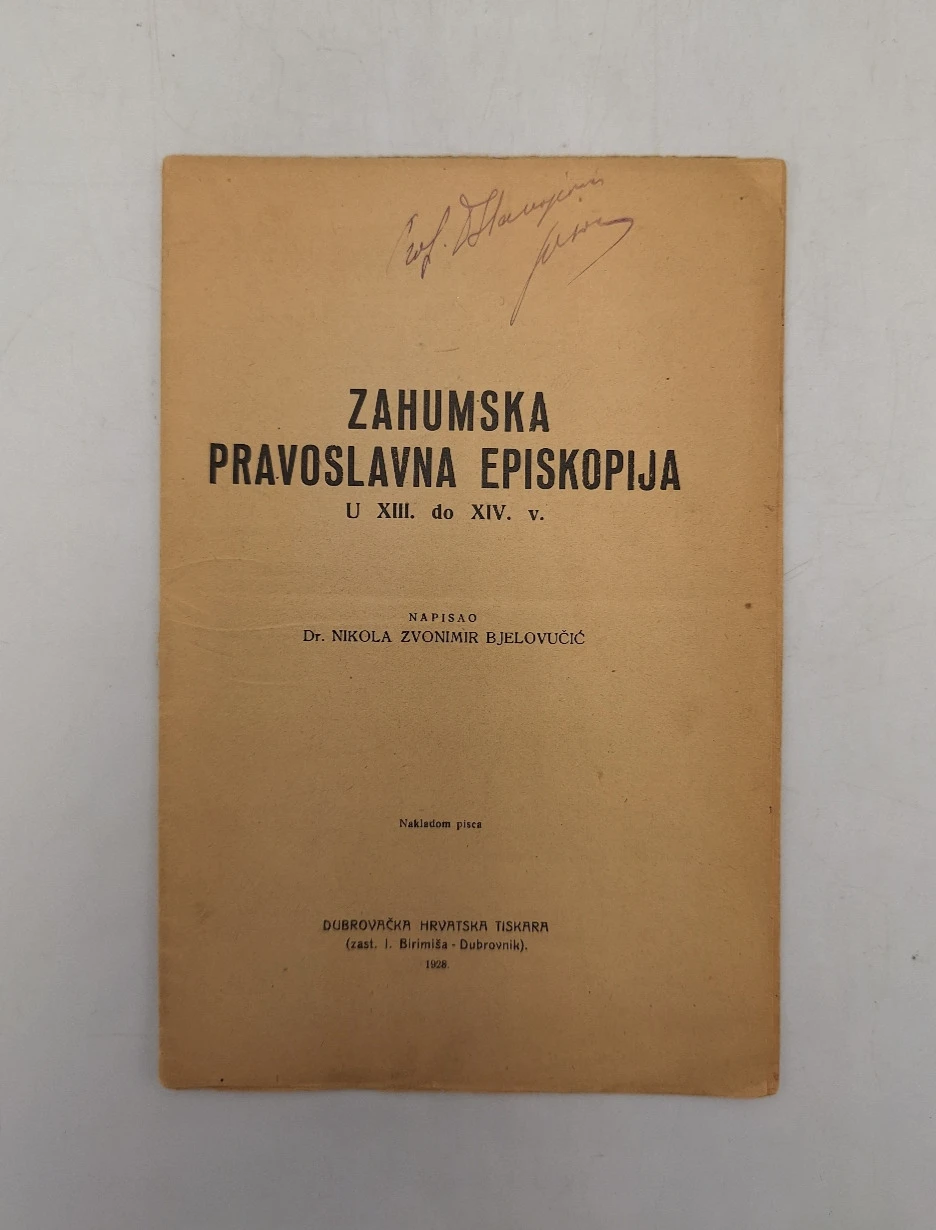
Zahumska pravoslavna episkopija u XIII. do XIV. v.
Basic information
- Author: Bjelovučić Nikola Zvonimir
- Publisher: Vlastita naklada
- Availability: Available
- Condition: Very good
- Code: 83023
Shipping options
Payment methods
Explore more
Zahumska pravoslavna episkopija u XIII. do XIV. v.
Bjelovučić Nikola Zvonimir
Summary
Nikola Zvonimir Bjelovučić: Zahum Orthodox Bishopric in XIII. to XIV. v.
BJELOVUČIĆ, Nikola Zvonimir, historian and ethnographer (Janjina, 11. XI 1882 — Janjina, 23. XI 1952). Son of Ivo, a sea captain from a prominent ship-owning family. He attended primary school in Janjina, high school in Dubrovnik (excluded due to political activity), Travnik and Mostar. He studied law in Zagreb (1901–04) and Vienna (1905–06) and received his doctorate in 1907 in Zagreb, where he also graduated in history and geography (1908–10). He practiced law and law in Dubrovnik and Trieste (1907–14). He was then a member of the Chamber of Commerce and Crafts in Dubrovnik, which appointed him a member of the Customs Council in Vienna. He had a law office in Trieste (1914), Metković (1919–23) and Dubrovnik (1923–35). He was a judge of the administrative court in Dubrovnik (1935–40) and Podgorica (1940–45). — In his native Pelješac, he encouraged the construction of roads, harbors and the opening of schools, using the influence of his uncle, court advisor Antun Vuković. In the spirit of the program requirements of the May Declaration of the Yugoslav Club in the Vienna Imperial Council, which sought the possibility of solving the South Slavic question within the framework of the Austro-Hungarian Monarchy, in February 1918, B. visited Austrian Prime Minister Ernst Seidler with Anton Korošec. In the interwar period, he was very active in implementing the agrarian reform in Dalmatia (1920–33), representing the interests of the peasants. Year In 1927, he ran for office in Herzegovina on the HSS list, but his candidacy failed, because he was sentenced to one month in prison for his speech in Zagreb. Before the 1935 elections, he left the opposition and ran on the government list of Boguljub Jeftić, but was defeated in the elections. In Dubrovnik, he was the founder and long-term president of the branch of the Brothers of the Croatian Dragon and the Croatian Antiquarian Society, as well as the founder and president of the Napredak branch of the Croatian Cultural Society. Year In 1925, he started the weekly Hrvatska riječ, of which he was the editor and owner. — He published legal, archaeological, historical and ethnographic articles as well as novels, poems and literary criticism in newspapers and magazines: Starine (1902, 1907, 1913), Vijenac (1902–03), Crvena Hrvatska (1903, 1905, 1908/09), Osvit (1904). (1910/11), Napredak, calendar (1912, 1930–33, 1944), Trialism (Trieste 1912), Hrvatski zmaj (1917, 1928), Jedro (1917), Smotra dalmatinska (1917), National unity (1919, 1920), Sloga (1920), Rad (1922), Narodna sloboda (1924–26), Croatian word (Dubrovnik 1925/26), Republican freedom (1926), Yugoslav sailor (1927), Croatian law (1927/28), Obzor (1927–30, 1932–33, 1936), Croat (1928), Croatian fighter (1928), Old Croatian education (1928), Hrvatska revija (1929, 1943), Neven (1929), Narodna starina (1930–32), Hrvatska obrana (Osijek 1932), Virovitički hrvatski glasnik (1932), Hrvatska straža (1933), Yugoslavenski list (1933–36), Narod (Sarajevo 1933), Novo doba (Split 1933), Dubravačka tribuna (1933–34), Dubrava (1934), Nova Danica (1935), Zeta (1936), Primorje (1939), Zagrebački list (1940), Hrvatska gruda (1941), Hrvatska smotra (1943), etc. He is not always reliable in historiographical works. He used ingenuity and wrong dating in order to draw conclusions, for example about the past of Pelješac, which he knew how to adapt to his political ambitions. As conservation commissioner, in 1922 he allowed the demolition of the old Croatian church of St. Peter in Trpanj, which D. Fabris characterized as a "compromise, dictated by the desire for a parliamentary mandate".
Additional information
- Author: Bjelovučić Nikola Zvonimir
- Publisher: Vlastita naklada
- Year of publication:1928
- Place of publication:Dubrovnik
- Pages:23
- Dimensions:13x20 cm
- Script:Latin script
- Condition:Very good
- Binding:Softcover
Reviews
0 reviewsWrite a review
Share your experience and help other readers choose.
This item has no reviews yet. Be the first to share your experience.
More books by Bjelovučić Nikola Zvonimir
More books from Vlastita naklada



You may also like