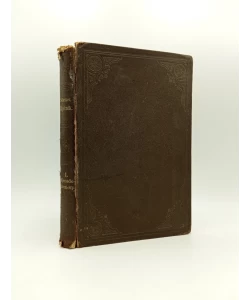
Njemačko - hrvatski riječnik I - II.
Basic information
- Author: Šulek Bogoslav
- Publisher: Franjo Župan
- Availability: Available
- Condition: Very good
- Code: 10628
Shipping options
Payment methods
Explore more
Njemačko - hrvatski riječnik I - II.
Šulek Bogoslav
Summary
Bogoslav Šulek: German-Croatian dictionary I - II.
Bogoslav Šulek is a Slovak by birth and a Croat at heart. He completed his studies in philosophy and legal sciences in Bratislava. He was also interested in natural sciences, especially plants. He was a polymath, publicist, educator and lexicographer.
In 1838 he came to Zagreb, attracted by the Illyrian revivalists and Ljudevit Gaj. He learned the Croatian language while working in Zagreb in 1838 at Župan's printing house. He joined the Illyrians in 1841. He anonymously edited Danica (from 1843 to 1846), and then wrote himself (What the Illyrians are up to). He also edited the illegal political weekly Branislav (1844-1845). In 1849, he broke up with Gaj. Then he edited Slavenski jug, Gospodarski list, collaborated in Pozor. He was one of the first members of JAZ (from 1866), and from 1874 until his death he was its secretary.
Šulek is best known for his lexicographical work, in which he continues the rich Croatian lexicographical tradition, enriching it with new words, new meanings, phrases and scientific names for new civilizational and scientific needs. How much he mastered the Croatian language can be seen from the fact that he coined new words in that language for the scientific and civilizational achievements of the time, which he knew well. This is reflected in his three dictionaries:
- German-Croatian dictionary,
- Croatian-German-Italian dictionary of scientific terms and
- Yugoslavian plant directory.
In 1860, Šulek published the German-Croatian dictionary. He dedicated it to J. J. Strossmayer. The dictionary covers 1712 pages. At the end of the dictionary there is a list of proper names (person and geographical names). An Appendix with additions, corrections and what needs to be omitted follows. Then it follows on page 8. List of words that are spelled with flock and then their correct pronunciation, eg: běsnoća - bjesnoća, brěst - briest. In the text of the Dictionary itself, words with a flock are written with a horned ě: d ělo, letěti, běsomučan...
The Dictionary contains about 70,000 entries. Many of them are quite common today, such as education, blacksmith, milkman, new believer, supremacy. Some of his creations were not accepted, such as dogle, brainstem, potion...Instead of some of his creations, a foreign word was kept:
drawer (Šulek: kolnica),
functionary (Šulek: doer),
absolutism (Šulek: autonomy),
continuity (Šulek: connection),
sediment (Šulek: sedo)...
Some are its creations accepted in a somewhat changed meaning: storeroom (Deponierung, today in the narrowed meaning of "pantry"),
roundwood (Mantelfläche des Cylinders, today "round of wood, roundwood"...
Others underwent changes in terms of expression:
peasantry (Landbevölkerung), today peasantry,
saturation (Saturation), today saturation, e.g. solutions,
summits (isolieren), today isolate (se),
signology (Semiotics), today signology ...
Rare!
Additional information
- Author: Šulek Bogoslav
- Publisher: Franjo Župan
- Year of publication:1860
- Place of publication:Zagreb
- Pages:872 1712
- Dimensions:15x22 cm
- Script:Latin script
- Condition:Very good
- Binding:Hardcover
Reviews
0 reviewsWrite a review
Share your experience and help other readers choose.
This item has no reviews yet. Be the first to share your experience.
More books by Šulek Bogoslav


More books from Franjo Župan


You may also like



Recently viewed