
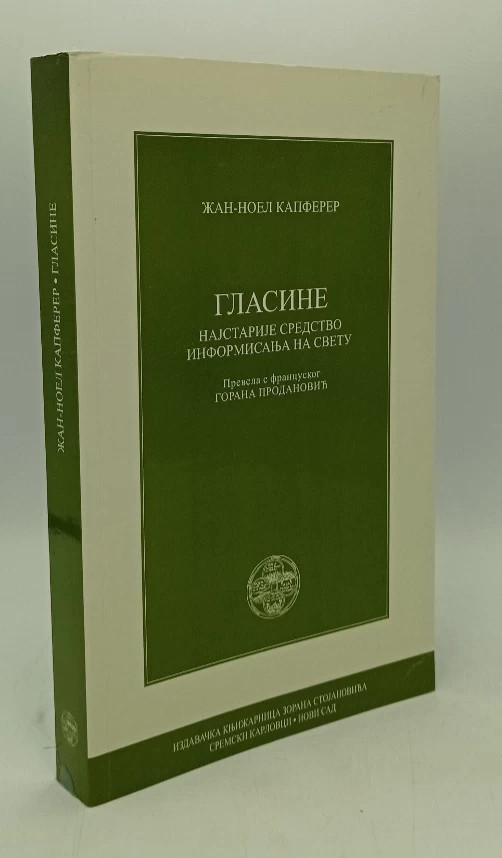
Glasine
Basic information
- Author: Kapferer Jean Noel
- Publisher: Izdavačka knjižarnica Zorana Stojanovića
- Availability: Available
- Condition: New book
- Code: 49515
Shipping options
Payment methods
Explore more
Glasine
Kapferer Jean Noel
Summary
Jean-Noel Kapferer: Rumors
The oldest means of information in the world
Until today, the study of rumors was accompanied by their negative evaluation: a rumor is necessarily incorrect, invented or irrational. Therefore, the existence of rumors was always lamented, they were seen as a temporary departure from the truth, a burst of madness. Some even saw in the increase in the number of public information means an opportunity to deal with rumours: television, radio and the press could abolish the reason for existence of rumours. We have shown in this book that this negative evaluation is unsustainable. On the one hand, that understanding of rumors led to a dead end: most of the characteristics of this phenomenon remained unexplained and described as pathological. On the other hand, it seems that such an understanding is primarily motivated by moralizing and dogmatism. Basically, there's only one way to stop rumors: stop people from talking. The obvious effort to circulate only reliable rumors leads right to the control of information, and then to the control of freedom of speech: the media would thus become the only permitted source of information. Then there would only be official information. This brings us to the very essence of the existence of rumours. A rumor is not necessarily "false", but it is therefore necessarily unofficial. Abandoned and sometimes in opposition, it challenges the official one by offering a different reality. That's why the mass media didn't push her out.
Additional information
- Author: Kapferer Jean Noel
- Publisher: Izdavačka knjižarnica Zorana S...
- Year of publication:2016
- Place of publication:Novi Sad
- Pages:338
- Dimensions:14x20 cm
- Script:Cyrillic script
- Condition:New book
- Binding:Softcover
Reviews
0 reviewsWrite a review
Share your experience and help other readers choose.
This item has no reviews yet. Be the first to share your experience.
More books from Izdavačka knjižarnica Zorana Stojanovića



You may also like