
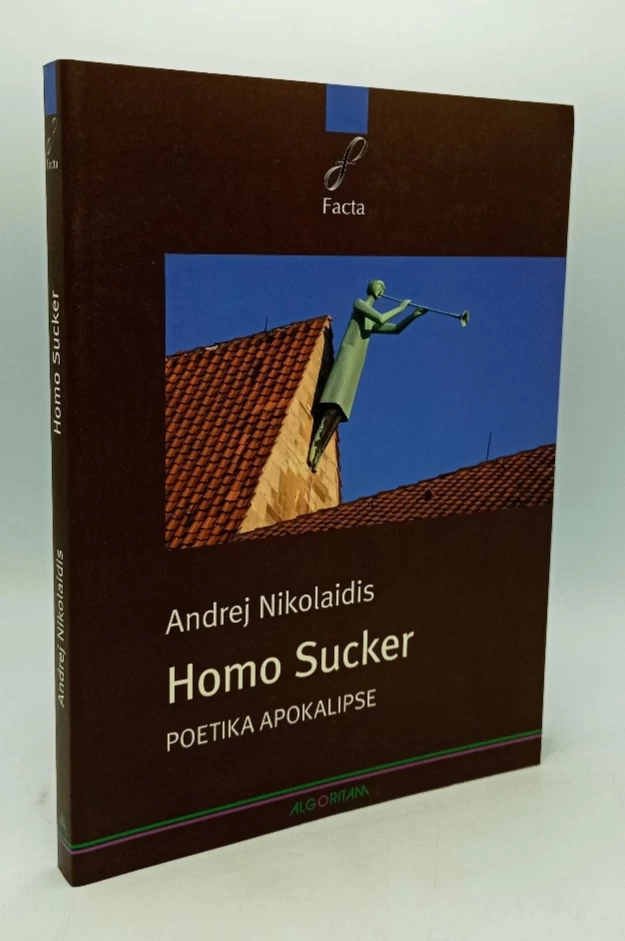
Homo Sucker
Basic information
- Author: Nikolaidis Andrej
- Publisher: Algoritam
- Availability: Available
- Condition: New book
- Code: 56450
Shipping options
Payment methods
Explore more
Homo Sucker
Nikolaidis Andrej
Summary
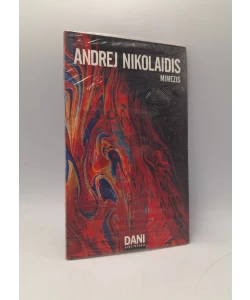
Andrej Nikolaidis: Homo Sucker
Poetics of the Apocalypse
Homo Sucker: Poetics of the Apocalypse is a book created as a collateral profit during many years of research and study of the Apocalypse, which the Montenegrin writer Andrej Nikolaidis undertook while writing the novel Arrival (Algoritam, 2009). The author himself will ironically say: "... enough talk about the Greek influence on European thought. For a change, here is a Greek who was influenced by Slavic philosophers..." and thank Slavoj Žižek, Žarko Paić and Srećko Horvat. He conceived the Poetics itself through three chapters, in his words: "The first part of the Poetics of the Apocalypse, 'How the steel of Christ was tempered', is an attempt at an essayistic-publicistic interpretation and, occasionally, a dialogue with Haddad's text. The second part of the book is called 'Badiou, Paić, Žižek: The Revolution that does not flow' - I think it is quite clear what I am doing here. The third part, 'Burn, Hollywood, Burn', tries to answer the question: why America in the first decade In the 21st century, she looked so carefully for the signs of the Apocalypse, and why her films prophesied the Apocalypse." However, if anyone is the Father of this book, it is Lacan. Namely, precisely the Lacanian reading of apocalypticists, those who bring the end of history (including Müntzer, Marx, Fukuyama) as well as relying on the works of Alain Badiou, Jacques Ranciere, Gianni Vattimo... made this book unprecedentedly contemporary, even timeless (such is its theme) and ancient - because it has a thesis. Namely, after all, Nikolaidis very convincingly concludes that ecological apocalypses, which are not coincidentally the most popular today, especially in Hollywood, are actually anti-apocalypses, pure opposition to the good old Apocalypse. Because they exchange the Name of the Father for the Mother, culture and civilization for Nature. It goes without saying that Andrej Nikolaidis did not forget to write, so this book is at least a double treat: philosophical and literary.
Additional information
- Author: Nikolaidis Andrej
- Publisher: Algoritam
- Year of publication:2010
- Place of publication:Zagreb
- Pages:145
- Dimensions:17x24 cm
- Script:Latin script
- Condition:New book
- Binding:Softcover
Reviews
0 reviewsWrite a review
Share your experience and help other readers choose.
This item has no reviews yet. Be the first to share your experience.
More books by Nikolaidis Andrej
More books from Algoritam







You may also like