

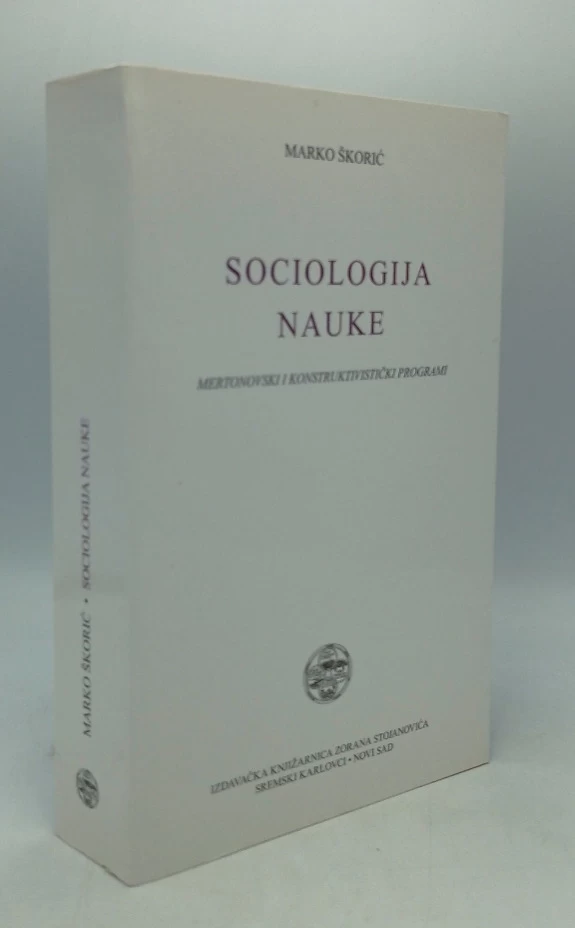
Sociologija nauke
Basic information
- Author: Škorić Marko
- Publisher: Izdavačka knjižarnica Zorana Stojanovića
- Availability: Available
- Condition: New book
- Code: 43865
Shipping options
Payment methods
Explore more
Sociologija nauke
Škorić Marko
Summary
Marko Škorić: Sociology of Science
Mertonian and constructivist programs
The book consists of an introduction, four chapters, concluding remarks and a list of references. In the introductory part, basic epistemological-methodological problems and disputes in sociology (science) are discussed. The first chapter is devoted to the origin and emancipation of the sociology of science. It begins with an overview of the optimistic understanding of science in the USSR, the USA and Germany in the first half of the twentieth century, and then analyzes the inadequacy of the positivist understanding of science. After that, he points to the sources of relativism in the classical philosophy of science, which becomes the dominant orientation of constructivist sociologists. Finally, the social and cognitive circumstances of the origin and development of constructivism and postmodernism are also discussed. In the second chapter, Merton's program of sociology of science is considered. Škorić believes that the beginning of the sociology of science can be located in the thirties of the last century, when Robert Merton published his doctoral dissertation on science in England in the seventeenth century. Therefore, in addition to Merton's thesis, Cilsel's thesis is also analyzed as another early work that connects the history and sociology of science, so that at the end there will be a detailed examination of numerous problems of the sociology of science that were raised by these works. In the third chapter, the constructivist program of the sociology of scientific knowledge is presented. Since this paradigm was dominant in the sociology of science during the last few decades, only representative authors were selected, and the selection was based on two criteria - those authors whose works caused the greatest polemics and were the most influential were selected. This includes members of the Edinburgh School and several other authors who have a similar theoretical position. In the fourth chapter, "scientific wars" are analyzed as a consequence of the rise of anti-scientific sociology (science). The most important distinction, which receives a lot of attention, is that between pro-scientific and anti-scientific theorists, primarily sociologists. After considering the basic concepts, the "scientific wars" themselves are discussed, understood as a polarized conflict between the aforementioned pro-scientific and anti-scientific theorists. Also, the attack on the academic left is analyzed in particular, with a critical review of sometimes overly simplistic criticisms. Finally, the final part of the manuscript is devoted to a critical review of the Mertonian and constructivist sociology of science, and at the end a very exhaustive list of relevant literature, almost entirely in English, is attached.
The original contribution to science was achieved by the successful application of comparative analysis in an extensive theoretical study of a hitherto insufficiently researched sociological problem, whereby almost all relevant problems of sociology were carefully, systematically and in-depth analyzed science.
Additional information
- Author: Škorić Marko
- Publisher: Izdavačka knjižarnica Zorana S...
- Year of publication:2010
- Place of publication:Novi Sad
- Pages:656
- Dimensions:14x22 cm
- Script:Latin script
- Condition:New book
- Binding:Softcover
Reviews
0 reviewsWrite a review
Share your experience and help other readers choose.
This item has no reviews yet. Be the first to share your experience.
More books from Izdavačka knjižarnica Zorana Stojanovića








You may also like













Recently viewed