
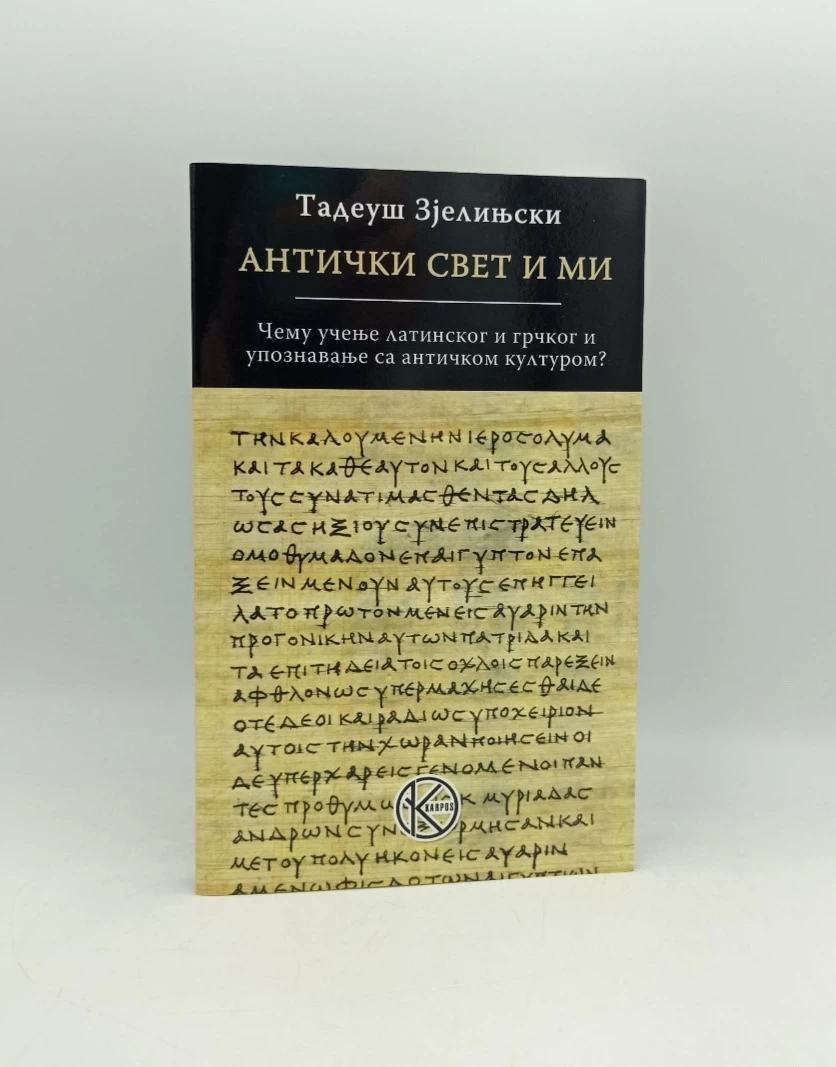
Antički svet i mi
Basic information
- Author: Zielinski Tadeusz
- Publisher: Karpos
- Availability: Available
- Condition: New book
- Code: 53112
Shipping options
Payment methods
Explore more
Antički svet i mi
Zielinski Tadeusz
Summary
Tadeusz Zielinski: The Ancient World and Us
Why learn Latin and Greek and get to know ancient culture?
According to Professor Tadeusz Zielinski (1859–1944), ancient culture has enormous significance for the development and preservation of European culture. It must continue to have a place in the education process. Classical culture is by its very nature, both historically and psychologically, an organic element in the education of European society and can only be removed if the entire contemporary European culture is also removed. However, ancient culture fulfills its role only when it is not treated as a norm that is blindly imitated, but as a fruitful seed thanks to which European culture grows and is refined. The universal value of getting to know ancient culture rests in the fact that it is the ability to truly educate. "Knowledge is forgotten, but education is not lost. An educated man, even when he forgets everything he has learned, remains an educated man." Education does not mean the mere availability of information. We can still learn from the ancient Greeks how to approach the "truth" and ask why and what. By learning Latin and Greek, we also learn about our mother tongue much more than is usually assumed, and precisely because by learning classical languages, we learn best and fastest to ask questions about the syntax, morphology, and phonetics of our mother tongue. Those lectures were published the same year in Russian, soon followed by German (1905) and English (1909) translations, and by the beginning of the Second World War they had been translated into a dozen other European languages. There is no doubt that the success of this book was contributed by the reasoned argumentation presented by Zzelinjski, as well as the tone, numerous interesting and convincing references to ancient philosophy, architecture, philology, literature, etc., but also the need of a part of the academic community for defense against aggressive pedagogical utilitarianism, which, both at the beginning of the 20th and at the beginning of the 21st century, tries to expel from the educational system all "useless knowledge" that cannot be easily monetized. In this sense, the work The Ancient World is still a relevant contribution to the debate on the meaning and purpose of education.
Additional information
- Author: Zielinski Tadeusz
- Publisher: Karpos
- Year of publication:2016
- Place of publication:Beograd
- Pages:153
- Dimensions:13x20 cm
- Script:Cyrillic script
- Condition:New book
- Binding:Softcover with dust jacket
Reviews
0 reviewsWrite a review
Share your experience and help other readers choose.
This item has no reviews yet. Be the first to share your experience.
More books from Karpos