
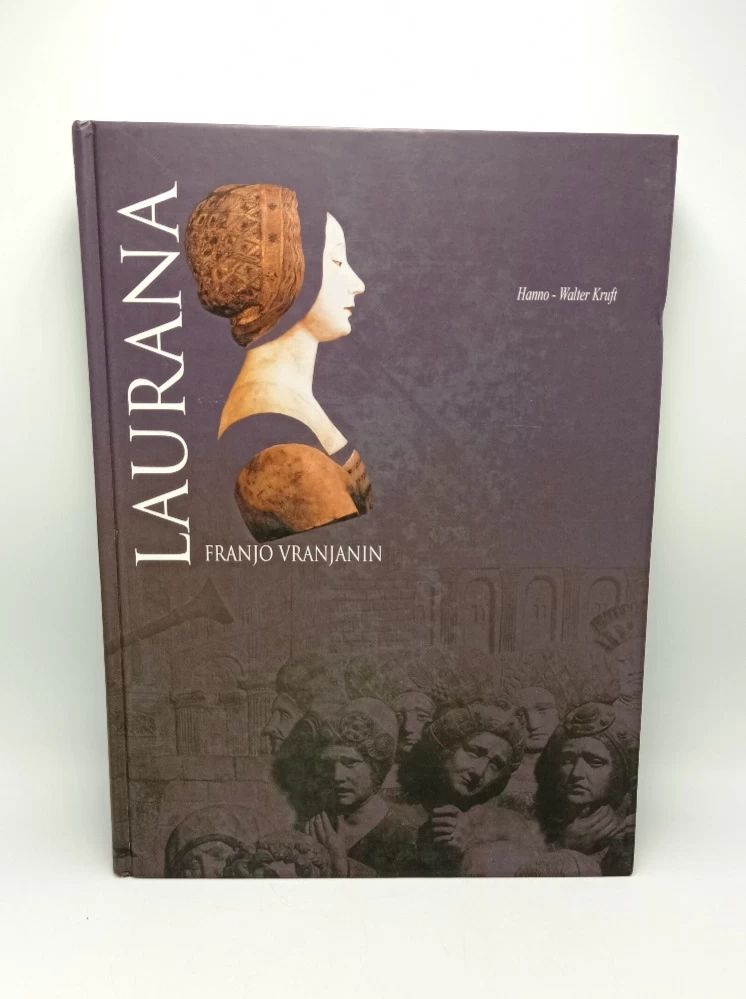
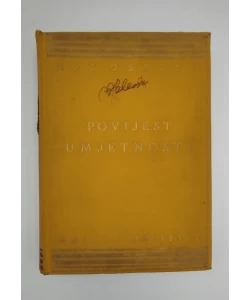
Franjo Vranjanin= Fracesco Laurana
Basic information
- Author: Kruft Hanno-Walter
- Publisher: Laurana
- Availability: Available
- Condition: Very good
- Code: 36562
Shipping options
Payment methods
Explore more
Franjo Vranjanin= Fracesco Laurana
Kruft Hanno-Walter
Summary
Hanno-Water Kruft: Franjo Vranjanin= Fracesco Laurana
Finally we welcomed the Croatian edition of Hanno Walter Kruft's book about Francesco Laurana — an early Renaissance sculptor born around 1420-1430. in Vrana near Zadar, whom we, not at all in the spirit of the climate from which he originates, call Franjo Vranjanin. Frane from Vrana is world famous as the author of mysterious female busts of reduced sculptural form. The strange energy of those slightly desexed heads framed by unusual wigs and headdresses, with narrowed eyes and downcast, distant gazes is recognized by both the audience and the profession, regardless of changes in taste. Kruft's translation of Laurana is the successor to Julio Klović's translation of Marija Cionini Visani (1977, NZMH). We expect that the Croatian translations of the other monographs on the Schiavons, which were written by foreign experts in the last twenty years, will come out in a more regular rhythm. With books like this, the Schiavons have a chance to live in our culture in the right light — the light of scientific reconstruction and interpretation of their life and work. Without such books, we fear, the Schiavons mostly remain the covers of streets, schools, proud busts of the Renaissance period, names carved in capitals on the frieze of the Strossmayer Academy. From the level of semantically relatively empty names and symbols, with which one can do anything and everything, from proof of the Italianness of our coast to proof that we have always been Europe, we rise to the level of content and knowledge.
Hanno Walter Kruft (Düsseldorf, 1938 – Rome, 1993) gained wider international fame and reputation with the monumental book History of Architectural Theory: from Antiquity to Today (München, 1985), which university textbook around the world. Important for our presentation is the beginning of Kruft's career, the period in which he was engaged in South Italian sculpting of quatrains. Along with many scientific works, that period resulted in a book about the triumphal arch of Alfonso of Aragon in Naples (Tübingen, 1975). The construction of the triumphal arch, inserted between the two towers of the Neapolitan Castel Nuova, was led by Pietro da Milano, while the manager of the construction of the towers was Onofrio della Cava. Both of them were employees of the Republic of Dubrovnik for the previous two decades. In 1452, King Alfonso wrote to the Dubrovnik senate to hand over to him exactly those two masters, in order to lead the construction of a representative and unique building that he wanted to mark the victorious entry into Naples in 1443. Among Pietro da Milan's collaborators, the master Frane from Zadar is mentioned for the first time.
Regardless of the other directions Kruft's career took, the fascination with Laurano remained permanent. It can be said that Kruft was an ideal historical art medium for getting to grips with the enigmatic Renaissance sculptor who was completely ignored by Vasari and the following centuries. On the one hand, he was the cultural inheritor of the transalpine tradition of fin de siecle, which not only discovered the author of the enigmatic Renaissance female busts, not only saw in them something of the spirit of Salome, but incorporated them as a sign, quote, paraphrase, dialogue into the fabric of his visual culture — from castings intended for home interior decoration to drawings by Cézanne or Khnopf. The art historians who gave the most important contributions about Laurana before Kruft also belong to this transalpine tradition. On the other hand, as a young expert, Kruft honed his skills in South Italian koine, which differs from the dominantly Florentine, but also from other centralist histories of style.
In the book about Laurana, the author chooses the most methodologically difficult path — he interweaves several lines of narration, in fact different discourses: biography, sharp-eyed analysis of the sculpture, careful iconographic analysis, discussion of attributive problems and the shares of workshops as in a scientific paper in a periodical, he analyzes order and purpose (as catalysts of style), he involves the history of reception, and his two chapters are like an excursion — typological, unlike the others, which are chronological-geographical.
We could say that Kruft unexpectedly made the book about substance with the chapter Beginnings in Dalmatia. Basically, we are not used to finding roots in the Schiavons in their homeland, because they mostly appear as already formed artists in one of the Italian centers. Croatian art history (as well as other art histories), directly or indirectly grafted with national-native feelings/ideologies, has never persisted in searching for Laurana's domestic beginnings. How can we now accept the thesis of a cold-blooded German, who finds the beginnings of the most important non-Florentine sculptor of the 15th century on our coast of the Adriatic? Kruft needs an introductory opening to his scientific narrative, and with the logic of a scientific hypothesis, he indeed finds it. If Laurana is documented for the first time as a craftsman in the workshop of Pietro da Milan in Naples, and if we know that his later life is also connected with the same craftsman, Kruft justifiably asks the question: could they not have met in Dubrovnik? Isn't it likely that the young gifted man from Vranje went down to the large eastern Adriatic center where extensive and demanding communal construction was in full swing (large and small fountain, Duke's Palace). Indeed, among the documented works of Pietro da Milana from Dubrovnik, Kruft recognizes sections that reveal a different style. He was led to this by the work of Vladimir Gvozdanović (Goss) published in Italy in 1975. But Kruft takes a critical look at Goss's study — out of a number of questionable attributions, he agrees with only one, that of the relief of a naked putta carrying water on the face of a small fountain. The German art historian, however, adds two more to these hypothetical works: the figure of Aesculapius on the capital of the Prince's Palace, and another putta carrying water from a small fountain. It should be mentioned that already in 1937, H.W. Valentiner presented a thesis about Laurana's beginnings in Dubrovnik with Pietro da Milan. In the case of Laurana's beginnings in Dalmatia, Croatian art history showed an exclusively positivist face (Cvito Fisković). It all boils down to the fact that his name is not mentioned in the documents. Today, Igor Fisković nevertheless accepts the assumption "that the Milanese drew him from Dubrovnik as an already experienced collaborator", although, like Renata Novak Klemenčič, he does not agree with Kruft's hypothetical attributions of Dubrovnik's works to Laurani. Kruft also accepts Goss' thesis about Francesco Laurana's possible first steps in Zadar (before his hypothetical arrival in Dubrovnik), namely in the goldsmith's workshop, for which that city was famous. Given that Laurana made only and only medals during her stay at the Angevin court in Avignon, Kruft believes that she could have acquired the basics of that craft in her native land.
Whether or not we accept the thesis about Laurana's beginnings in Dubrovnik, there remains a great chapter in which the humanist Dubrovnik, Onofrio and Pietro, are placed in a broader framework, in a whole, in a relationship - in which we generally do not see them.
Publishing the venture of the Zagreb publishers Difo and Lauran is truly commendable. We can even conclude that the Zagreb edition has certain virtues compared to the Munich editio princeps — the notes are not at the end of the book, but follow the text, and the same is true of the reproductions (in the Munich edition, half of the reproductions are at the end of the book). However, it is unclear to us why the bibliography from the Munich edition of 1995 was not reprinted in the Zagreb edition. We also note that the text required another proofreading.
The Croatian edition of Kruft's Laurana was concluded with an excellent afterword by Ivana Prijatelj Pavičić — a valuable bibliographic study of the reception of Laurana by Kukuljević and A. Dudan to the scientific contributions in our country and in the world that followed the publication of Kruft's book.
Additional information
- Author: Kruft Hanno-Walter
- Publisher: Laurana
- Year of publication:2006
- Place of publication:Zagreb
- Pages:254
- Dimensions:25x34 cm
- Script:Latin script
- Condition:Very good
- Binding:Hardcover
Reviews
0 reviewsWrite a review
Share your experience and help other readers choose.
This item has no reviews yet. Be the first to share your experience.
More books from Laurana


You may also like



Recently viewed