
Alberto Fortis and his journey through Dalmatia
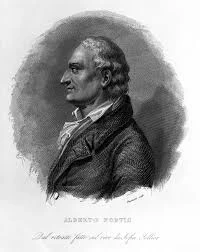
Who was Alberto Fortis?
Alberto Fortis was born on November 9, 1741 in Padua. His father was a humble and impoverished nobleman, and his mother an educated lady.
In her home, Fortis's mother, had a literary salon, so the Padua aristocracy and intelligentsia gathered in the family house.
From his earliest childhood, young Alberto was surrounded by educated people who instilled in him an interest in literature and natural sciences.
After his father's death, most likely due to material poverty, at only 13 years old Fortis went to the seminary, and later to the hermit order of St. Augustina.
Interest for our regions
From the very beginning of life at the Fortis seminary, literature and natural sciences attracted much more than theology. He was driven by a great passion for reading, writing and research.
He arrived in Rome from Padua. There he had the opportunity to stay in the famous Angeliki Library where, among other things, he met people from our region; Benedikta Stay and Rajmund Kunić.
One of his role models was Ruđer Boković, whose scientific-epic songs he enjoyed reading.
Over the years, Fortis came into conflict with church elders, primarily because he felt very constrained and unfree staying in one place.
He managed to arrange for him to go from Rome to Venice, where, by moving in the intellectual circles of that city, he gained numerous acquaintances.
It was then that Fortis' first trips to Croatia began. At first he traveled alone, and later he also brought rich Englishmen.
First trips to the Croatian world
During the Easter holidays in 1765, the young theologian Fortis went on his first scientific trip, to Istria.
24-year-old Alberto described the people from that area as poor and rude. (rozzi ahabitani).
For his second trip, apparently Istria left a deep impression on him, Fortis again chose our region, specifically the islands of Cres and Lošinj.
He arrived there in the company of agricultural researcher John Symonds and botanist and doctor Domenico Cirillo. They stayed for a little more than two weeks exploring minerals and fossils.
During the trip around Cres and Lošinj, Fortis meeted with simple and educated locals recording all the precious information that could be used for writing a book.
Fortis summarized his impressions in the following sonnet:
"Your friend who collects pebbles
and grass and pebbles from the road,
does not let insects live in peace
following fish and birds as well."
The Italian theologian arrived in our country in 1771 for the third time. This time with two Englishmen. The trip was well prepared.
The expedition went to Dalmatia where they visited the cities of Split and Trogir, went to Dalmatinska Zagora, saw Roški Slap, Skradin and Zadar and crossed over to Cres, i.e. Lošinj.
However, it seems that Fortis embarked on that trip without the knowledge of his elders and the permission of the authorities, which further complicated their already strained relations. followed the voice of a monk who is too free in his behavior and political views. src="https://www.antikvarijat-biblos.hr/media/img/blog/CIXdMJJuF_Fortis Path around Dalmatia Biblos.jpg">
Photo: Fortis, Alberto: VOYAGE EN DALMATIAE I-II /JOURNEY TO DALMATIA I-II Berne, edition 1778. source Antiquariant Biblos
In the period from 1771 to In 1773, Alberto Fortis visited Dalmatia several times. During that stay on our coast, he collected stones, inscriptions in Latin, old money, manuscripts, as well as books from the Glagolitic press of Senj.
What is interesting is how Fortis, during these trips, he often turned from a describer into a reformer. Namely, he not only observed but also proposed solutions even though he knew they would not be adopted.
He noticed great poverty in villages and cities, bad management, the bribery of the bureaucracy, and for all this, he believed, the priests who dumbed down the people instead of enlightening them were to blame.
In the bookDalmacija road from Zadar to Šibenik in the first book and from Trogir to the Makarska coast in the second book.
the traveloguecame out in an era when the discovery of unknown regions and distant lands was a literary fashion.
The book also includes a chapter about the Moralci (continental population of Venetian Dalmatia - Vlachs) and a previously unknown work by Vrančić - a travelogue through the wilds of the Balkans.
Here is how Fortis, a lover of our regions and people, describes the Dalmatia of that time:
"Morlak, who lives far from sea coasts and occupied places, generally speaking, is a completely different moral man from us. Sincerity, trust and honesty and good family, both in everyday life actions and in contracts, sometimes turn into harmlessness and stupidity. The Italians who trade in Dalmatia and the inhabitants of the coast themselves, unfortunately, are often abused; that's why the trust of Morlak has decreased a lot and is decreasing every day, giving way to suspicion and mistrust."
"Morlak, hospitable and generous by birth, opens his poor hut to a stranger, goes out of his way to serve him well, never asking for and often stubbornly refusing any gratitude."

Photo: Internet
Visit to Dubrovnik
At the end of 1779, Fortis traveled to Dubrovnik, right on the border with Turkey. Dubrovnik delighted him. It was quite different from the neglected and dilapidated Dalmatian cities that were under the Venetian administration.
Dubrovnik is showered with praises:
"good water, good wine, good bread, good fish and good meat, even ice cream and sweets, and beautiful hands that offer them to you - that is one of the greatest goods of our unwilling world which
-if everyone felt like what I'm feeling now - I wouldn't call it the valley of tears but the valley of Eden."
In the city-republic, Fortis meets friends with whom he will remain connected for the rest of his life. These are mainly members of prominent Dubrovnik families.
href="https://www.antikvarijat-biblos.hr/knjige/povijest/dalmacija/put-po-dalmacija">Put po DalmacijaHasanaginica is a Bosnian folk song that was written in the 17th century. It was most likely told through oral transmission to area of Imotska krajina which was then part of the Bosnian Pashaluk.
It is about a ballad that Fortis translated into Italian and published in his book A Journey through Dalmatia. After that Hasanaginica was translated into numerous world languages.
The greatest literary minds of that time, such as Goethe and Pushkin, translated it into their languages.
The significance and impact of Fortis's travelogue in Europe

Photo: href="https://www.antikvarijat-biblos.hr/knjige/hrvatska-rara/travels-into-dalmatia">Journey to Dalmatia is one of the most interesting works of Italian literature in the second half of the 18th century.
During that period, interest and the search for places where one lives the original life increased, and precisely our regions were still insufficiently explored and therefore attractive to researchers.
The reactions to Fortis's book in Dalmatia were very interesting. Namely, the book encouraged people to think about the economy and administration.
The state of the economy, a problem that Fortis's book did not deal with, will become the central issue of Dalmatian educators.
Of course, this was not allowed to be openly discussed and discussed because the central Venetian government not only did not want to restore the economy, but also significantly contributed to its impoverishment and decline.
Ivan Lovrić's reaction to Fortis's Path Dalmatia
One of the most interesting reactions to Fortis's book was that of Sinjan's Ivan Lovrić. With the aim of correcting and supplementing Fortis' statements, especially regarding the part of Dalmatia he knew better, in 1776 he wrote and published Remarks on the Journey through Dalmatia by Abbot Albert Fortis and Life of Stanislav Sočivice.
Lovrić's book consists of three parts: On the course of Cetina, On customs of Morlak and Life of Stanislav Sočivice.
In the first part, Lovrić presented many impressions about the Cetina region based on his personal experience.
In the second part, On the Customs of Morlak, he makes some different observations about the problems raised by Fortis. Namely, very sharply and directly, under the influence of Hobbes, Rousseau and Voltaire, he wrote about the reasons for cultural and economic backwardness. Morlaka, calling out friars and monks.
Also, Lovrić, although he came from a landowner's family, did not believe that agriculture would prosper in serfdom, but believed that it could be expected to flourish when the land was owned by peasants.
The only thing that was important to the supreme authority was that our regions provide a sufficient number of obedient soldiers and that tax money flowed into the state coffers. Fortis was also aware of this, but he did not have the courage to write it as clearly as Lovrić.
In the third part of his book, Lovrić writes about the highway robber Stanislav Sočivica, who because of his nobility and acquired from other hajduks.

Photograph: Ivan Lovrić: Notes on Putu po Dalmacija, 1948, Zagreb, source Antikvarijat Biblos
Alberto Fortis is one of the few foreigners who dedicated his most significant work to our people, among whom he felt natural and comfortable from the first meetings.
His book is an extremely important document about Dalmatia in the 18th century.
The first editions of Fortis's work "A Journey through Dalmatia" and Lovrić's book "Osservazioni di Giovanni Lovrich sopra diversi pezzi del Viaggio in Dalmazia del signor abate Alberto Fortis coll'aggiunta della vita di Soçivizca", as well as new editions of those books can be found here in Biblos! :)
href="https://www.antikvarijat-biblos.hr/knjige/hrvatska-rara/travels-into-dalmatia">Alberto Fortis: Travels into Dalmatia, 1778, England
Prepared by: Marijana Matijević
Biblos Newsletter
For book lovers who enjoy finding the rare
New titles, special copies and quiet recommendations from the antiquarian bookshop.