
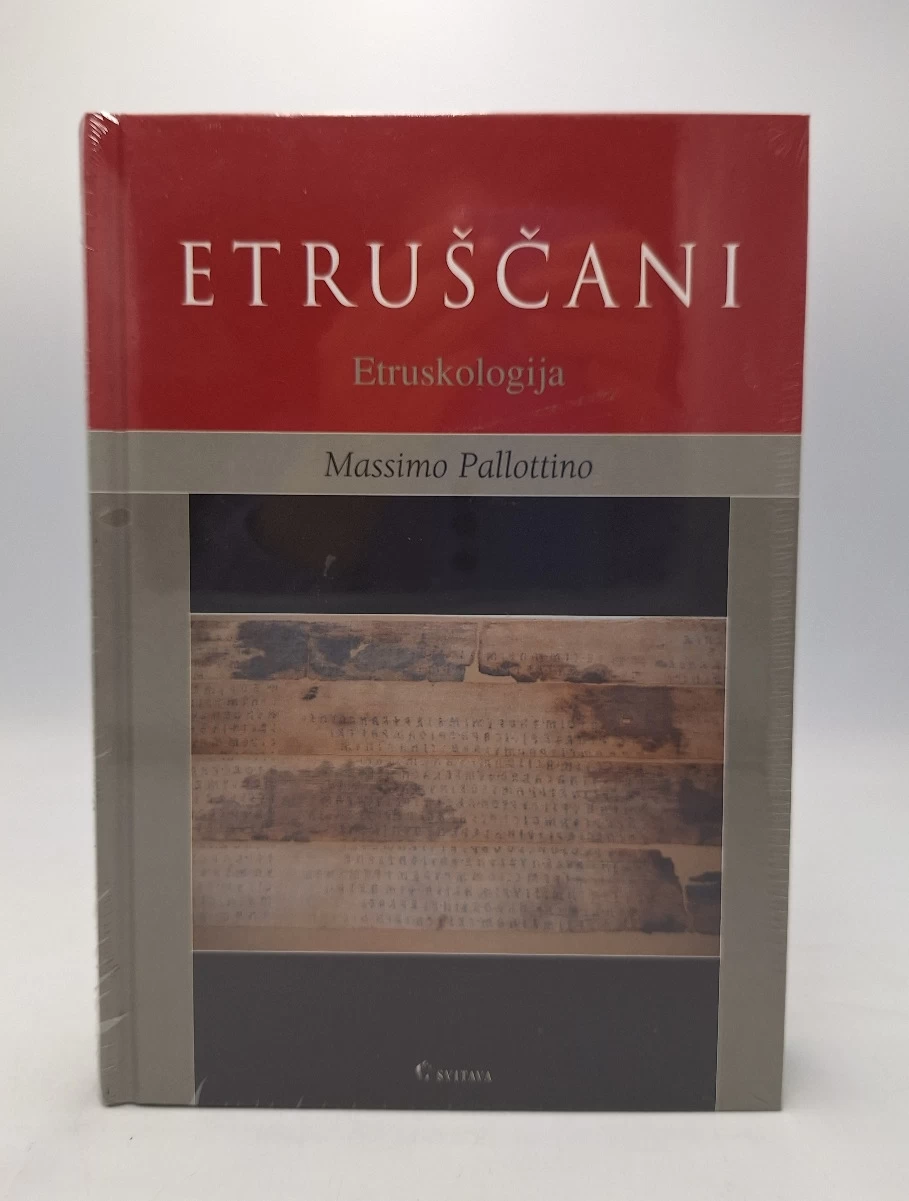
Etruščani - Etruskologija
Basic information
- Author: Pallottino Massimo
- Publisher: Svitava
- Availability: Available
- Condition: New book
- Code: 23306
Shipping options
Payment methods
Explore more
Etruščani - Etruskologija
Pallottino Massimo
Summary
Massimo Pallottino: Etruscans - Etruskology
143 plates and 18 pictures in the text
According to the seventh, renewed Italian edition
The first Croatian edition with a supplement on Etruscan monuments in Croatia
Interest in the Etruscans and their great civilizational achievements is in a continuous upward trend. This is evidenced by numerous relevant publications that appear almost every day everywhere in the world. It is, in fact, about a nation that, according to the famous Roman historian Titus Livius, was so powerful that the word about it spread by land and sea along Italy from the Alps to the Straits of Messina (Liv. 1,2,5: ... tanta opibus Etruria erat ut iam non terras solum sed mare etiamper totam Italiae longitudinem ab Alpibus adfretum Siculumfama nominis sui implesset..). Numerous events dedicated to that ancient Italian population, professional and scientific gatherings, appropriate festivals, and above all a multitude of interesting exhibition projects contributed to the increase in interest in the Etruscans. They served very well in demystifying the Etruscans as an enigmatic, unknown people, which was sometimes unnecessarily insisted upon without a real basis and solid arguments.
A kind of peak of such activities was the year 1985, which in Italy was even declared "the year of the Etruscans". At that time, as part of the previously launched "Etruscan Project", numerous thematic exhibitions were organized all over the country, especially in Tuscany, then in Umbria and Lazio, but also in some other Italian provinces, and not only in those that inherited the former Etruscan home territory. The central such manifestation, the exhibition entitled "Civilization of the Etruscans", was held
in Florence, while interesting smaller thematic exhibitions were opened in other Tuscan centers, Arezzo, Siena, Cortona, Voltera, Chiusi, etc., but also throughout Italy in Perugia, Milan, Mantua, etc. They brought to the public almost all the most important segments of the Etruscan civilization, which left behind deep and very difficult to reach traces, not only in the narrower area of the former Etruria, in the central areas of the Apennine peninsula, but also in the wider Central European and Mediterranean areas where the recognizable Etruscan cultural influence reached.
*the book is packed
Additional information
- Author: Pallottino Massimo
- Publisher: Svitava
- Year of publication:2008
- Place of publication:Zagreb
- Pages:541 143
- Dimensions:16x22 cm
- Script:Latin script
- Condition:New book
- Binding:Hardcover
Reviews
0 reviewsWrite a review
Share your experience and help other readers choose.
This item has no reviews yet. Be the first to share your experience.
More books from Svitava

You may also like