
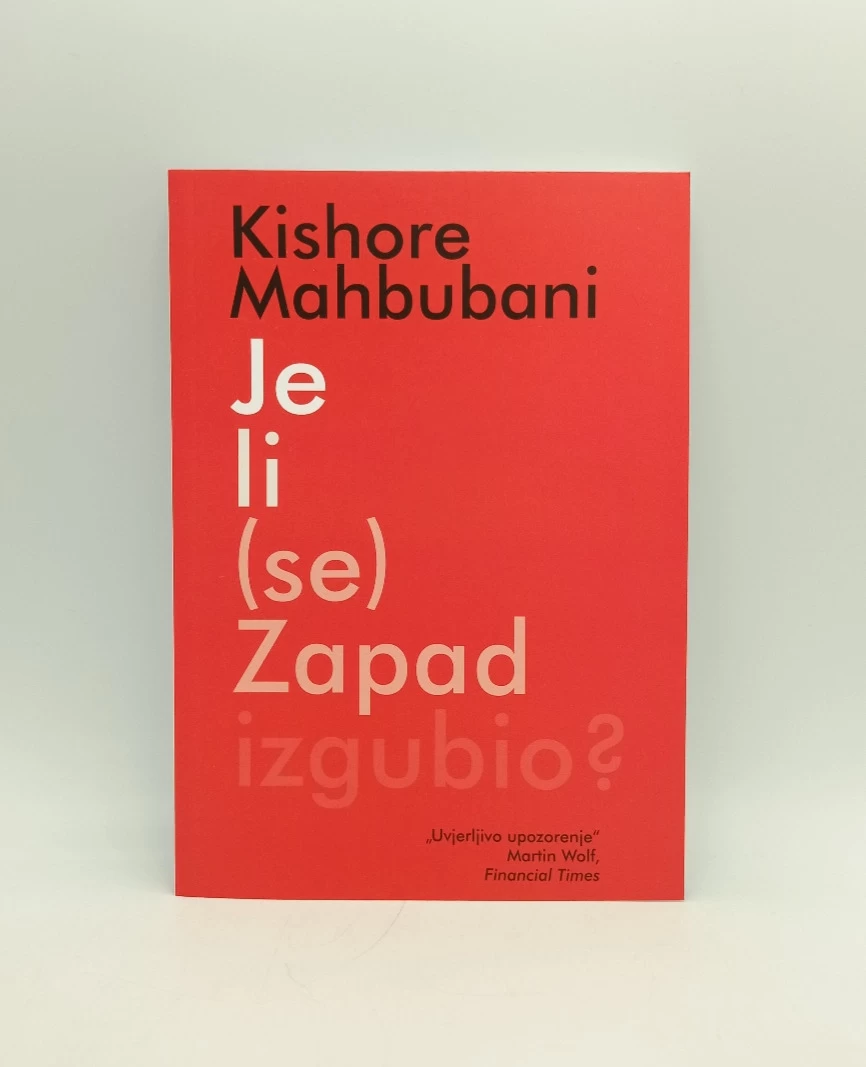
Je li (se) Zapad izgubio?
Basic information
- Author: Mahbubani Kishore
- Publisher: MATE d.o.o.
- Availability: Available
- Condition: Excellent
- Code: 64130
Shipping options
Payment methods
Explore more
Je li (se) Zapad izgubio?
Mahbubani Kishore
Summary
Kishore Mahbubani: Has the West lost itself?
Why does the West feel lost? The answer is simple. At the beginning of the twenty-first century, history has turned a new page, perhaps the most significant page that humanity has ever turned - but the West refuses to accept or adapt to this new historical era.
What is the great turn that history has taken? A brief comparison of the past 200 years with the previous 1800 years will provide the answer. From 1 AD e. until 1820, the two largest (world) economies were always "those of China and India". Only after that period did Europe take off and America followed. Viewed against the background of the past 1,800 years, the most recent period of relatively superior Western performance relative to other civilizations is a major historical aberration. All such deviations come to a natural end and this is happening even now.
And what is the problem? It is important to understand the nature of our age. The strategist Machiavelli emphasized this when he said: "That ruler who relies entirely on his luck, perishes as soon as luck turns. I also believe that happy is he who acts as the spirit of the times demands; and conversely, unhappy is he who acts contrary to the spirit of the times." Yet, although the zeitgeist has changed, and although the West will necessarily have to make major changes to adapt to this new era, no important Western figure has "had" the courage to speak the default truth about our times: the cycle of Western world domination is coming to a natural end. Their populations, on the other hand, can feel these big changes in their bones, and in the labor markets. This, in part, explains the supposed political dissonance - at least for the elites - in relation to events such as the election of Trump and Brexit.
The share of the West in the world economy will continue to decrease. This is inevitable and unstoppable because other societies have learned how to imitate the best practices of the West. Does this mean that existence in the West will become worse? The recent stagnation of incomes and the rise of job losses among the working classes in America and elsewhere seem to confirm that hard years are (already) coming.
Mahbubani's description of Western thought leaders as reluctant readers of the writing on the walls reminds me of the self-confident Chinese officials of the late Qing dynasty who dismissed the possibility of a world that could challenge their superior system. His call to action suggests that if the West is careful, it could avoid the "fate" of Qing officials. - Wang Gungwu, National University of Singapore
“Remarkable analysis… a welcome counterpoint to so much prevailing wisdom” - Lawrence H. Summers, former Chief Economist of the World Bank
“On reflection, American – and before that European – dominance can be seen as a brief aberration and the rise of China and other Asian countries as a simple return to the natural state of things. That's certainly the key point of the provocatively titled Is the West Lost? by Kishore Mahbubani, a Singaporean scholar and former diplomat. - Gerard Baker, The Times
"A sobering warning... It's hard to disagree with this advice from a well-informed friend of the West." - Martin Wolf, Financial Times
"The book contains strong challenges and deserves serious attention for its optimism about progress in the 'Remain' and for its positive call for the West to adapt to new structures and join positively in shaping a global future for all." - Sir Richard Jolly, Institute for Development Studies
Additional information
- Author: Mahbubani Kishore
- Publisher: MATE d.o.o.
- Year of publication:2021
- Place of publication:Zagreb
- Pages:106
- Dimensions:15x21 cm
- Script:Latin script
- Condition:Excellent
- Binding:Softcover
Reviews
0 reviewsWrite a review
Share your experience and help other readers choose.
This item has no reviews yet. Be the first to share your experience.
More books from MATE d.o.o.



You may also like