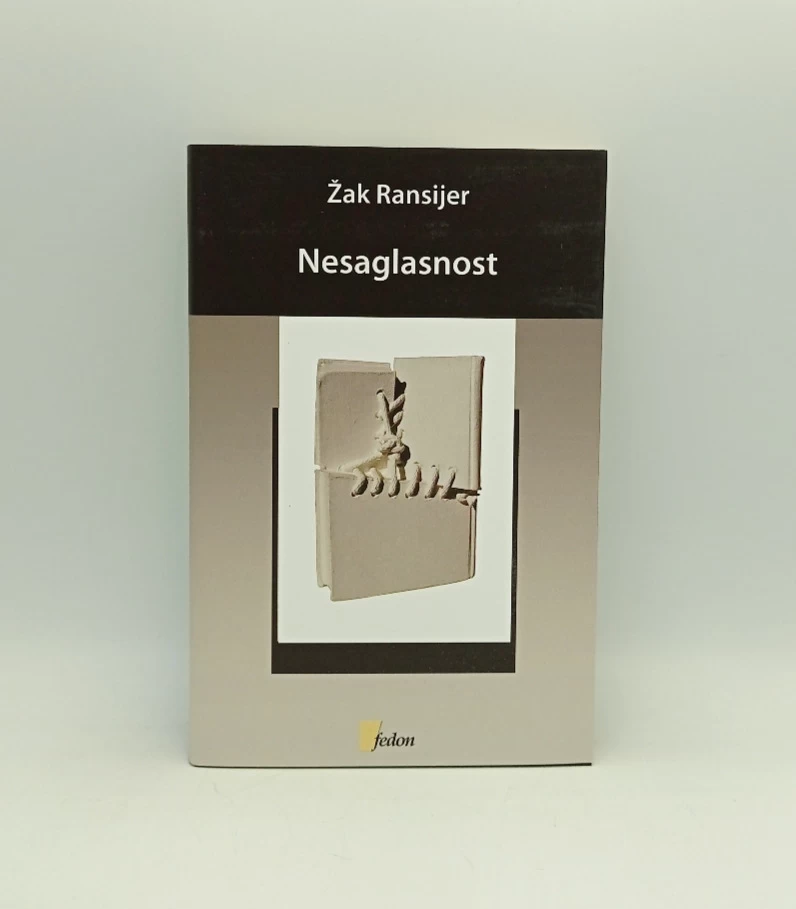

Ranciere Jacques: Nesaglasnost
€ 12,00
Free delivery in Croatia for orders over EUR 70
Basic information
- Author: Ranciere Jacques
- Publisher: Fedon
- Availability: Available
- Condition: Nova knjiga
- Code: 42850
Shipping options
GLS Croatia
5€
Delivery
0€
Personal collection at the antique store
0€
GLS parcel machine
3€
Payment methods
Pay on pickup
CorvusPay
By general payment / Virman / Internet banking
Cash on delivery
Nesaglasnost
Ranciere Jacques
Summary
Jacques Ranciere: Disagreement Politics and Philosophy
The book Disagreement is published by Jacques Ranciere in 1995, marking, in a certain way, the end of the Habermasian paradigm of politics as a search for consensus. To that extent, the term "politics of discord" appears as a kind of oxymoron that combines two seemingly incompatible concepts: if politics is always work based on the principle of gathering and organizing the human community, it would be agreement (harmony, consensus), and not disagreement, that would be the accompanying element of the concept of politics understood in this way. Disagreement, therefore, would be a force opposed to the political one. Ranciere, however, tries to show that it is possible to understand politics from a perspective that does not assume consent as a greatness, nor does it assume some kind of principle, some kind of beginning (arche) that would precede the political struggle itself, which means that at the base of politics there is a constant struggle of forces, an eternal game of opposing powers.
Additional information
- Author: Ranciere Jacques
- Publisher: Fedon
- Year of publication:2014
- Place of publication:Beograd
- Pages:202
- Dimensions:13x20 cm
- Script:Latinica
- Condition:Nova knjiga
- Binding:Meki
You may also like










Recently viewed








Biblos Newsletter
For book lovers who enjoy finding the rare
New titles, special copies and quiet recommendations from the antiquarian bookshop.