
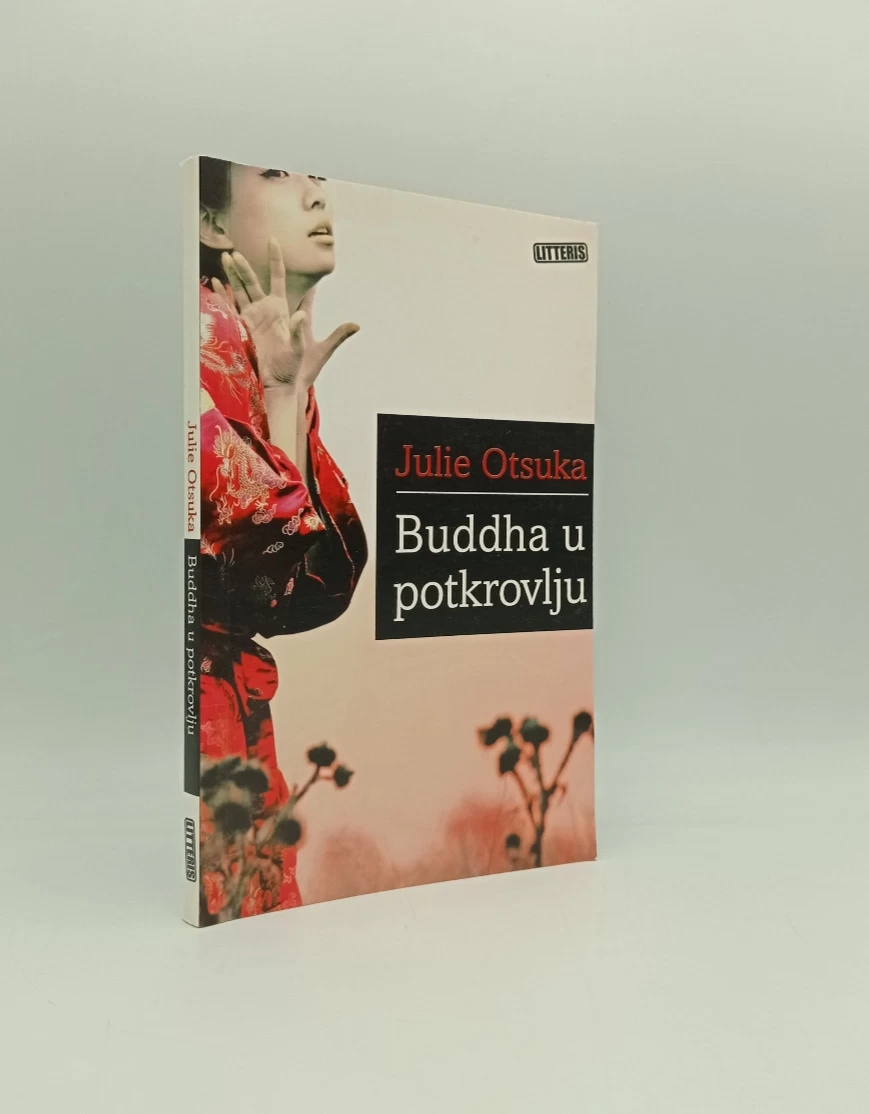
Buddha u potkrovlju
Basic information
- Author: Otsuka Julie
- Publisher: Litteris
- Availability: Available
- Condition: New book
- Code: 60327
Shipping options
Payment methods
Explore more
Buddha u potkrovlju
Otsuka Julie
Summary
Julie Otsuka: Buddha in the Attic
Imagine that you only know the person with whom you are about to spend your first wedding night from a blurry black and white photo. The idea is unpleasant, but as we know, arranged marriages are a widespread practice throughout history in all cultures and social strata. Starting with the rulers who, as a rule, did not have the freedom to choose a marriage partner, to, for example, the current Romani tradition of contracting underage marriages. In addition, since the Middle Ages, the custom of arranging marriages on the basis of pictures (then oil portraits) of physically distant future spouses has been established in aristocratic families. "Buddha in the Attic" (The Buddha In The Attic, 2011) is the second novel by award-winning Japanese-American writer and former painter Julie Otsuka (1962). Having given up visual art, she will channel her creative energy into a new medium - she will turn to literature. A historical-fictional novel opens before us, for the purposes of which the author will engage in extensive research on topics that touch her intimately. Her family moved to America from Japan at the beginning of the last century for economic reasons. After the attack on Pearl Harbor, everyone was interned, but Otsuka did not learn much from her relatives about the trauma of the concentration camps from World War II - they kept her in the dark for generations. This is primarily about the choral confession of Japanese women who were sent to America at the beginning of the 20th century. The so-called arranged brides travel in the bellies of transoceanic ships, in order to secure their future by marriage. For weeks on the open sea, they are anxious before meeting their compatriots and future spouses who, judging by their correspondence, have successfully settled in the promised land. But the men who greet them at the port will not be the ones from the photos that stick to girls' palms as tickets to a better world. And so the unfortunate women, miles from home and family, will find themselves back where they started - in poverty and condemned to hard manual labor. With the fact that that beginning is now a very final end. The hatch clicked, the circle of misfortune closed forever, with no possibility of movement - return or departure. This that is, will be their certainty until death. As a rule, the female protagonists remain unnamed, which gives their lives and Otsuka's romanticized narrative a universal dimension. Chapter after chapter we witness their sailing to California, consummation of marriage, working in the fields or in better houses, giving birth and raising offspring. And these children are condemned to double apostasy, because they do not want to speak Japanese and are ashamed of their parents, while at the same time they are stigmatized as other within the school system and beyond, in American society. Otsuka's novel is written from an unusual position of the collective, in the 1st person plural. In those hundred or so pages, the evil stories, hopes and resignations of approximately the same number of women will be strung together. And not only American Japanese women, but also their white neighbors and superiors. We dwell on the suspicion and patronizing of privileged white women that Japanese women feel exposed to on a daily basis, but with the last chapter, the focus shifts, the perspective is reversed. Closure of the novel in the form of an epilogue brings colorful and conflictingly intoned testimonies of members of the resident white population about coexistence with Japanese immigrants. Their experiences of these overseas intruders vary from extreme intolerance, even fear to warmth and affection. But even this empathy of the latter is superficial, salon-like. In the end, it seems that they all have one thing in common: they will quickly forget that there were ever any Japanese among them. "Buddha in the Attic" is a novel about humiliation and suffering. About discrimination and a marginal social group. About Japanese immigrants who, from their predetermined social margins, suddenly disappear in droves into the unknown after the air attack on the Hawaiian port . However, it is above all an allegory, even an apotheosis, of female cohesion and solidarity. This tiny and fragile prose reopens and re-examines two problematic questions. Otsuka poeticizes the sociological phenomenon of arranged marriages by exemplifying the experiences of the first two generations of Japanese immigrants to America in the early 1900s. Her interest is specifically in the fact that Japanese and Korean workers, who arrived in the USA and settled mainly in Hawaii and the West Coast, looked for marriage partners in the homeland they had left without return, which would be resolved through intermediaries, based on photos from the catalog. The horror of xenophobia to which American Japanese - interestingly, most of them had citizenship - was systematically exposed in the period from 1942 to 1945 recedes from the darkness of the background. The author should be congratulated for the wise decision to avoid dry facts, despite the effort invested in in-depth research, and to consciously avoid forcing a monolithic biography in some presumptuous historiographical docu-fiction. In his delicate text, Otsuka will resort to a more original and far more effective technique. Opting for minimalism and ellipticity, she penetrates into the core of life's reality by lyrically isolating emotions. The novel "Buddha in the Attic", winner of the French Femina étranger award for 2012, is a poetic condensate of the harsh immigrant reality, but also of American national shame. Two important topics on the edge of taboo are articulated here by a female voice, in choral singing. The story is unsettling, but not gloomy: it shines with the love of humanity, the winning spirit and the strength of women who, despite being predestined for suffering, not only stand up and stand up, but also dare. It would be ideal to enjoy Julia Otsuka's text in its entirety, in one, uninterrupted reading, which the compressed form allows, and its rhythmicity, intensity and transparency of bubble sentences almost set it as imperative.
Additional information
- Author: Otsuka Julie
- Publisher: Litteris
- Year of publication:2014
- Place of publication:Zagerb
- Pages:139
- Dimensions:13 x 21 cm
- Script:Latin script
- Condition:New book
- Binding:Softcover
Reviews
0 reviewsWrite a review
Share your experience and help other readers choose.
This item has no reviews yet. Be the first to share your experience.
More books by Otsuka Julie

More books from Litteris








You may also like








Recently viewed