
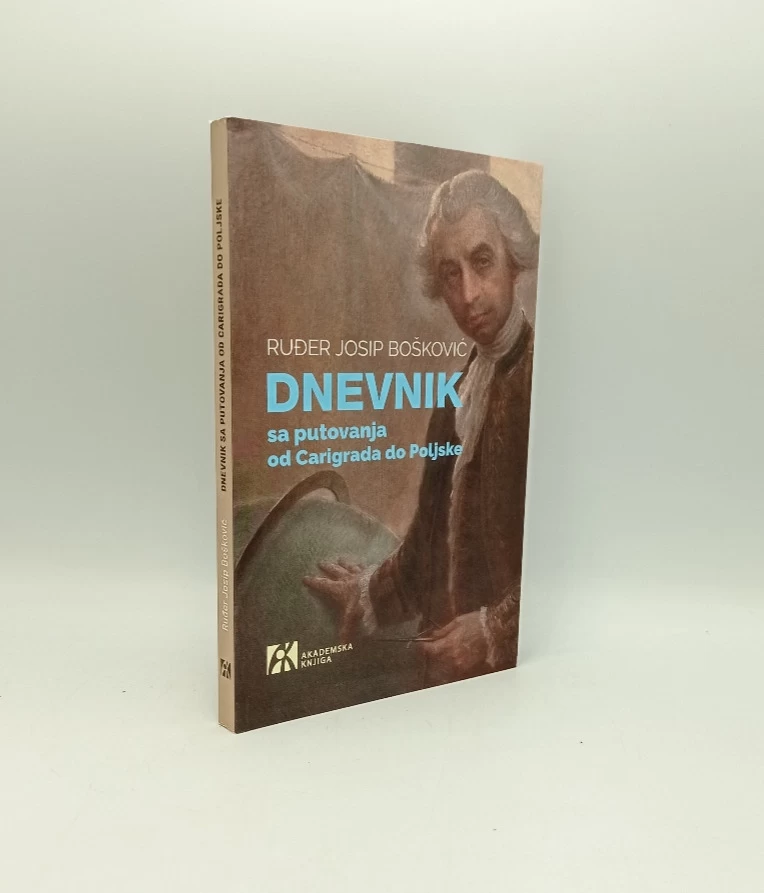
Dnevnik sa putovanja od Carigrada do Poljske
Basic information
- Author: Bošković Ruđer Josip
- Publisher: Akademska knjiga
- Availability: Available
- Condition: New book
- Code: 65946
Shipping options
Payment methods
Explore more
Dnevnik sa putovanja od Carigrada do Poljske
Bošković Ruđer Josip
Summary
Ruđer Josip Bošković: Diary of a trip from Constantinople to Poland
With his criticism of classical physical concepts (from absolute space to absolute time), Ruđer Bošković anticipated contemporary theories and hypotheses of the new categorical apparatus, with which the theory of relativity operates. His numerous researches into natural and philosophical phenomena were extremely appreciated by his contemporaries and later, so it is no wonder that he became a member of many academies and the highest scientific institutions of his time.
He was inclined to apply the new approach in the social sciences as well. That's why he critically approached the social reality of his time, looking for a lever, with which humanity will take new paths. He listens to physiocratic writers, but also checks them in practice; he discusses the new trends taking place on the North American continent (for example, he meets Benjamin Franklin and maintains correspondence with him) and reports to his - Dubrovnik - government about the implications of these new trends for his Dubrovnik.
Although today he is recognized by many nations (as a naturalized French, English or Italian), it is "skipped" that he was closely connected with his hometown, Dubrovnik, throughout his life, and that he corresponded with his brothers and sister in his mother tongue, Croatian. He followed the events taking place on the eve of the French Revolution on the European scene with full seriousness. He agrees with the criticism of reality, but he is not enthusiastic about the suggested social solutions, nor those advocated by his friends - Mirabeau and Turgot. In practice, lucid as he was, he checks the suggested solutions and when they do not match with life, he remains reserved about the suggestions. And this is probably the basic conclusion of the economic analysis of his "Journey from Constantinople to Poland".
This does not mean that the social sciences, which he successfully wrestled with during his journey from Constantinople to Poland, but also in the extremely extensive correspondence he has with numerous laureates of his time, should be added to the exceptional number of scientific fields in which he proved himself ("Croatian Biographical Lexicon" states that he was a mathematician, physicist, astronomer, philosopher, diplomat and poet). Namely, analysts of Bošković's activities eluded his connections with physiocratic circles, especially with two prominent economists: physiocrat Victor de Riqueti, Marquis of Mirabeau and A.R.J. Turgot, who was close to the physiocratic circle, although he did not belong to it. He will maintain more permanent ties with them, participate in their work and ideas, although he himself will not become an ardent supporter of the Physiocratic doctrine.
The book that is now being published is the first complete edition in the Croatian language, 222 years after Bošković's edition in the Italian language (in Bassano in 1784). I am convinced that this will contribute to a better understanding of that part of his versatile activity, just as the "Journey from Constantinople to Poland" itself will reveal all the greatness of our Dubrovnik man.
Vladimir Stipetić
The book was published in the "Croatian Economic Thought" library, which publishes the most important works from the heritage of Croatian economic heritage in an effort to remove the centuries-old, and still today, neglect of our economic science and to reaffirm our exceptional legacy.
Additional information
- Author: Bošković Ruđer Josip
- Publisher: Akademska knjiga
- Year of publication:2022
- Place of publication:Novi Sad
- Pages:183
- Dimensions:13x21 cm
- Script:Latin script
- Condition:New book
- Binding:Softcover
Reviews
0 reviewsWrite a review
Share your experience and help other readers choose.
This item has no reviews yet. Be the first to share your experience.
More books by Bošković Ruđer Josip


More books from Akademska knjiga





You may also like