
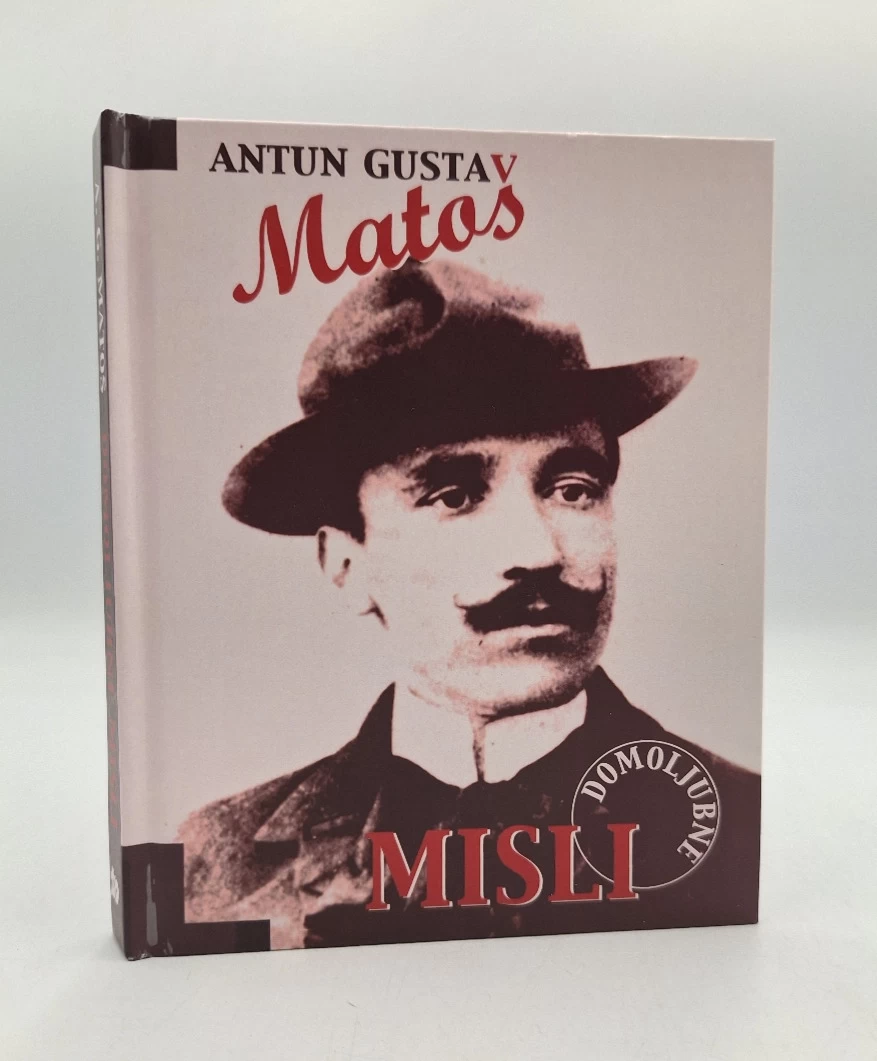
Domoljubne misli
Basic information
- Author: Matoš Antun Gustav
- Publisher: Šareni dućan
- Availability: Available
- Condition: New book
- Code: 56671
Shipping options
Payment methods
Explore more
Domoljubne misli
Matoš Antun Gustav
Summary
Antun Gustav Matoš: Patriotic thoughts
Today, unfortunately, the Croatian country is worth more than us.
Our world does not rejoice because it is a holiday,
but because it does not have to work because of the holiday.
We do not celebrate because we work,
but we celebrate that we do not have to work.
Where Croatia is the poorest, there is the most Croatian.
Croatia is today a country of complete bankruptcy:
political, economic, social and literary.
A more intelligent and energetic workforce is moving to America.
Stupidity is great power and only a stupid politician does not count with it.
And as long as there is a heart, there will be Croatia!
Antun Gustav Matoš was born on Friday, June 13, 1873 in the village of Tovarnik, Srijem, on the eastern edge of Croatia. According to the words of Matoš's mother, the midwife received the newborn and said: "This little one of yours will be a great man, his name will be mentioned a lot, but - he will also suffer a lot." The family moved to Zagreb in 1875, so Matoš says that he is a native of Srijem and raised a native of Zagreb. Since he did not pass the seventh grade of high school for the second time, due to insufficient Croatian language skills among other things, his parents sent him to the Military Veterinary Institute in Vienna, but he lost his scholarship. He returned to Zagreb in 1892 and published his first short story Power of Conscience in the "reputable" Vijenc, "when only the columns of Brašljan and Pobrat were open to the droolers". After military service in Kutjevo and the Horse Riding School in Zagreb, he deserted in the summer of 1894, wandered around his native Slavonia, was arrested as a military fugitive in Mitrovica and imprisoned in the Petrovaradin fortress, from where he fled to Serbia and Belgrade. Thus began Matoš's European wanderings: seven years in Belgrade (the first time in Obrenović's pro-Western Serbia from 1894 to 1898, the second time in Karađorđević's nationalist Serbia from 1904 to 1908), a year and a half in Geneva (1898–1899) and five years in Paris (1899–1904). If you add to that short stays in Vienna, travels through Munich and two health trips in his late years, one month in Florence in 1911 and two months in Rome in 1913, Matoš was a cultural nomad who drew on various European sources and established world standards for modern Croatian literature. He wrote in all genres, from lyrics, artistic prose and travelogues to newspaper feuilletons, erudite essays, criticism and polemics. By the representation of all genres, by realized aesthetic values, by the breadth of his erudition and the universality of his spirit, Matoš is a modern classic of Croatian literature. In Belgrade, he developed as a journalist, critic and writer. After his right hand became stiff, he wrote there his first publicly published poem Utjeha kosa in 1906. In Geneva, he got acquainted with the idea of landscape in Rousseau and H.-F. Amiela, who will establish his theory and aesthetic practice of landscape in the meeting with M. Barrès. Immediately after arriving in Paris, he wrote the symbolist novella Camao, which he wrote to Vladimir Tkalčić that it would be "the best of everything" he had published so far. About fifteen novellas were written in Paris, including many anthologies such as Once Upon a Time, Now It Was Mentioned, Balcony, Flower at the Crossroads, Road to Nothing, Lonely Night, etc. Paris is the location of famous feuilletons published in the books Impressions and Ogledi, which he wrote for Croatian Law from the Paris World Exhibition in 1900, lamenting the fact that Croatia does not have an independent pavilion and admiring the wonders of modern civilization. Florence and Rome are the places of his enthralling erudite feuilletons about European art and culture, and the experience of the black gondola as a coffin for a short stay in Venice, Rome as the "City of Death" of culture and the black lake Nemi as a "grave" are Matoš' experiences and forebodings close to death. After all, Zagreb is the place of Matoš's political feuilletons, sumptuous travelogues around Zagreb and polemics with his own
m "dear contemporaries". There, in the skirmishes on the domestic political scene, he shaped the idea of the Croatian nation, and in contact with the surroundings of Zagreb, he developed the idea and aesthetic practice of the landscape. After futile treatment abroad and several difficult throat operations at the Hospital of the Sisters of Mercy in Zagreb, Matoš died on March 17, 1914. His last poem, written a few days before his death, was the sonnet Notturno, in which the lyrical subject makes peace with the cosmos: "gentle light pours from the heights", and the "railway" of Matoš's life is "already swallowed up by distance".
The first impression of today's reader who picks up twenty volumes of Matoš's The collected works have the timeless value of his art and the unusual appeal of his ideas and thoughts in feuilleton and journalistic activities. It is not surprising that Matoš's novels, poems and travelogues are as artistically valuable as they were at the time of their creation. As a lover of aesthetic form, larpur artist and devotee of world culture, Matoš created universal aesthetic forms in his artistic genres beyond the historical styles in which he wrote and the ideas he represented. What is really strange, even fascinating, is the infectious appeal of Matoš's ideas and thoughts, which he expressed in non-fictional genres - travelogues and feuilletons, essays, literary and other criticisms, polemics, letters and notebooks.
One reason for the attraction of Matoš's ideas and thoughts is in himself. Matoš was also an artist as a fej-tonist and publicist, an artist of puns, humor, language games and caricatures, all based on the principle, as he himself pointed out, that better journalism has already merged with literature. As a concerned patriot and cultured European, he wrote about all topics of Croatian reality and modern civilization at the time, from the unresolved national question of Croatia at the end of the Austro-Hungarian Monarchy, economic and social problems to scientific and technological achievements, feminism, sports, fashion and environmental issues. Matoš's favorite "disciple" Ujević said about his teacher: "He was not a thinker, but he was something far better than how unstable reality is better than a rigid idea." Matoš did not create "stiff ideas", but artistic images - imagological constructs. In his thoughts and ideas, Matoš is the creator of the modern Croatian cultural imaginary - an empire of images about all phenomena of national life and mentality, European culture and civilization, gender relations and human nature. They were lucid insights, often stereotypes, many of which are still in circulation today.
The second reason is the appeal of Matoš's ideas and thoughts to us. In many spheres of political, social and cultural life, we have returned to Matoš's era. Matoš lived and wrote in the era of the first globalization, liberal capitalism and the supranational community of the Austro-Hungarian Monarchy. We live in the age of another, even more challenging globalization, ultra-liberal capitalism and the new supranational community of the European Union. Many of the questions that Matoš discussed are being asked more fiercely today than in his time. Thus, at the beginning of the 21st century, Matoš's thoughts and ideas acquired the charm of a strange topicality.
For a hundred years, devotees of Matoš's art have been trying to answer the question of what is the secret of one of the greatest writers of Croatian literature. According to Ivo Andrić, Matoš is "the master of words", according to Stanislav Šimić, he "made time, not time himself", according to Albert Bazala, he was "consistent only in his inconsistency". Matoš said about himself that he was the first Croatian writer who made his life "a novel, a work of art, as if I were painting myself". Perhaps it is precisely in this miraculous combination of art and biography, high aesthetic standards and incorruptible journalism, consistent Croatianness and cultural Europeanness that the irresistible attraction and topicality of the "magical trigram" of Croatian literature - A.G.M.
Krleža is a writer. Matoš is a legend and a myth. This is also evidenced by this booklet - a quotation pearl.
Dubravka Oraić Tolić
Additional information
- Author: Matoš Antun Gustav
- Publisher: Šareni dućan
- Year of publication:2014
- Place of publication:Koprivnica
- Pages:173
- Dimensions:12x15 cm
- Script:Latin script
- Condition:New book
- Binding:Hardcover
Reviews
0 reviewsWrite a review
Share your experience and help other readers choose.
This item has no reviews yet. Be the first to share your experience.
More books by Matoš Antun Gustav



More books from Šareni dućan


You may also like




Recently viewed