
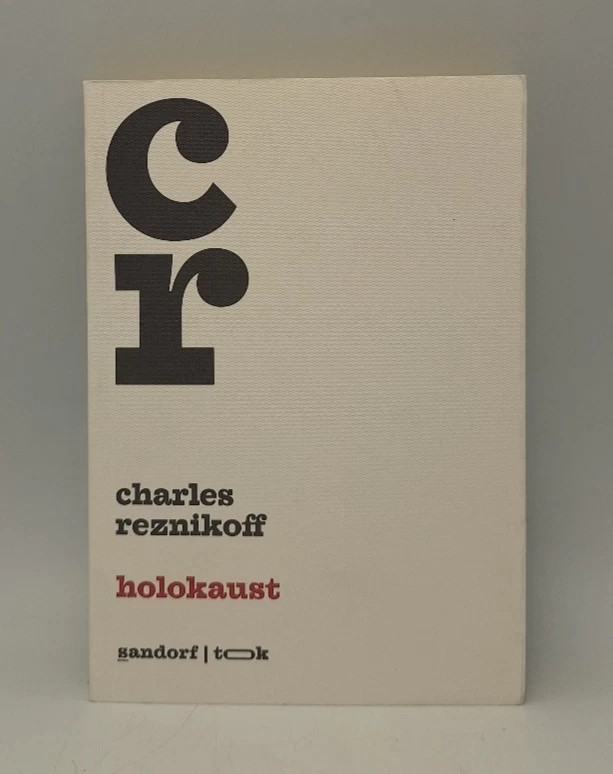
Holokaust
Basic information
- Author: Reznikoff Charles
- Publisher: Sandorf
- Availability: Available
- Condition: New book
- Code: 58066
Shipping options
Payment methods
Explore more
Holokaust
Reznikoff Charles
Summary
Charles Reznikoff: The Holocaust
The Holocaust by Charles Reznikoff is one of the most poignant books of poetry ever written. Its author appears completely from the sidelines - as a playwright, editor, compiler of a manuscript in which he himself hardly intervenes, reducing his role to that of a medium: one who helps to mediate testimonies.
From the endless mass of court files, Reznikoff - following the objectivist poetic method - selected the material, leaving out the authentic names of people, sub-questions and everything said by lawyers and judges. Avoiding all rhetoric, he does not change what he finds, he only shortens it in places in order to shape the narrative line, rhythm and music.
Reznikoff Holocaust, therefore, deliberately deprives the usual poetic apparatus; a treasure trove of figures, images and astonishing strategies, delivering the reader the icy, technical horror of Nazi mass destruction. He avoids the rightly criticized takeover and subsequent aestheticization of the victim's voice, avoids retelling, fictionalization, and even the story itself. Proving between the lines that it is very possible - perhaps even necessary - to write poetry after Auschwitz.
Charles Reznikoff was born in 1894 in New York, where he died in 1976. A lawyer by profession, he is an American poet and translator associated with the Objectivist school of poetry that wrote poetry based on real documents and events. Between 1918 and 1961, he published twenty-three books of poetry and prose, mostly in samizdat. A wider audience noticed him only in the sixties of the last century, after his magnum opus Testimony: The United States 1885–1890, a representative book of Objectivist poetry, was published by the respected publisher New Directions. He published the poem Holocaust in 1975, a year before his death. Firmly rooted in reality, he wrote in free verse that makes the reader identify with the circumstances described in the poems. Critics praised him especially for his careful use of language and the visionary quality of his poetry.
Additional information
- Author: Reznikoff Charles
- Publisher: Sandorf
- Year of publication:2020
- Place of publication:Zagreb
- Pages:123
- Dimensions:12x17 cm
- Script:Latin script
- Condition:New book
- Binding:Softcover
Reviews
0 reviewsWrite a review
Share your experience and help other readers choose.
This item has no reviews yet. Be the first to share your experience.
More books from Sandorf




You may also like