

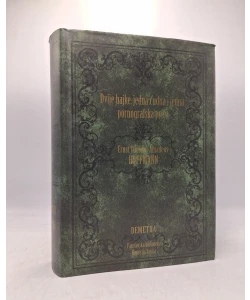
Igra staklenim perlama
Basic information
- Author: Hesse Hermann
- Publisher: Liber
- Availability: Available
- Condition: Very good
- Code: 17125
Shipping options
Payment methods
Explore more
Igra staklenim perlama
Hesse Hermann
Summary
Hermann Hesse: The Glass Bead Game
The Glass Bead Game is often interpreted as a creation in the tradition of literary utopias and the German development novel. That work, however, is completely neither. Entwicklungs-roman, from Goethe's Wilhelm Meister to Mann's The Magic Game, focuses on the life experiences of a character designed in the spirit of individualism. His biographical path is conceived in such a way that it touches the widest possible area of human experience: social, erotic, scientific, artistic. The biography of Hesse's hero Josef Knecht, however, is based on a relatively narrow selection from the stock of experience. Instead of diversity in successes, conflicts, doubts and resolutions, a calm life flow, directed from the beginning to a tangible goal, largely reigns here. Therefore, Hesse's work ignores the liveliness of the events (which also appears in many modern novels as a relic of the traditional form of intrigue) in favor of a textual structure that adds a wealth of essayistic considerations to the descriptions and conversations. The game is a lyrical monument to a man who thinks and lives in the categories of the game, not in the categories of the modern commercialized world.
Additional information
- Author: Hesse Hermann
- Publisher: Liber
- Year of publication:1979
- Place of publication:Zagreb
- Pages:498
- Dimensions:13x21 cm
- Script:Latin script
- Condition:Very good
- Binding:Hardcover with dust jacket
Reviews
0 reviewsWrite a review
Share your experience and help other readers choose.
This item has no reviews yet. Be the first to share your experience.
More books by Hesse Hermann






More books from Liber




You may also like






Recently viewed