
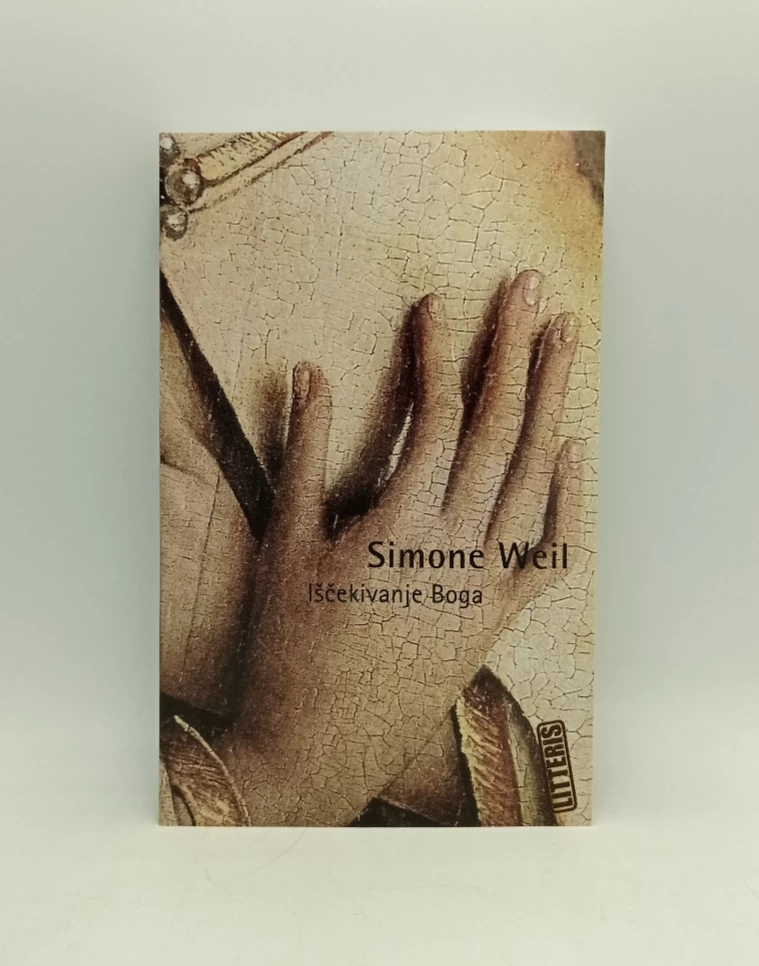
Iščekivanje Boga
Basic information
- Author: Weil Simone
- Publisher: Litteris
- Availability: Available
- Condition: New book
- Code: 60288
Shipping options
Payment methods
Explore more
Iščekivanje Boga
Weil Simone
Summary
Simone Weil: Waiting for God
The texts collected under the title "Waiting for God" ("L'Attente de Diu") are among the most beautiful texts left by Simone Weil (1909 - 1943), a French writer and philosopher of Jewish origin who is considered the greatest mystic of the twentieth century. Written between January and June 1942, these texts are more or less related to the dialogue that Simone Weil had with the Catholic priest J.M. Perrin, from June 1941; listening to the Truth together, she attracted by Christ, and he a priest for thirteen years. In 1949, Father Perrin agreed to publish these texts, and especially the correspondence that forms the most beautiful part of these texts - in order to introduce the public to the most instructive pages that speak of her inner experience and her personality. But the reason for this publication was primarily the desire to give others the opportunity to enter into this dialogue, which Simone expressly wanted during their various meetings. *** Simone Weil was born in Paris on February 3, 1909. She did not receive any religious upbringing: she was brought up in the spirit of complete agnosticism. One of the main features of her childhood was love, full of sympathy, for the unfortunate; she was about five years old when she discovered human misery thanks to the First World War in 1914 and the godfather of a soldier. Thanks to her prematurely developed intelligence, she successfully completed her education. At the age of nineteen, she entered the faculty (Normale), and at the age of twenty-two she became a professor of philosophy (1928 - 1931). She was a professor of philosophy, then a worker at the Renault factory, she took part in the Spanish Civil War, from where she returned to teaching after her health deteriorated. After she was dismissed from the service in 1940 (because of her Jewish origin), she moved first to New York, and then to London, where she worked for the French Committee of National Liberation. She died at the age of 34 from complete physical and mental exhaustion from hard work and deprivation. Nevertheless, her heart belonged to the whole world, a few months before her death she wrote: "Disaster around the globe besieges me and paralyzes all my abilities; I cannot heal and free myself from this obsession if I myself do not wholeheartedly participate in danger and suffering. This is a condition for being able to work".
Additional information
- Author: Weil Simone
- Publisher: Litteris
- Year of publication:2010
- Place of publication:Zagreb
- Pages:247
- Dimensions:13x20.5 cm
- Script:Latin script
- Condition:New book
- Binding:Softcover
Reviews
0 reviewsWrite a review
Share your experience and help other readers choose.
This item has no reviews yet. Be the first to share your experience.
More books by Weil Simone

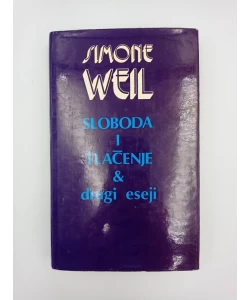
More books from Litteris











You may also like










Recently viewed