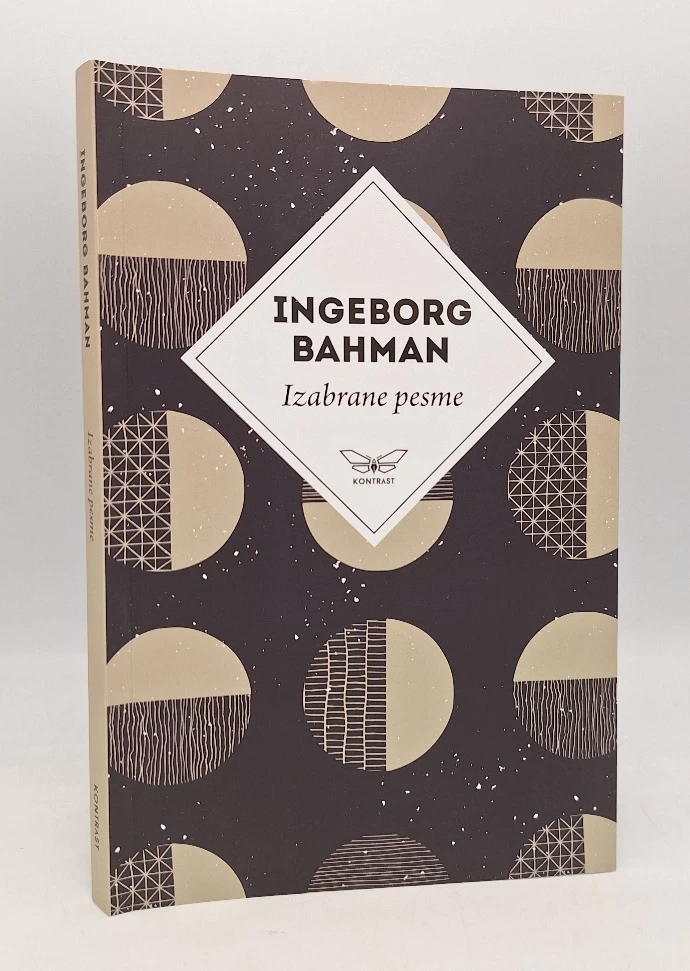

Bachmann Ingeborg: Izabrane pesme
€ 8,00
Free delivery in Croatia for orders over EUR 70
Basic information
- Author: Bachmann Ingeborg
- Publisher: Kontrast izdavaštvo
- Availability: Available
- Condition: Nova knjiga
- Code: 80387
Shipping options
GLS Croatia
5€
Delivery
0€
Personal collection at the antique store
0€
GLS parcel machine
3€
Payment methods
Pay on pickup
CorvusPay
By general payment / Virman / Internet banking
Cash on delivery
Izabrane pesme
Bachmann Ingeborg
Summary
Ingeborg Bachmann: Selected Poems
Receiving the "Georg Bichner" award, Krista Wolff quoted in her speech probably Ingeborg Bachmann's last poem, "Without delicacy", pointing out that "... this is a language beyond all doubt, but still a language. (...) A poem that renounces art must paradoxically be a work of art. A poet who fully expresses himself does not cancel himself: the desire to suppress remains to testify to it. Her share will not be dispersed".
Christa Wolff's claims reveal what most surprised German audiences when Bachmann's poetry first appeared - her poems were nothing like the poetry of the great poets of the previous generation.
In 1953, when her first collection of poetry "Produženo vrijeme" was published, Bachmann received the Gruppe 47 prize, one of the most coveted literary prizes of post-war Germany. When her second and last collection, "The Call of the Big Bear" was published, the calmer and stronger and more direct images elicited twice as much praise from the public and critics. Finding herself in the role of a celebrated poet, Bachmann wrote fewer and fewer poems. These late poems, although similar in expressiveness, emerge from a somewhat different mental and emotional register.
Part of the uniqueness of Ingeborg Bachmann's poetry lies in the characteristic combination of abstract language and strong, concrete images - what has been called the "philosophical language of images". The "higher", more sovereign plateau of consciousness expressed in them with slightly atonal musicality and often in classical patterns of versification is preoccupied with themes of duration and uncertainty, freedom and boundaries. And the borders, above all the borders of the country and language, paradoxically do not close, but open space for the new - a utopia, an imaginative "nowhere" where there is possibility, not necessity: "The day will come when people will have black and golden eyes, they will see beauty, they will be freed from dirt and all weight, they will rise into the air, they will go under water, they will forget their blisters and torments. The day will come when they will be free, all people will be free from the freedom they thought about. it will be greater freedom, it will be beyond all measure, it will be freedom for a lifetime..." These words from Bachman's novel "Raspberry" represent the last steps of a great journey that began twenty years earlier, in her first poems. Her voice changed tempo, register and genre form, but remained recognizably committed to faith in the coming utopia.
Additional information
- Author: Bachmann Ingeborg
- Publisher: Kontrast izdavaštvo
- Year of publication:2021
- Place of publication:Beograd
- Pages:144
- Dimensions:13x20 cm
- Script:Latinica
- Condition:Nova knjiga
- Binding:Meki
You may also like





Recently viewed




Biblos Newsletter
For book lovers who enjoy finding the rare
New titles, special copies and quiet recommendations from the antiquarian bookshop.