
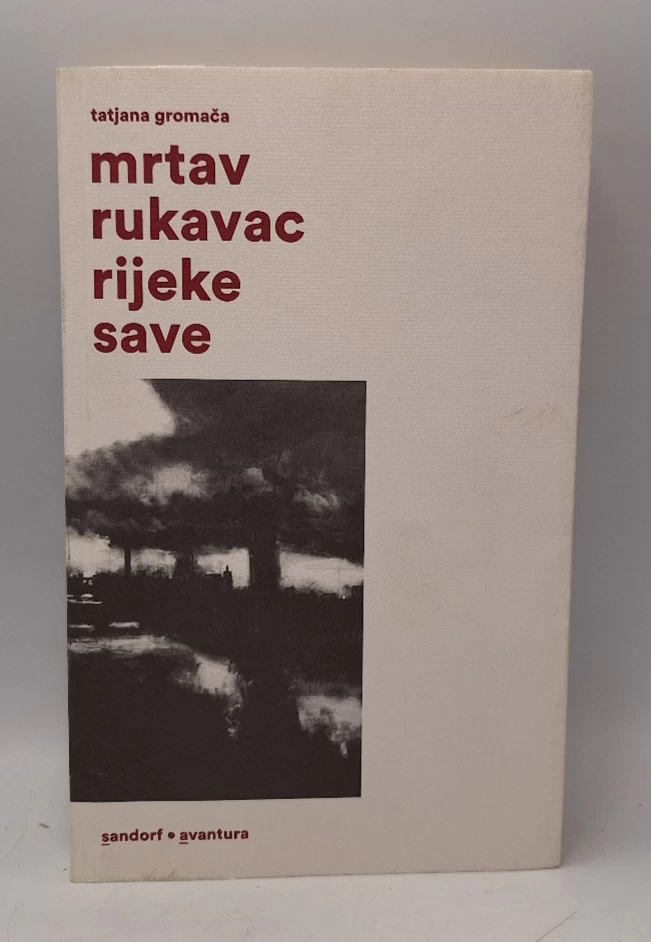
Mrtav rukavac rijeke Save
Basic information
- Author: Gromača Tatjana
- Publisher: Sandorf
- Availability: Available
- Condition: Very good
- Code: 52876
Shipping options
Payment methods
Explore more
Mrtav rukavac rijeke Save
Gromača Tatjana
Summary
Tatjana Gromača: The Dead Arm of the Sava River
And when the first winter twilight slowly begins to descend over this village, and this entire sad Posavina region, when on the road, on which a thin crust of ice has caught, a returning traveler sees a half-drunk cyclist with a fur cap on his head, in a leather coat, rusting pedals in his rubber boots on a bicycle, swinging on a bicycle as if on some strange device from a prehistoric amusement park, thus risking being swept away by a speeding vehicle, when the returning passenger also sees how on the back seat of the bicycle, on the so-called bicycle suspender, the cyclist is carrying luggage tied with a rope—a lying sack of potatoes, even better, a bottle of gas, or a slaughtered little pig, a so-called wounded person, then he suddenly feels as if someone is in his hands put a key with the help of which opens the secret lock of the mythology of this region, a kind of Vitebsk, a region in which—and these are the favorite words of the traveler, who feels a deep belonging to an unknown, dark homeland—a pillow is called vankush, a foal is a cujzek, a dress is a clyde...
And that region, with this nocturnal winter cyclist as a symbol, as an archetype and the bearer of all essential life and metaphysical meanings, is not here ends, but this signifier extends all along the course of the Sava river, all the way to its confluence with the Danube, where this picture and this fateful scene stretches, and then along Bosut, Tisza, Begej, Brzava and Timiš, it climbs towards the Hungarian border, continuing towards the other plains of the Czech Republic, Hungary and Romania...
True life, finally exposed and illuminated, therefore the only truly lived life is the one that has enabled us literature, Proust tells us in Time Found. This could be the motto of this book you are holding in your hands: in contrast to nostalgia, which keeps the places and areas of our childhood frozen as in those glass globes with artificial snow, the work of literature, i.e. its precise linguistic grinding of memories, evocations, feelings connected to all those corners of our youth suddenly revives that world and makes it real. Found time means that tide of intensity—captured in the cover of this book—which is created by finding and releasing each individual moment, a self-contained atom of time, which crystallizes the perceptions and affects of a place around itself and spreads in concentric circles indefinitely.
—From Leonard Kovačević's Afterword
Additional information
- Author: Gromača Tatjana
- Publisher: Sandorf
- Year of publication:2018
- Place of publication:Zagreb
- Pages:208
- Dimensions:13x20 cm
- Script:Latin script
- Condition:Very good
- Binding:Softcover with dust jacket
Reviews
0 reviewsWrite a review
Share your experience and help other readers choose.
This item has no reviews yet. Be the first to share your experience.
More books by Gromača Tatjana

More books from Sandorf

You may also like