
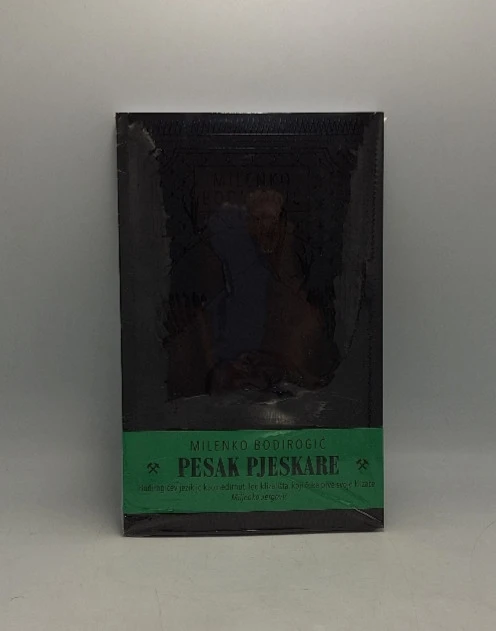
Pesak pjeskare
Basic information
- Author: Bodirogić Milenko
- Publisher: Orfelin izdavaštvo
- Availability: Available
- Condition: New book
- Code: 81970
Shipping options
Payment methods
Explore more
Pesak pjeskare
Bodirogić Milenko
Summary
Milenko Bodirogić: Pesak pjeskare
Milenko Bodirogić's new novel Pesak pjeskare was eagerly awaited, because the previous one Po šumema i gorama (2019) ended at the place where the story of the narrator himself and the origin of his melancholy could begin, which blows through the thick pages of this prose like snow over Konjuh while a partisan company buries a Husin miner. The sand of the sandbox can also be read as a story about the lost friendship of three boys - Mensur, Bogdan and the narrator himself - in the City of Salt, Coal and Sand. In the search for that vanished world, in which Bodirogić is a virtuoso, spaces of fertile melancholy grow, whose meanders the narrator will weave into the story of Yugoslavia between the Husin Rebellion (1920) and two war crimes that will mark the end of the City as it once was, which tried to find its own, different path, resisting the siren call of the nation for a long time. Sand by Milenko Bodirogić Pješčanik is a novel that, like Ismet Mujezinović's often-mentioned painting Self-Portrait with a Monument, tells us about everything that influenced the great Yugoslav painter to stop and warn society about the detours he takes. And Bodirogić stands alone and naked in front of us, with his sandbox in his heart, a quiet, deserted place where the wind ripples small dunes at night.
Additional information
- Author: Bodirogić Milenko
- Publisher: Orfelin izdavaštvo
- Year of publication:2024
- Place of publication:Novi Sad
- Pages:182
- Dimensions:13x20.5 cm
- Script:Latin script
- Condition:New book
- Binding:Softcover
Reviews
0 reviewsWrite a review
Share your experience and help other readers choose.
This item has no reviews yet. Be the first to share your experience.
More books by Bodirogić Milenko
More books from Orfelin izdavaštvo
You may also like






Recently viewed