
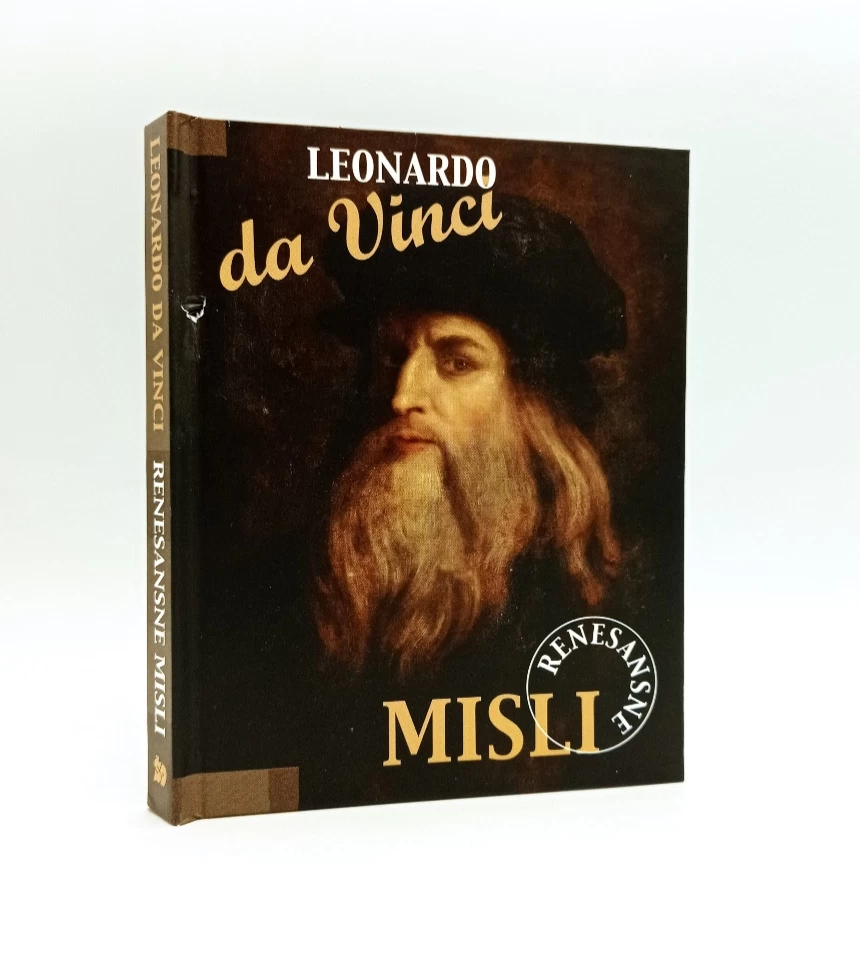
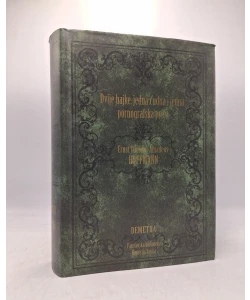
Renesansne misli
Basic information
- Author: Da Vinci Leonardo
- Publisher: Šareni dućan
- Availability: Available
- Condition: Excellent
- Code: 56267
Shipping options
Payment methods
Explore more
Renesansne misli
Da Vinci Leonardo
Summary
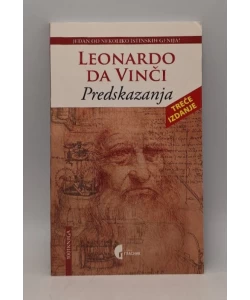
Leonardo da Vinci: Renaissance Thoughts
Leonardo da Vinci (1452 – 1519), was raised in his father's home as the illegitimate child of Sir Piero da Vinci and a young peasant woman, Katarina. He studied in the painting workshop of Andrea del Verrocchi in Florence. A protégé of Renaissance nobles (Ludovico Sforza, Cesare Borgia), the Pope and the Florentine Republic, he lived and worked in Milan, Rome, Florence, and according to legend, died at the hands of King Francis I, who allowed him the freedom of controversial research in the Clos-Lucé villa at the southern end of the small town of Amboise, on the banks of the Loire.
Leonardo created great works of painting and sculpture by penetrating into hitherto unexplored areas of nature and realizing the harmony of beauty and the truth. Notable are his intuitions about geological formations and predictions about space catastrophes, an attempt at mechanical flight, a (forbidden) study of anatomy on human corpses, and countless technical projects. At the same time, he did not forget the practical needs of the environment, which was also in line with the modern understanding of the humanistic period (for example, ideas about irrigation systems, about a modern city, about fortification to defend the Venetians from the Ottomans on the Soča).
For Leonardo, the observed experiment and mathematics were the main sources of scientific knowledge. In nature there is a strict law that can be expressed mathematically. Nature is a living, spirit-filled and purposefully arranged whole, in it every part tends to maintain itself, and in order to maintain itself better, it tends to remain as a whole.
Leonardo's writings, from which smaller compositions are usually separated, such as fables (favola), jokes (facezie), bestiaries (bestiario), witty riddles (indovinelli) and prophecies (prophecies), include notes of the most diverse content and meaning (written on the right to the left, to be read in front of a mirror), accompanied by extraordinary drawings and sketches. It is, in fact, one huge "diary" of a thinker, scientist and artist. Poetic power lies in his lapidary aphorisms or observations about nature, art, science, the elements, especially about water, and about changes in the earth's relief, about monstrous Nemans from ancient times (which he did not consider mythological beings), the secrets of the human body and the controversies of the beginnings.
Leonardo did not publish any books and did not have a humanistic education, but his prose expression is peculiar and original, while his unsystematic notes exude a visionary lyricism.
His writings (about 7,000 sheets) were scattered after his death and have not been preserved in their entirety. Some fragments and thematic units appeared before, for example Treatise on Painting (Trattato della pittura, Paris 1656), and most of them were published in recent times.
Mario Kopić
My door is open to leftists and rightists, black and white and yellow and red and all other people, women, lesbians, homosexuals.
I do not teach anyone anything; I'm the one who learns.
Unfortunately, most of the saviors of the world are already dead. Somehow, by the way, they forgot to save themselves.
If you want to see what kind of second-rate writer he is, it's the one
who throws a party or organizes a party when his book comes out.
Being young is the only religion – as if it's a hard-earned virtue.
I'm just an old fart, nothing more. Well, I didn't manage to kill myself with alcohol. I was close, but I didn't make it. I deserve to live now with what's left.
Additional information
- Author: Da Vinci Leonardo
- Publisher: Šareni dućan
- Year of publication:2019
- Place of publication:Koprivnica
- Pages:146
- Dimensions:12x16 cm
- Script:Latin script
- Condition:Excellent
- Binding:Hardcover
Reviews
0 reviewsWrite a review
Share your experience and help other readers choose.
This item has no reviews yet. Be the first to share your experience.
More books by Da Vinci Leonardo
More books from Šareni dućan




You may also like





Recently viewed