
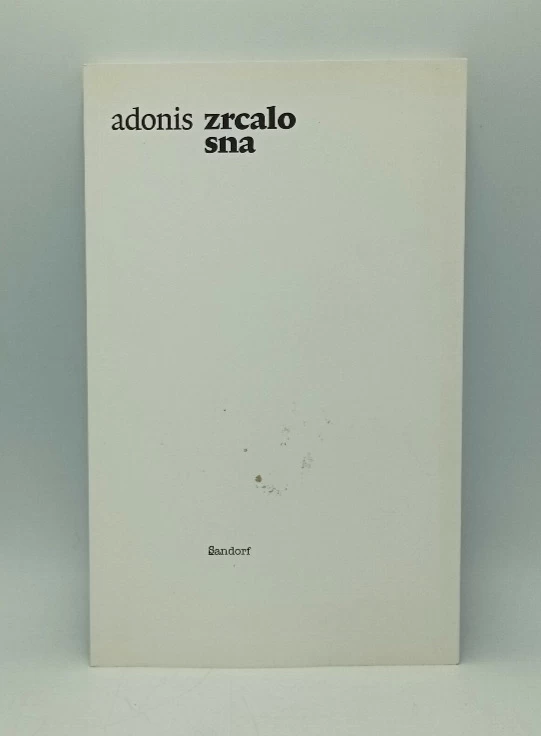
Zrcalo sna
Shipping options
Payment methods
Explore more
Zrcalo sna
Adonis
Summary
Adonis: The Mirror of a Dream
The poet Adonis, real name Ali Ahmad Said Asbar, was born in 1930 in Kassabin, a mountain village near Latakia, in northwestern Syria. Adonis is one of the leaders of the Arab modernist movement in the second half of the 20th century. He rejects the constraints of meter and rhyme, is inspired by French symbolism and surrealism, Nietzsche's philosophy, mythologies of the Middle East, Islamic mysticism and the verses of the Syrian thought poet Abu al-Ala' al-Ma'arri from the 11th century. Contrary to the dominant currents of Arabic literature since the 60s of the 20th century, characterized by direct political and social engagement, he remains faithful to his sometimes almost impenetrable, hermetic poetic expression even in the verses in which he thematizes the burning issues of the Arab world. Adonis published twenty collections of poetry and thirteen books of literary history and literary criticism. He translated Yves Bonnefoy and Saint-John Perse, edited anthologies of Arabic poetry and taught Arabic literature at the universities of Damascus, Beirut, Paris, Princeton and Georgetown. He has been living in Paris since 1985. In 1997, he was awarded the French Knight's Order for Arts and Letters, in 2007 he received the Norwegian Academy's Bjørnson Prize for Literature and Freedom of Expression, and in 2011 the Goethe Prize for Literature. His songs have been translated into numerous world languages. Since 1988, when the Nobel Prize for Literature was awarded to the Egyptian novelist Nagib Mahfouz, Adonis has been mentioned every year as the next laureate from the Arab world.
Reviews
0 reviewsWrite a review
Share your experience and help other readers choose.
This item has no reviews yet. Be the first to share your experience.
More books from Sandorf













You may also like