
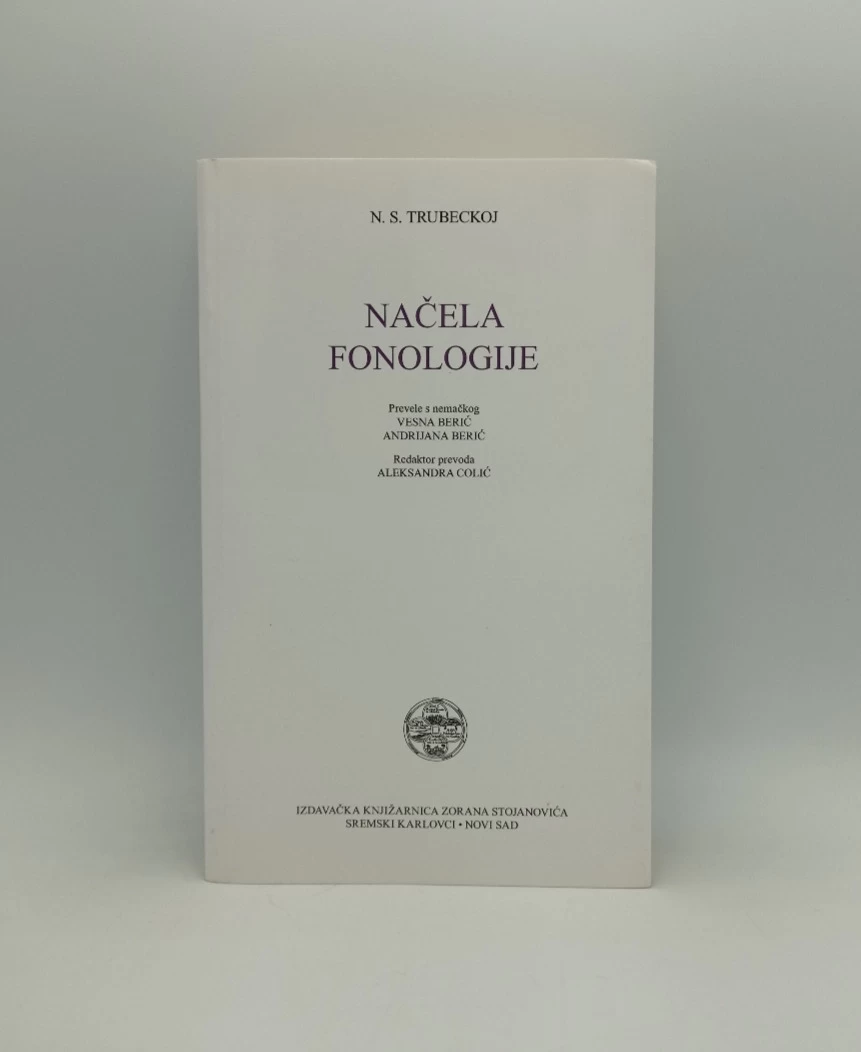
Načela fonologije
Basic information
- Author: Trubeckoj Nikolaj
- Publisher: Izdavačka knjižarnica Zorana Stojanovića
- Availability: Available
- Condition: New book
- Code: 45453
Shipping options
Payment methods
Explore more
Načela fonologije
Trubeckoj Nikolaj
Summary
Nikolaj Trubecki: Principles of Phonology
The book Principles of Phonology by the great Russian linguist Nikolai Sergeevich Trubecki, published for the first time in 1939, belongs to the classics of linguistic literature. Its author is one of the leading linguists of the 20th century and the founder of phonology as a linguistic discipline. Along with Roman Jakobson, he is the most important representative of the Prague Linguistic Circle, in which many ideas of modern linguistic theory were founded. Trubecki was a student of famous philologists such as Brugman, Leskin and Vindiš, with whom, in the spirit of the young grammarian era, he acquired rich philological knowledge, and the shaping of his theoretical assumptions was influenced mostly by the contact with the understandings of Ferdinand de Saussure, the founder of European structuralism and the most significant representative of this linguistic direction, which characterized most of the last century.
Principles of phonology is the main work of Nikolaj Trubecki, a synthesis of his phonological ideas, a combination of synchronic phonology and phonological theory, and the studiousness with which Trubecka approached this work is evidenced by the fact that he studied about 200 phonological systems of the world's languages while preparing the book. With this book, as its title suggests, Trubecka established the basic principles of phonology, in addition to the terminology and glossary of this discipline, in which we single out the following concepts as the most important: phoneme (invariant linguistic unit), archiphoneme, morphophoneme, variable voice realization (combinatorial variant), facultative variant, binary opposition, the concept of neutralization, markedness, distinctive oppositions (as the basis of R. Jakobskon's theory of distinctive features) and dr. Many of the questions that Trubecka dealt with are not only the basis of phonology, but today they are again in the focus of interest, occupying a central place in phonological theory, and in linguistic approaches that differ from structuralism (e.g. the concept of neutralization and the theory of markedness in generative grammar).
Additional information
- Author: Trubeckoj Nikolaj
- Publisher: Izdavačka knjižarnica Zorana S...
- Year of publication:2016
- Place of publication:Novi Sad
- Pages:350
- Dimensions:14x23 cm
- Script:Latin script
- Condition:New book
- Binding:Softcover
Reviews
0 reviewsWrite a review
Share your experience and help other readers choose.
This item has no reviews yet. Be the first to share your experience.
More books by Trubeckoj Nikolaj


More books from Izdavačka knjižarnica Zorana Stojanovića







You may also like