
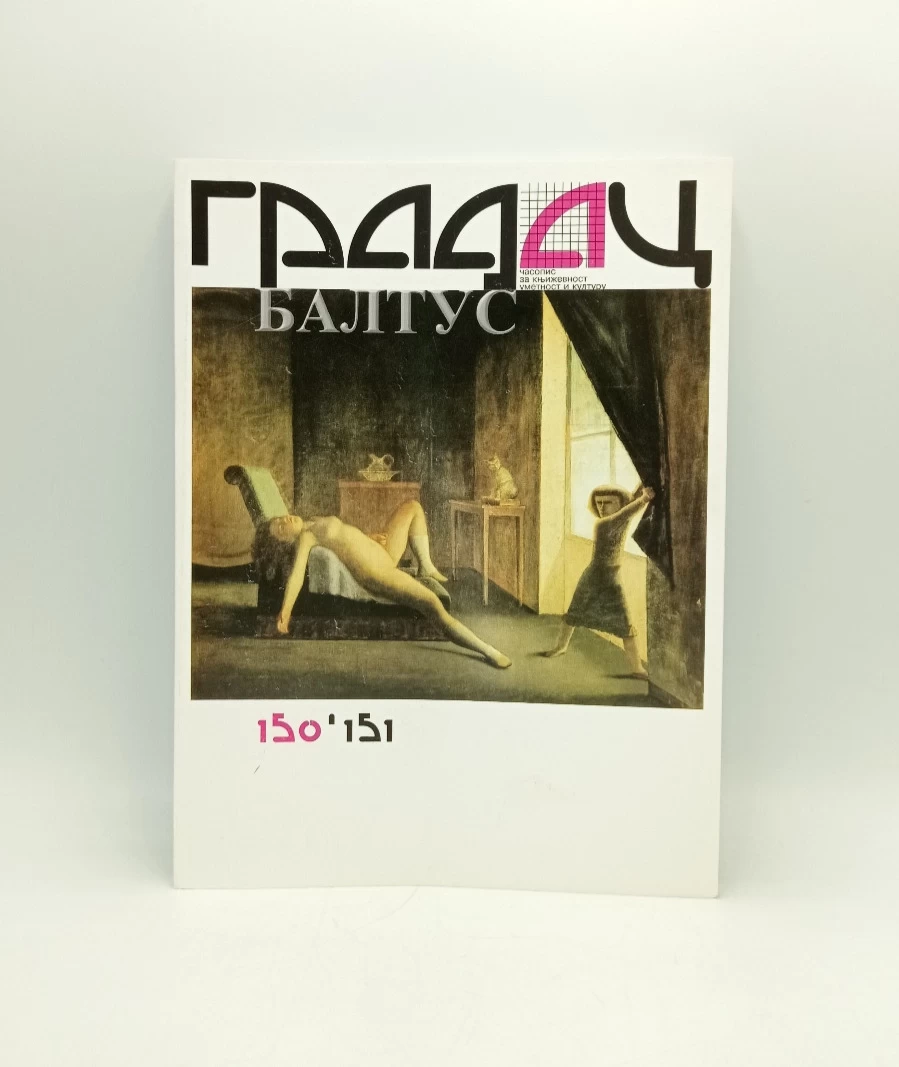
Gradac, Baltus, br. 150-151, 2003-2004
Basic information
- Publisher: Gradac
- Availability: Available
- Condition: New book
- Code: 48166
Shipping options
Payment methods
Explore more
Gradac, Baltus, br. 150-151, 2003-2004
Summary
Gradac, Baltus, no. 150-151, 2003-2004
Journal of Literature, Art and Culture
Baltazar Klosovski de Rola, called Baltus, of German-Polish-Russian descent, a distant relative of Bayron's on his father's side, was born on February 29, 1908 in Paris.
Not only Rilke (who was his mother's lover) was delighted with his painting, but Picasso also bought it. one of his paintings, because he was excited by the muted-passionate eroticism of his works. When someone later remarked that there was pornography in his paintings, he said that his paintings were religious, and that he painted angels.
He did not graduate from any art school, but in his youth he copied the great masters, so his work can be said to be a personal history of painting. Someone said that "exactly because this painting reminds us of many things, Baltus does not resemble anyone".
His life is mysterious and enigmatic. In the catalog of one of his exhibitions, he wrote only this about himself: "Baltus is a painter about whom nothing is known. Now look at his paintings." However, it is known that he lived in Paris, Berlin, Bern, Rome (manager during the restoration of the Villa Medici) and Geneva.
There are several reasons why we present Baltus here today. First, his example is instructive in that he did not accept new phenomena in the painting of his time. For him, only tradition was new, in the sense that what is forgotten is new, provided that tradition is not the chains that bind us. The second reason is Baltus' complete dedication to painting, but not in the sense of a craftsman, but in the sense of a devotee who surrendered himself to his work as a prayer, whose spirit burns in the deepest heights. The third reason could be a story about honesty in art, about a "convention" that, although despised, is preserved in the works of great creators, because honesty is not only a moral category, it is the driver of what is the art of life and the life of art. Are these reasons enough to understand the spiritual crisis of our time?
Additional information
- Publisher: Gradac
- Year of publication:2004
- Place of publication:Čačak
- Pages:166
- Dimensions:19x24 cm
- Script:Cyrillic script
- Condition:New book
- Binding:Softcover
Reviews
0 reviewsWrite a review
Share your experience and help other readers choose.
This item has no reviews yet. Be the first to share your experience.
More books from Gradac



You may also like




Recently viewed