

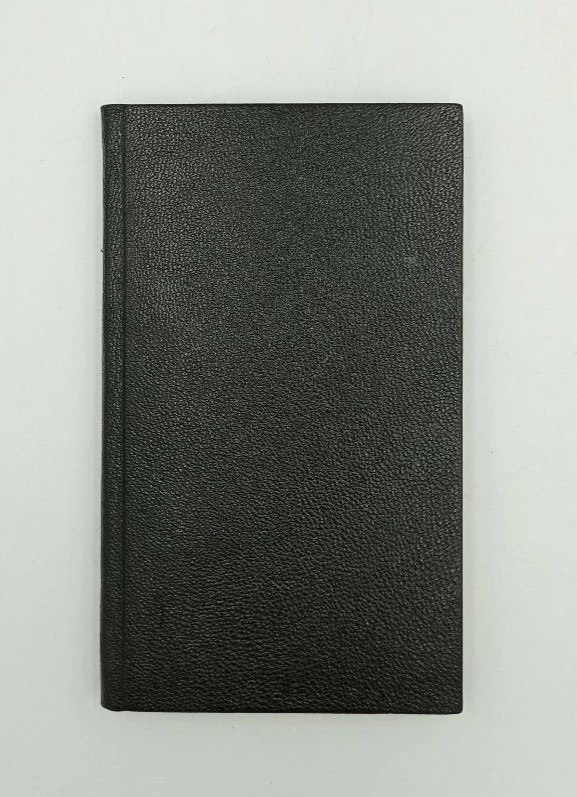

Sollen wir Magyaren werden
Basic information
- Author: Hoič Samuel
- Publisher: -
- Availability: Available
- Condition: Very good
- Code: 32946
Shipping options
Payment methods
Explore more
Sollen wir Magyaren werden
Hoič Samuel
Summary
Domoljúb Horvatovich (Samuel Hojč): Sollen wir Magyaren werden Fünf Briefen geschrieben aus Pesth an einen Freund an der Theis von D. H.
Ex-libris Dubravčić
The personality and work of Samuel Hoič. — With the hundredth anniversary of the Croatian revival. Who is the author of the political brochure: "Sollen wir Magyaren werden?" (1833—1933) Political brochures of the first half of the last century in Austria-Hungary, taken as a whole, represent a chaos of the most diverse ideas, good and immature, statesmanlike and naive, radical and reactionary, sober and fantastic; therefore, it is impossible to capture this chaos in a single circle of ideas. The common characteristic of all opposition brochures was a unanimous resistance against the orderly and absolutist spirit of Metternich's system and an almost universal inclination towards doctrinaire, that most sympathetic weakness of idealists — liberals.1) For understandable reasons, these brochures were published anonymously or under a pseudonym. Thus, it is not known who is the author of the brochure »Slaven, Russen, Germanen«, which has the year of publication 1843 on the title page. It is attributed to Comrade Jordan and Karel Mosak Klasopolski. The opposition brochures mainly fought for lofty principles, while the government brochures were almost all weak and unconvincing. There were also stupid government brochures. Of these, it is certainly the most stupid: »tiber Kroatien als eine durch Unterjochung erbogenne ungarische Provinz und des Konigsreiches Ungarn wirklichen Theil«, (Leipzig, Fr. Kohler, 1844). The government police system of the first half of the 19th century did not know the people, it knew only the subjects: it did not even know large units, which live their own unique spiritual life, it knew only individuals, held in community by chains of laws and police regulations. The fear of revolution caused the Austrian emperor to fear constitutionalism and any participation of the people in the government. Emperor Francis believed in the divine origin of the ruling power and was convinced that any form of cooperation with the people must end in the government's disaster. He was a complete absolutist, wanting to decide everything himself. In 1825, Metternich wrote the following to the Austrian ambassador Esterhazvje in London: "La politique de sa Majeste Imperiale a toute la valeur d'une religion." In this article, we should deal with the brochure "Sollen wir Magyaren werden?", which was published a hundred years ago in Karlovac, that "most popular city in Croatia". The importance of Karlovac as a cultural and publishing center was outlined by F. C. in the article "The City of Karlovac in the Illyrian Revival"2): "The son of Karlovac's "mair" Juraj Sporer printed the "Illyrian Almanac" for the year 1823 at Prettner's in Karlovac. 1823.« Mirko Lopašić, (father of the historian Radoslav Lopašić), printed poems at Prettner at that time, in which he celebrates all major political and cultural events. Year In 1810, he printed "Letters to the great Francia Maressal of Marmond", and in 1823. "Greetings of the Horvatovs of Karlovac to their great native Mr. Bishop of Zagreb Maksimilijan Vrhovac". In that pre-Illyrian era with the first tremors of rebirth, when the masses of the Croatian people were asleep, petrified, without spiritual life and without national beating veins, several books were printed in Karlovac, in which there are bright grains, thrown out of awakened souls. (From these books it can be seen that Karlovac had a printing house 150 years ago, which was bought by Prettner from Waitz in 1822, and another printing house was opened in 1809 under the name "Civil and Military Book Printers".) The cultural and national rejuvenation of the people of Karlovac in the Illyrian direction and mentality could not remain without a strong influence of the fact that precisely in Karlovac in the year In 1832, two of the most important books of the Illyrian revival were printed: Count Janko Drašković's book "Dissertation" — that first "Credo" of the political belief of the Illyrians, in which the first blow was to break the political ties between Croats and Hungarians — and the booklet of the young priest Josip Kundek "The Word of the People's Language", in which the young commoner cried painfully: "Isn't it a shame, my sons, that it is in the living language in the spot beauty?" Those booklets, in which they were printed in Karlovac with a large and ideas, imprinted all the warmth and light of those ideas on the souls of Karlovac." The following year, a significant booklet »Sollen wir Magyaren werden?«,8) was published in Karlovac, which met with the sympathy of all non-Hungarian peoples. In "Obzor" a few years ago, I announced the results of Slovak science about the author of the brochure. It took almost a hundred years to establish without a doubt who the author of that brochure was. Among the Croatian scholars, Dr. Gjuro šurmin was the first to deal with this question in his article "The Fate of a Brochure". 4) šurmin very conscientiously presented everything that was written in our country about that brochure, but he could not discover the real author, and wrongly attributed the brochure to Kollar. Here is what Dr. Gj writes. Šurmin: E. I. Tkalac in his book "Jugenderinnerungen aus Kroatien" p. 243. narrates that year 1832 booklet by an anonymous writer »Soilen wir Magvaren werden? Sechs Briefe geschrieben aus Pest«, printed in Karlovac by Prettner, was of great success, and it was published at the opening of the Požun Parliament in 1832 — so, by chance, at the same time as Drašković's Dissertation. The weaver states that the book was censored by the censor from Karlovac, the Franciscan father "Aurelius Hoerman", the same censor who allowed Gajo to publish the book "Die Sehlosser bei Krapina" in 1826. It is known that Gaja was rejected in Varaždin by the censor, the Zagreb Jesuit Klohammer. Weaver on p. 245. narrates that Hoermann, a Bavarian by birth, brought an investigation upon himself as a censor of those pamphlets by an anonymous writer, which relieved him of the censor's office. The booklet went through three editions in a short time, and all three were approved by Father Hoermann. "In Pest, the brochure caused a real uproar, and the Viennese government was blamed for being in a secret agreement with the author of the treasonous book, to which the royal censor gave his imprimatur". The book was also confiscated at the protest of the Viennese government, but only two copies of the third edition could be confiscated, because everything else was sold out. They couldn't find out about the writer, and that's what makes this booklet interesting. Of course, if the answer to the question is: Sollen wir Magyaren werden? was negative. Tkalac himself (p. 244) writes that the opinion about the author of that brochure was different. It could also be Čaplović, but it seemed to Tkalac that it could have been written by Jan Kollar. Still year. 1853 in "Kola" IX. 47, Mirko Bogović wrote that Kollar is the author of this brochure. Mich. Horvath (in the German translation by Novelli) in his book "Funfundzwanzig Jahre aus der Geschichte Ungarns" (1823—1848) I. 463 does not know whether Gaj or Kollar was the one who published this booklet after the opening of the assembly in 1832. At the celebration of the fiftieth anniversary of the Croatian revival, prof. T. Smičiklas, in his treatise "Croatian national idea" (Work 80, p. 47), speaking about Drašković's "Dissertation", which was printed in the same work alongside his treatise, said: "This same booklet (Dissertation), written in a fervent patriotic spirit, was also published in German under a different title, which more clearly shows the intention of the noble count - under the title: "Sollen wir Magyaren werden?" (first in Leipzig and later in Karlovac in 1833) and it went through several editions in a very short time." Of course, I say that not a single word of this is true, so it is futile to refer to the letter of Vj. Babukić from April 1833, from where on p. 61—63. in Smičiklas's brochure »life and works of Vj. Babukić" we only learn that Babukić sent a brochure to Požega, begging them to read it carefully, and that it already "can't be found. I grabbed two at the beginning, I'm keeping one," and he sends the other to Professor Franikić. Of course, it was omitted in the Memorial Book. In "Materials for the History of Croatian Literature", vol. II, 213 (1899) mentioned by prof. M. šrepel, that in 1838 Antun Vakanovie "in Kariovac published under the pseudonym "Domoljub Horvatović" a famous brochure full of fervent Slavic sentiment, Sollen wir Magyaren werden? which greatly pleased patriotic readers". Šrepel must have written it on the occasion of Tkalčeva's statement in the mentioned book on p. XIII., where the Weaver died not from the opinion that the brochure was written by Koilar, but that at the time of Vakanović's death (1894), it was found that Vakanović was the author of that brochure. Šurmin is aware of two editions of this booklet. One has this inscription: »Sollen wir Magyaren werden? Fiinf Briefe geschrieben aus Pesth an einen Freund an der Theis, von D. H. Karlstadt, Gedruckt bei Johann N. Prettner, 1833.« with a signed preface dated February 1, 1833, and signed by »Domoljub Horvatović«. There is in everything 92. p. The second copy has everything on the first sheet, as mentioned before, only the place »Fiinf Briefe« has »Sechs Briefe geschrieben aus Pesth an einen Freund an der Theis, von D. H.. Dritte vermehrte und verbessert Ausgabe.« Printed in Karlovac in 1833, but on the first sheet on the second page it says »Sine ira et studio. Tacitus." The Sechster Brief runs from 92-102. pp., which Murko did not see, because he had an older edition in his hand. In Intelligenzblatt" Agramer polit. In the Zeitung (from May 25, 1833) there is a brochure advertisement, but with "Fiinf Briefe", in 8°. It was some time later, when the booklet came out. On June 4, 1833, Đ. Dear. Rumy about that brochure to Stratimirović: "Beachtung verdient die dagegen (gegen die Magjarisierung) vor kurzem erschienene Schrift: Sollen wir Magyaren werden?" (Jagić, Letters II., 776. 1897.). therefore, Tkalčeva's information that it was published in 1832 is unreliable, while the "imprimatur" could be from the year 1832, and that "Sechs Briefe" is marked by Tkalac according to the third (or could it be the second?) edition. Year In 1833, he spoke in "Luna", p. 220. friend of the Slovenes, and of our Illyrians in particular, lawyer Professor Dragutin Rumy about that booklet. His article clearly establishes the opinion of Murkov, that the writer is a Protestant, that he is a native Slovak, and by the style it is quite easy to believe, says Dr. Šurmin, that Kollar is the author of this booklet. Our people rightly pointed out that this booklet caused a lot of good news for the national issue in Croatia in those gloomy times. There can be no doubt about that. "Ost unđ West" in March 1862 recounts that the "aussergewohnliche Wirkung" of these brochures and the Viennese government led them on the right path in observing the events, and that is why the Croatian cause began to succeed from this time (Horvath o. c. I. 470). The Serb "Simeon Schityar, a large buyer from Becs in Pest" sent Gaju a letter written on August 18, 1833, in which he wrote that he had sent his Slavoglasje and Drašković's brochure to the brothers, so that the Serbian world could see "how the brothers of the Horvati graciously defend their sanctuary from the wicked Asiatics, and how they are not ashamed to confess the holy truth." These books (as you can see) were marked in our first Chronicle, but I can't translate them and print them here - But many of our brothers, only-born Croats, enlightened us. »Sollen wir Magyaren v/erden? ucsini tsudo«. That's how the merchant of that time judged it. In his excellent Slovenian study »The Beginning of Gajevih »Novin« and »Danice«. According to new sources," Dr. Matija Murko mentions that "the famous brochure, published three times, Sollen wir Magyaren werden (Karlstadt, 1833, 8°, 92 pages) was written by Jan Kollar.5) That brochure is in no way behind Kollar's work, "iiber die literarische Wechselseitigkeit zwischen den verschiedenen Stammen und Mundarten der slavischen Nation" (Pest, 1837). The parallel goes, says Murko further, because he also found the backbone of that brochure in a previous article, namely in the »Jjetopis Matica Srpske III. (1827) p. 132—152. under the caption "A few words about how the Slavs in Hungary are becoming Magyarized", which then also appeared in "Danica" (I. 1835, no. 23-25). In "Jjetopis" an anonymous writer refers to "uberlieferungen der Geschichte unserer Zeit" by Zschokke Aarau in 1820. In the year 1821 (not 1820) of Zschokke's journal, we find it on p. 552—558. the article "Etwas iiber die Magyarisierung der Slaven in Ungarn", which was reworked and supplemented, went into "Jjetopis". All this is according to Murko Kollarovo. Murko himself points out that it is clear from the content that it was written by a Protestant Slovak who knew Serbs. Ideas and harmony and brilliance no brochures determined to betray Kollar. Jan Kollar often stood up against the oppression of the Slavs, but he almost always had in mind the unjustified hegemony of the Hungarians in Hungary. This was correctly felt by T. G. Masaryk: »Kollar describes the struggle of the Slavs with the Germans in all its strength and inadvertently has before his eyes the unfavorable relationship between the Slovaks and the Hungarians; hence the life and color of poetic images and poems about Germanization and denationalization; in the Czech Republic and Moravia, there could not have been such a strong popular feeling of violence". And just de facto before he wrote his sermons on good qualities, Kollar published the fiery article "Etwas tiber die Magyarisierung der Slaven in Ungarn" (1821). These facts led many to think that Kollar reworked and expanded these thoughts in the brochure »Sollen wir Magvaren werden?« (Karlovac 1833, p. 92). This is what the champions of today's Slavic studies, Dr. Matija Murko and Dr. Jan Jakubec, thought (Czech literature XIX century. II. 2. ed. p. 339.). Kollar's authorship of that brochure was also highlighted by Dr. Miloš Weingart, whose editorship published Kollar's work: "Debate on Slavic Reciprocity" (Slovansky ustav, Praha 1929, p. XV.). In the same work, at the end (p. 241), Weingart nevertheless admits that Dr. Aibert Pražak has irrefutably proven with six pieces of evidence that the author of that brochure is the Slovakian Evangelical pastor Samuel Hoič (1806—1868). Weingart rightly adds that the conceptual connection between Hoich's brochure and Kollar's opinion can easily be determined. "Maybe - he continues - Hoič wrote his brochure with Kollar's knowledge or in agreement with him". Even after it was undoubtedly established that Hoič was the author of that brochure, the Russian scholar V. A. Francev (Zagreba »Sveslavenski zbornik« in 1930 in the article »J. Kollar and Russian scholars in Zagreb year 1840—1841) still holds to the theory that Kollar is the author of the brochure »Sollen wir Magyaren werden?«. French scholar Emile Haumant6) attributes that brochure to Janko Drašković. In the London Slavic and Eastern European review "The Slavonic Review" (June 1931), its editor Professor R.W. SetonWatson evaluates Emil Haumant's new work "La Formation de la Yougoslavie" and objects to the French scholar for attributing the brochure "Sollen wir Magyaren werden?" to Count Drašković; Seton Watson notes that the author of that brochure is Jan Kollar. Karl Zink's bookstore in Prague often organizes auctions of valuable books. Thus, in the auction under the name "Our Revival" that bookstore also offered the brochure "Sollen wir Magyaren werden?", and identified D. Horvatović as the author.7) Kollar's authorship was defended by J. Karasek relying on the opinion of M. Murko (see Archiv fiir slavische Philologie, g. 27. p. 154—160., Kollars Antheil an politischen Broschiiren.). The author of the first complete work on Illyrianism, the Russian scholar Platon Kulakovski (Warsaw 1894), then Dr. Bogdanović in his "Overview of Croatian and Serbian Literature", Dr. M. Šrepel in his discussion of Jan Kollar (in the work "Pictures from World Literature", Zagreb 1891, ed. Matice Hrv. pp. 105-134), and Dr. Stj. Bosanac in his article in Kollar's memorial (1893, Zagreb) — they do not mention the brochures »Sollen wir Magyaren werden?« at all. dr. Jan V. Ormis points out in his article "Two Notes" ("Slovenske Pohl'adv", Turč. St. Martin, 1931. No. V. p. 333.), that he was the first to decipher the author of the brochure "Sollen wir Magyaren werden?" Hoitsy Pal, son of Samuel. He is Mr. 1896 for IV. volume of Szinnye's works (pp. 988-9) gave information about his father Samuel, among which he listed first as his father's work: »Fiinf Briefe geschrieben aus Pesth an der Theiss von D. H. Karlstadt, 1833.« This was also stated in his article by the Nestor of Slovak scholars and the president of Matica Slovakia Josef škultety.8) Professor of J. A. Comenius University, Dr. Albert Pražak published a collection of his discussions under the title "Slovenian studies" (Sbornik filosoficke fakulty university Komenskeho v Bratislavč, vol. IV. ch. 43., 1926.). This book contains ten discussions, among which there is also a monograph entitled "Samuel Hojč" (pp. 55-71). Prazak partly corrected and partly supplemented the articles of Jungmann, Riezner, Szinnyei, Vlček, Heidler about the life and work of Samuel Hojč, (this is how Hojč most often signed himself; it is also written like this: Hoič, Hoits, Hoics, Hoitsch; Hungarian Szinnyei spells it Hoitsy. According to Ormis' interpretation, we write consistently Hoič). The life and work of Sameul Hoič after A. Pražak was thoroughly studied by Dr. Jan V. Ormis, who published the excellent monograph "Samuel Hoič" in his very interesting cultural-historical work "From Slovak Folk and Literary History" (Prague, 1932, pp. 59-101), according to which we provide authentic information. Samuel Hoič was born on November 16, 1806 in Brezna. After completing theology, Hoič became a chaplain (1833) to the superintendent of the Potika district, Pavle Josefy, in Tisovac. Jozeffy consecrated him as a priest. From Tisovac, he went to Banska Bystrica as a chaplain to Jan Sekerinim, the superintendent of the Ban district. He came to the tannery on August 10, 1836, where he stayed until 1840. That year, pastor Jozef Krčmery died in Gornja Mičina in the Zvolen region, and Samuel Hoič came to replace him. Hoič worked in Mičina for 19 years. In 1859, he thanked for his service and went to Sapa in the Pest region. As the priest of Mičin, Hoič married Amalia, daughter of Pavel Sekovič, with whom he had eight children. S. Hoič died in 1868 on his estate in the wasteland of Vatya in the Peštan region. After the Hungarian revolution, Hoič published two German articles in Hornyanszko's journal »Protestantische Jahrbiicher fiir Oesterreich«: »Beitrage zur Verfassungsgeschichter der protestantischen Kirche in Ungarn« (II—III. 1855—6) and "Riickblicke auf die Stimmen iiber den Entwurf zur einer Koordinaticn der evang. Landeskirchen Ungarns" (IV., 1857) A year before he renounced the title of pastor, he published the Slovak school booklet "Catechism of Doctor Martin Luther" (based on the Holy Scriptures, Budapest 1858). He also wrote other less important things (critiques and reports). Dr. Jan Ormis rightly says: "The most important work of Hoič is the two political brochures, published in a time gap of ten years; because of them, it deserves to be mentioned in Slovak literature and literary history". In addition, it should be added that Hoič deserves to be presented to the Croatian readership precisely because of these brochures. The biography of Hoičev was also published by Slavik in the organ of Matica Slovakia "Slovak views" (1931. 570.) according to the visitation record from 1885. Literally, Hoič worked very little and always episodically. Chronologically, his political brochure »Sollen wir Magvaren werden?« is the first. According to Ormis, they considered the Croats Antun Vakanović, Janko Draškoviće or Ljudevit Gaj to be the authors of that brochure. M. Murko held that the author was Kollar, but wrongly. In 1843, ten years after his first, Hoič published his second political pamphlet »Apologie des ungarischen Slavismus« (Leipzig 1843). He did not sign with his full name here either, but only with his initials: S. H.,..., which can easily be supplemented with H(oits). The second brochure is in the form of letters like the first. It contains six letters addressed to Ljudevit Kossuth, then editor of Pesti Hirlap. Condemning Hungarianization in those brochures, Hoič also eo ipso defended Croatian national rights. we only regret that after the revolution, Hoič obviously distanced himself from Slovak opinion (instead of Hoič, he began to sign himself "Hoits", which is clear from the correspondence with A. Sladkovič, which Ormis thoroughly studied). He began to neglect the Slovak language in his own family. His son Pavel or Hungarian Pal was already fully Hungarian, who was ashamed to admit his Slovak origin. This is certainly a piece of pre-revolutionary Slovak tragedy, which occurs mutato mutandis among all Slavic peoples, including us Croats. There remains an open question, which no one has even raised, namely: how Samuel Hoič came into contact with Antun Vakanović, that is, how his brochure was printed in Karlovac. I will answer that question when I get to study some of our and Slovakian archives. dr. Albert Prazak states that Hoič is truly the author of that brochure: "Sollen wir...", these evidences, which confirm the above statement: 1. there is one copy in the Bratislava library of Štur's students, which was donated by Mr. Josef Milowuk in 1837. The code H. with Hoič is filled in on that copy. 2. Szinnyei in his bibliography (IV. 918.) mentions among Hoič's works in the first place »Fiinf Briefe aus Pesth an einen Freund an der Theiss von D. H. Karlstadt 1833.. 3. that Hoič is the author, speech and special form (letter), which Hoič used under his own name ten years later in the brochure »Apologie des ungrischen Slavismus«, which is otherwise related to the first brochure. 4. Hoič's authorship also proves another way of apologetic thoughts, their current character and richer fullness of content, and different construction. 5. Hoič in his later brochure "Apologie des ungrischen Slavismus" refers directly to the brochure "Sollen wir.." in order not to have to repeat what he said in 1833. 6. The authoritative proof of Hoič's authorship is his own letter to Michal Hlavacko in Levoč, written from Tisovac on May 20, 1833. This letter is in the church archive of the Evangelical church in Levoč. Along with that letter, Hoič sent Hlavacka several copies of his brochure »Solien wir...«. In the letter, Hoič says: "I am writing to you confidentially, that I am the author of that brochure, which was published by our Slavophiles". Hoič says that he wrote the brochure for this purpose, to put an end to Hungarian anger, which threatens to destroy our language and people, through literature. »Hoic's brochure »Sollen wir.« has a foreword by Horvatović (Vakanović). Domoljub Horvatovič introduces himself in the preface as the publisher and explains why he published the brochure. His friend wrote these papers for his own pleasure, but he presented in them many accurate observations of the new Hungary. Time is important for this, because a systematic attempt is being made to separate Hungary from Europe with an exclusive Hungarian language and to create an island for itself. That attempt is not a happy one. In their time, the Germans had more rights to Croatia, because Zrinski defended Croatia from the Turks on behalf of the Habsburgs, and yet they did not try to Germanize Croatia. Then follow five letters: in the first letter, Hoič describes the situation in Hungary, since Hungarianization took over. Even a few years ago, Budapest was outwardly German, as if it were somewhere in the middle of the German state. Today it is exclusively Hungarian. People start to feel ashamed of their non-Hungarian names, so they Hungarianize them. Non-Hungarian languages seem simple to them. Hoič considers this artificial propaganda of the Hungarian language and Hungarianism unfavorable and calls it "Die Quelle kiinftigen Ungliicks ftir das Lahd", "Die Quelle der Sittenverderbnis", "Das Grab aller Kultur des Landes". Hungarians Hungarianize such regions, where they are in a slight minority. For the spread of Magyarism, public decorations and badges of honor are distributed. A special Magvar Nemzeti Intezet: Hungarian National Institute for the Hungarianization of the Slavs there was founded in Novohradsko. In some municipalities, people who speak and pray to God in Slovak are punished with beatings. In the second letter, Hoič examines the fundamental meaning of this procedure. Instead of the previous Latin language, the Hungarian language is to reign everywhere. The Hungarians certainly forgot that a nation is not only defined by language, but also by character, idea, life, and tradition. Science, art and the whole way of thinking can be developed only in the mother tongue. Nations have their great future in them, science and art are developed in them. The Hungarians only borrowed from the Slavs and will continue to borrow. The Hungarian Slavs will best achieve their mission in humanity through their Slavonicity. That is why they have and must have another concept of love for their homeland, which Hungarians and Magyaronians propose to them: they see their homeland in the historical society, carried by Slavic grandfathers and grandsons, relatives and friends, in love and preference for the places where they have lived since time immemorial, in their inherited Slavic spirit, feeling, in Slavic culture, in a special way of thinking self and feelings, which is completely different than in Hungary. Therefore, the Hungarian Slavs will not become Hungarians, nor will they ever become Hungarians. Hungarians must not forget that Hungary will progress only if the Hungarian people love it. This love is only possible if the Hungarian people can preserve their heritage traditions and their mother tongue. Nations can flourish only by education in their own language and tradition. Today, the terms nation and state should not be confused. If you take away a people's language, you take away their way of thinking and feeling, their customs, their religion, their sense of honor, their whole self. This would also be the case if he wanted to expel him from his homeland and let him live without a home. If you take away a people's language, you have destroyed it, you have destroyed its folk tradition, story, song and you have sinned against the whole of humanity. Hungarian non-Hungarians have no will to become Magyarized. People's apostates cannot be measured. They will never be reliable Hungarians, because whoever betrays one nation is always prone to further betrayal. Hungarians should not be afraid of Slavs. Their gentle, industrious, pious spirit, their diligence, quiet penance, philanthropy and peacefulness guarantee good service to the country. They do not want to leave their mother tongue. If they wanted to give it up, as the Hungarians and Magyaronians want, they would become inhuman and would only harm the country. The state must not suppress the national language. If the non-Hungarians were anointed, they would not be able to feel at home in the Hungarian state and would not be able to make any sacrifices for it in a dangerous hour. Therefore, the Hungarians would do well to make the Hungarian language diplomatic and curial. We should watch over it, so that the higher classes know that language; they should not push him into non-Hungarian areas and push him into schools and churches of other nationalities. In the third letter, Hoič warns the Hungarians to abandon the idea that they will be able to convert the non-Hungarians from their mother tongue to the Hungarian language. However, this is neither necessary, nor expedient, nor natural. There are only 3 and a half million Hungarians in Hungary, there are a majority of non-Hungarians in Hungary, so they cannot be Hungarianized. The people give the country its name or the country gives it to the people. This does not mean that the people would be obliged to adopt the language of other nationalities in the country. Just as Czechs are the majority in the Czech Republic, and the country is called Česká, Boehmen, Bohemia, so in Hungary the Hungarians have a predominance, but the country is called Ugarska, Ungarn, Hungaria. If Germans can live in the Czech Republic alongside Czechs, they must also exist in Hungary alongside Hungarians and Slavs, Germans and other nationalities. The language of the nation can only be the language in which he uttered his first words. The mother tongue (lingua rnaterna, die Muttersprache, Landesprache, la langue maternelle) cannot be replaced by any other. Hungary was named after the Slavs (Ugoria, Ungaria, Ungern from above), as Jornand writes in the work »De rebus gestis V.«, where Hungary is primarily understood as the Slavs. There cannot be one honni nyelv (land language) in Hungary, there must be several. Hungarians push their language, because it is supposedly the most cultured. However, this is a misconception, because the most cultivated language is German, and it would logically follow that Hungary should be Germanized. In recent times, Russians and Poles have been brought up speaking French, so they still remain Russians and Poles. Until now, there were four equal languages in Hungary, side by side. Now the Hungarian language has risen, but that is no reason to destroy the other three languages, because these languages are also rising culturally. The relationship between Slavs and Hungarians is a relationship of equal to equal. The recent claim of Tudomanyos Gyujtemeny (XIV. 1 st.) against Palacki, that the Slavs were admitted to Hungary under the condition that they become Magyarized, is nonsense. How then should we interpret the saying of St. Stephen: "unius linguae, uniusque moris regnum imbecille et fragile est"? Hoič further states that history speaks against the supremacy of the Hungarian language and Hungarians. In the fourth letter, he rejects the idea that the Hungarian Slavs will die out as well as the Polabian Slavs. Hoič goes on to note how the Slavs and Germans in Hungary covered in Germans in every respect (Zrinski in the military sense, Bel, Wallaszky or Genersich in the cultural sense.). The German and Slovak parts of Hungary always had twice as many pupils as the Hungarians, and the German and Slavic peasants were always ahead of the Hungarians. In the fifth letter, Hoič deals with the fact that Hungarian writers also Hungarianized non-Hungarians. That is the biggest misconception. On the contrary, writers should recommend that all nationalities be awakened through schools, which must teach the children's mother tongue. If non-Hungarians are taught Hungarian, they will become a national caricature: together with the language, their religious feeling and sense of honor would disappear. The national genius was preserved only in the cultivation of the mother tongue. Without him, the nation's fate is sealed. The Hungarian Slavs have no will to merge into the Hungarian people. Hungarian Slavs have a wide homeland of brothers in all four parts of the world. Despite all the ideological lack of concentration and despite the slightly strange form of these letters, says Pražak, they are nothing more than an attempt to synthetically defend the Slovak and Croatian languages against Hungarian. Hoich's brochure is actually the first political brochure in Hungary, which strongly opposed the new political regime and the mostly prepared laws, which were promulgated in 1834 and which deprived the non-Hungarian peoples of Hungary of their political rights. Hoič did not present anything new: in essence, he collected those objections against the Hungarians, which have been raised since the end of the eighteenth century, when the Hungarians led the campaign for the unionism of the churches, by means of which they wanted to gradually implement the complete Hungarianization in Hungary. Hoič had predecessors and is in close contact with them. Year In 1834, he stood up against Magyarism for Catholic-ecclesiastical reasons and prof. no. Moyses. Hoich's second pamphlet is "Apologie des ungrischen Slavismus" (Leipzig, 1843). In it, he stands up against Košut, who is the main pioneer of the Magyarization of the Hungarian Non-Magyars. The term Ungar and Magyar began to be deliberately mixed, and the term Magyar is already extending little by little to all the inhabitants of Hungary. Non-Hungarians no longer even have the opportunity to stand up against it, because all journalism serves Hungarianization. Slovaks can only fight abroad, where they can freely publish brochures and defend themselves in front of the world. Hoič considers the lack of orientation in concepts to be the main evil, so he interprets the concepts: "Volk, Volkstiimlichkeit, Sprache, Nation, Nationalitat, Vaterland". In that brochure, he analyzes the concept of political pan-Slavism, and talks about the relationship of Slovaks to other Slavic brothers. This brochure is much more concrete than the first one, and that's because it came out of concrete facts and the political consequences of Magyarism, which came to power. Hoič openly stated that the Hungarians can count on the Slovaks as loyal Hungarian citizens only on the condition that they will be able to exist with them on an equal footing in the national sense, educate themselves and manifest themselves and together with the Czechs and Moravians cultivate the culture that they have had in common for centuries. Hoic's speech, addressed to the Hungarians, is self-aware, dignified and lordly as an equal with an equal. He clearly expressed that the state can be maintained on the principle of general national justice and equality. Hoič also mentions Zagreb and Croats in his second brochure. Albert Pražak counts Samuel Hoič among the most serious Slovak publicists of his time and among the important political workers of the pre-March period.
Additional information
- Author: Hoič Samuel
- Publisher: -
- Year of publication:1833
- Place of publication:Karlovac
- Pages:92
- Dimensions:11x18.5 cm
- Script:Latin script
- Condition:Very good
- Binding:Hardcover
Reviews
0 reviewsWrite a review
Share your experience and help other readers choose.
This item has no reviews yet. Be the first to share your experience.
You may also like