
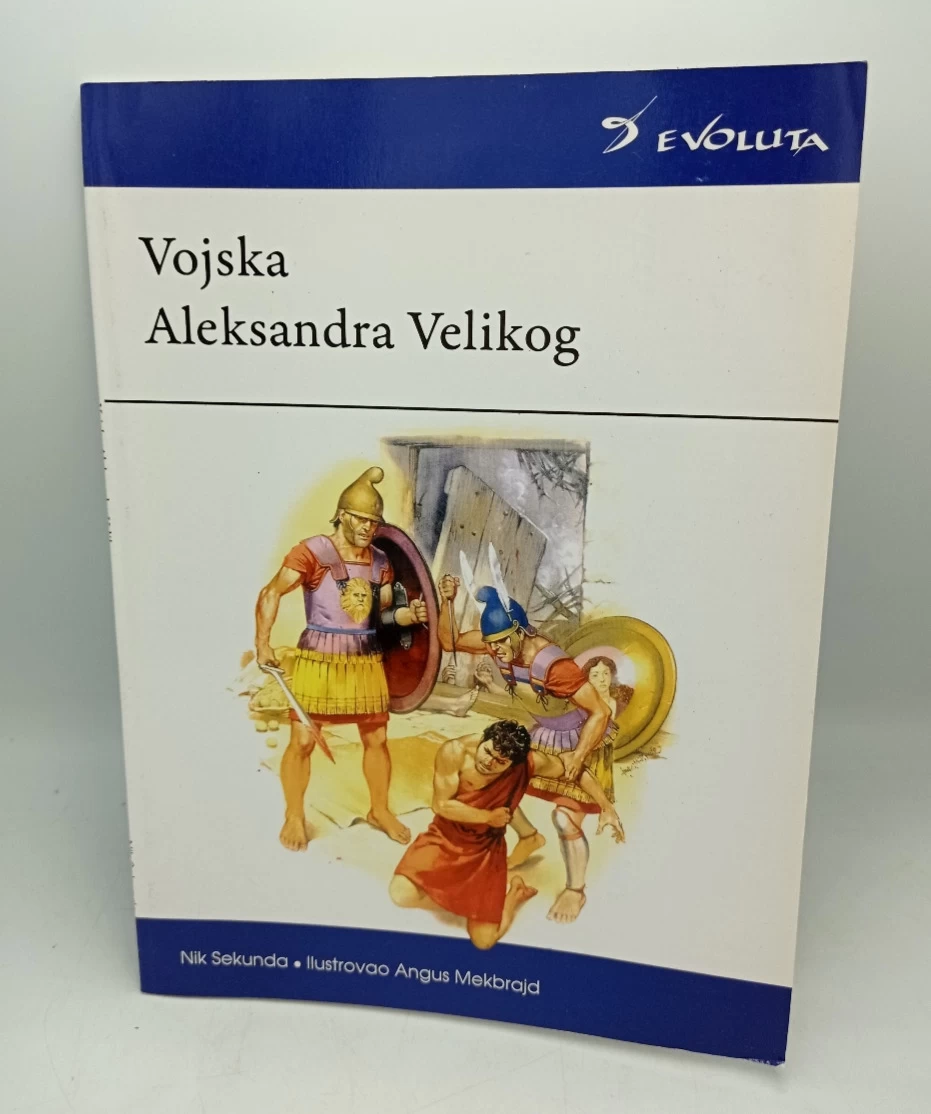
Vojska Aleksandra Velikog
Basic information
- Author: Sekunda Nikolas
- Publisher: Evoluta
- Availability: Available
- Condition: Very good
- Code: 57090
Shipping options
Payment methods
Explore more
Vojska Aleksandra Velikog
Sekunda Nikolas
Summary
Nicolas Secundus: The Army of Alexander the Great
We know the details of Alexander's reign only from a small number of works written several centuries after the events they describe. These works are often contradictory and in many cases can be proven to contain obvious errors. The patient work of a large number of scholars during the last century has greatly improved our knowledge of the Macedonian army, and although many problems still await resolution, we may have reached a situation where it is possible to write such a book.
A monograph of this scope certainly cannot fill the gap. Almost every statement in the text that follows can be disputed. Lack of space does not allow us to mention the work of predecessors or the individual proposals they made as possible solutions to certain problems; but we hope that the discussion could be continued in the pages of the books mentioned in the recommended literature. On the contrary, some new proposals are given in the text, but, again, lack of space prevented me from explaining them in more detail. I also limited my work to the end of 331 BC. although in principle I considered later reforms and continued to follow the history of individual units even after this date. Because of all the above, this book should not be understood as a comprehensive overview, but only as an introduction to Alexander's army. What still brings the events of 2,300 years ago to life is, above all, the vivid picture of the famous battles described in the ancient texts, so this book focuses on how uniformed the army units were. Two archaeological sources are invaluable. The Alexander mosaic, which represents a Roman copy of the original work, is probably the apotheosis of Apelles' painting of Alexander in battle against the Persians. A color reproduction of that image appears in most illustrated books about Alexander. Alexander's sarcophagus, which was commissioned by Alexander's vassal, King Abdallonim of Sidon, and which is now in the Archaeological Museum in Istanbul, is not that accessible to the average reader. The once vividly colored painting had largely faded by the time the sarcophagus was excavated, more than a century ago. The color faded rapidly during the excavation, which continued later. The original publication by O. Hamdi Bey and Theodor Reinach: Une necroplole royale a Sidon (Paris 1892) - includes several heliochrome sarcophagi which, despite their poor quality, add a few details to the remarkably complete work of F. Winter: Der Aleksandersarkophag aus Sidon (Strasbourg 1912). Both of these books are very rare and can only be found in a few libraries in Great Britain. A bit more information can be obtained from G. Mendel's book Catalog of Museum Sculptures (although this information should be taken with a grain of salt); as well as from Folkmar von Grivi's book: Der Aleksandersarkophag und seine Werkstatt (Berlin 1970), which used a special kind of photography to reveal some now invisible details, and is very useful for its detailed descriptions. Finally, some conflicting questions were resolved (and speculated) by the personal interviews I conducted in Istanbul, and I would like to thank the museum authorities and friends in Istanbul for their help and time under difficult circumstances.
Additional information
- Author: Sekunda Nikolas
- Publisher: Evoluta
- Year of publication:2006
- Place of publication:Beograd
- Pages:40
- Dimensions:19x25 cm
- Script:Latin script
- Condition:Very good
- Binding:Softcover
Reviews
0 reviewsWrite a review
Share your experience and help other readers choose.
This item has no reviews yet. Be the first to share your experience.
More books from Evoluta