
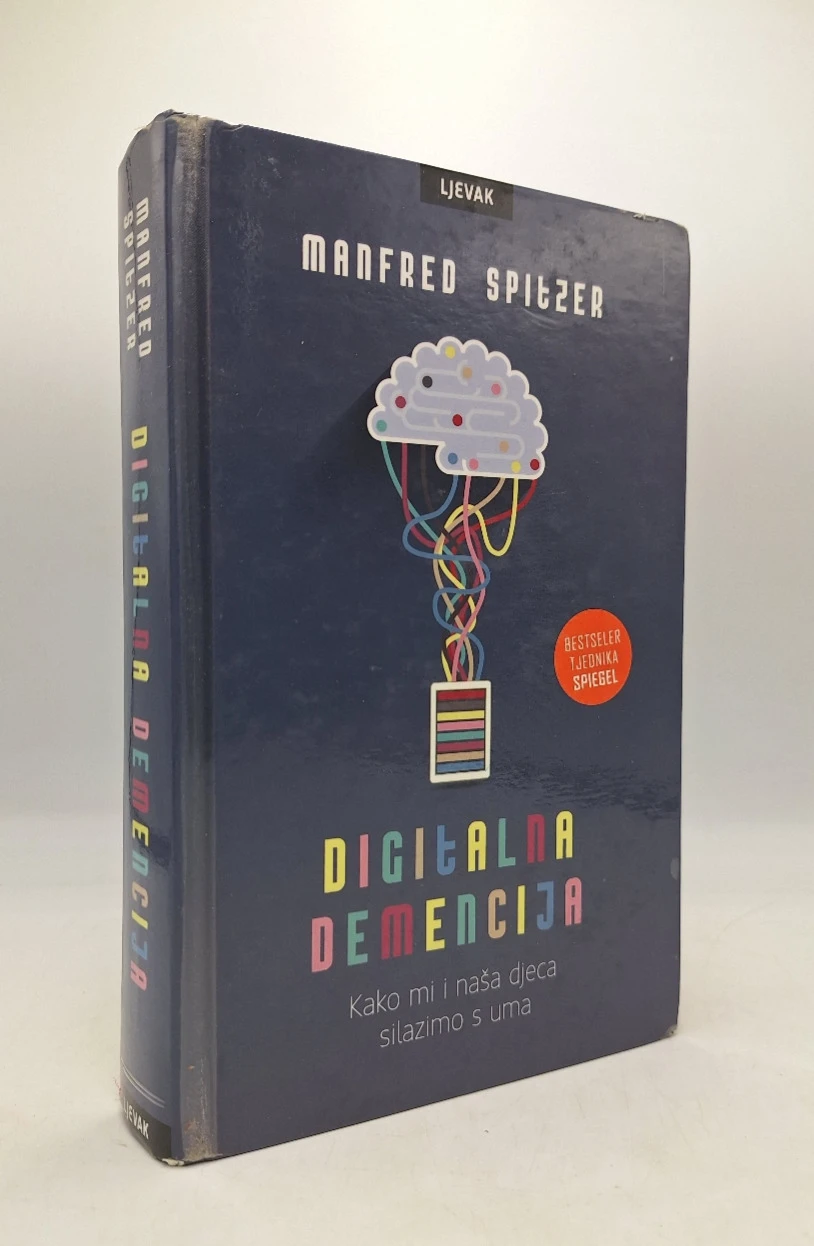
Digitalna demencija
Translator: Perić Boris
Basic information
- Author: Spitzer Manfred
- Translator: Perić Boris
- Publisher: Naklada Ljevak d.o.o.
- ISBN: 9789533552132
- Availability: Available
- Condition: Very good
- Code: 69934
Shipping options
Payment methods
Explore more
Digitalna demencija
Spitzer Manfred
Translator: Perić Boris
Summary
Manfred Spitzer: Digital Dementia
Reputable German neuroscientist and psychiatrist Manfred Spitzer in the book Digital Dementia: How We and Our Children Lose Our Minds warns parents to limit the time spent in front of digital media screens for children whose brains are still developing. The key premise is that electronic media - smartphones, digital assistants, computers, satellite navigation and constant internet connection - "free" us from usual mental efforts, and therefore we become more and more dependent on technology, and our psychological abilities weaken. Many children have no need to memorize information because they know they can "Google" it at any time, says Manfred Spitzer. Multitasking or working on several things at the same time, madly clicking from page to page, distracts children's attention, wastes energy and disrupts focusing on what is important. The more time they spend surfing and playing various games, the more problems children will have with attention and concentration. In addition, games can be addictive. Furthermore, the more time they spend in front of electronic media screens, the worse social skills children will have, the less socialized and frustrated they will be.
Manfred Spitzer, along with Nicholas Carr and Susan Greenfield, was among the first to dare to publicly ask logical questions related to the mentioned dangers and to propose and stand up for their solution, which would be based on objective scientific knowledge. He was among the first to recognize the seriousness of the problem and gave it the appropriate name - digital dementia - which has already become generally accepted today.
population, enable a better understanding of the (positive and negative) effects of these technologies on brain development and cognitive processes and enable a better discussion about the introduction of new technologies." From the review of Assoc. Ph.D. Goran Sedmak
"The book abounds with a large number of original scientific references and quotations. This is perhaps its strongest point, because the author does not make blanket comments, but primarily the results of scientific research on the basis of which he argues and justifies his views. This is best seen through the author's views that he is not a priori against digital media, because he uses them all the time, but advocates for their optimal use, by which he means the ways and the amount that is best for people, especially young children both mentally and physically." From the review by prof. Ph.D. Goran Šimić
"The social need and justification for publishing a translation of the book Digital Dementia is particularly reflected in the context of the current polarization of the two main currents in Croatian society: one that is almost exclusively in favor of as fast and complete digitization as possible, and the other, somewhat more moderate and cautious, that follows the author's thoughts and conclusions that every technology has both positive and negative sides. Both of them will benefit from this reading." From the review by prof. Ph.D. Goran Šimić
*copy from the library
Additional information
- Author: Spitzer Manfred
- Translator: Perić Boris
- Publisher: Naklada Ljevak d.o.o.
- Year of publication:2018
- Place of publication:Zagreb
- Pages:344
- Dimensions:14x21 cm
- Script:Latin script
- Condition:Very good
- Binding:Hardcover
Reviews
0 reviewsWrite a review
Share your experience and help other readers choose.
This item has no reviews yet. Be the first to share your experience.
More books by Spitzer Manfred

More books from Naklada Ljevak d.o.o.















You may also like