
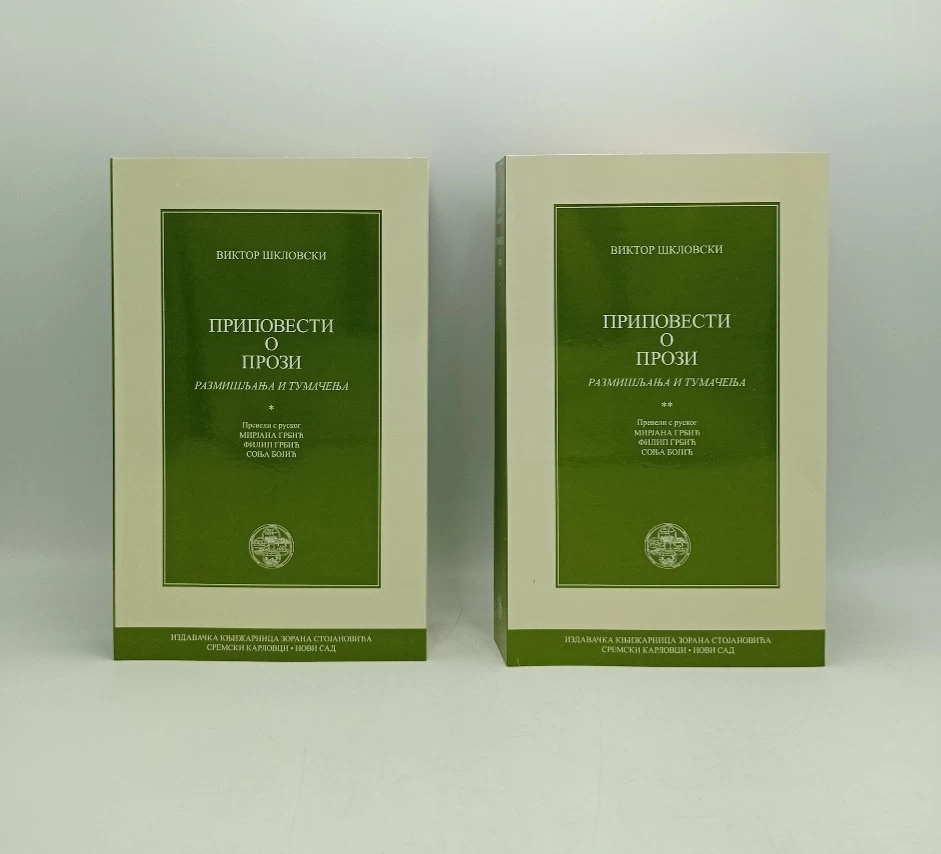
Pripovesti o prozi I - II
Basic information
- Author: Šklovski Viktor
- Publisher: Izdavačka knjižarnica Zorana Stojanovića
- Availability: Available
- Condition: New book
- Code: 43460
Shipping options
Payment methods
Explore more
Pripovesti o prozi I - II
Šklovski Viktor
Summary
Viktor Shklovsky: Tales of Prose I - II
Viktor Shklovsky, Russian and Soviet writer, literary theorist and historian, film theorist and screenwriter, is one of the founders of the school of Russian formalism and the author of a large number of prose, theoretical, memoir and biographical books (about Mayakovsky, Leo Tolstoy, Eisenstein, painter Pavel Fedotov).
Ideas of the formalist school they were created more than a hundred years ago, and its foundations were laid by Šklovski. Formalism influenced various areas of humanistic knowledge, not only the theory of literature, but also the theory of art, philosophy, psychology, linguistics, cultural studies, music theory. Although the beginning of formalism is counted from 1913, the first declaration of this trend was the work of Viktor Šklovski Vaskrsvanje reči, from 1914.
"Man's oldest poetic creation was the word. Words are now dead and language is like a cemetery, but when the word was just born, it was alive and picturesque... Now, when the artist wanted to deal with a living form and with the living, not with a dead word, he breaks the word and deforms it... he restores the former brilliance to the old brilliants of the word..." The idea of resurrecting the word remained important for Šklovski until the end of his life. He said that dust falls on the world and that is why we stop experiencing it. Dust falls on the glass of life, the picture of life becomes cloudy and man lives bleakly, without light, and literature, the writer, wipes that glass with a plot and life becomes visible, attractive and tangible again.
In his two-volume work "Prose Tales", Šklovski reveals to the reader the methods by which changes in the world are fixed, a world that modern man would not know about if art had not immortalized them.
The first part of the book considers primarily the Western prose. The author guides the reader through the ancient world in which the first European novels were created, talks about works that preceded the Decameron, about a novella that describes the position of humanists in society and a novella that explores the relationship to the old by means of a new interpretation of existing metaphors.
The history of Western literature in Shklovski's book becomes a marvelous story about how the world changed and how it remained the same, and what changed in the changed world thanks to a new view of the world and how the heroes of the Greek novel, Tisuća and one night, Apuleius's Golden Donkey, Boccacci's novels or Lazarčić from Tormes passionately and stormily went towards the first great European novel - Don Quixote, how the world was undergoing great changes that affected the change of consciousness about what is good and what is evil.
Special chapters of the book are dedicated to Cervantes, Shakespeare, Voltaire, Dickens, and because of the rapture and passion with which Stern is narrated, this book offers the kind of excitement and reader's joy caused by gifted documentary prose.
If the first part of the book deals "primarily" with Western prose, the second part of the book deals with Russian prose, Russian novels and short stories. Thinking about the birth of the Russian novel, Shklovsky begins by considering the plot in Pushkin, the relationship, personal and literary, between Pushkin and Gogol, about Gogol's works - the overcoat from which the great Russian novel emerged - about Goncharov, Tolstoy and Dostoyevsky, about Chekhov and, especially, about the late Tolstoy. The book ends with reflections on Mihail Sholokhov's Silent Don and the drama of the Russian Cossacks.
Additional information
- Author: Šklovski Viktor
- Publisher: Izdavačka knjižarnica Zorana S...
- Year of publication:2017
- Place of publication:Novi Sad
- Pages:938
- Dimensions:14x23 cm
- Script:Cyrillic script
- Condition:New book
- Binding:Softcover
Reviews
0 reviewsWrite a review
Share your experience and help other readers choose.
This item has no reviews yet. Be the first to share your experience.
More books by Šklovski Viktor
More books from Izdavačka knjižarnica Zorana Stojanovića