

Port St George fur I'Isle de Lissa - Luka Sv. Juraj Vis
Basic information
- Author: Roux Joseph
- Publisher: -
- Availability: Available
- Condition: Excellent
- Code: 13021
Shipping options
Payment methods
Explore more
Port St George fur I'Isle de Lissa - Luka Sv. Juraj Vis
Roux Joseph
Summary
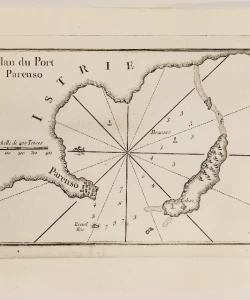
Joseph Roux: Port St George fur I'Isle de Lissa - Port St. Juraj Vis
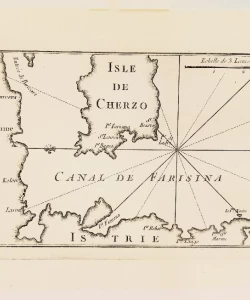
This nautical chart shows the coastline around part of the island of Vis in Croatia. The graph shows the depth and anchor point measurements.
Published in "Recueil des principaux plans des ports et rades de la Mer Méditerranée estraits de ma carte en douze feuilles, dédiée à Mons.gr le duc de Choiseul, ministre de la guerre et de la Marine, gravée avec privilège du Roy, par son très humbre serviteur Joseph Roux Hidrographe du Roy à Marseille, 1764" - an atlas containing copper plate plans of ports throughout the Mediterranean.
Joseph Roux: (1725-1793), French cartographer and hydrographer, most productive in the second half of the 18th century. He also made navigation instruments. He worked in Marseille, where he printed, published and sold his own maps and nautical instruments. In the middle of the century, he acquired the honorary title of royal hydrographer (Hidrographe du Roy), and in 1764 he published a series of 12 maps of the Mediterranean (Carte de la Mediterraneé), and then a small atlas, composed of about a hundred plans of ports in the Mediterranean. Throughout the 19th century, subsequent variants of that atlas appeared, a kind of "folk atlas". Maps show the area from France to Italy, usually with the following accompanying dedication: Recueil Des Principaux Plans, des Port, et Rades de la Mer Mediterranée, Estraits de ma Carte en Douze Feuilles DEDIEE A MONS.gr.LE DUC DE CHOISEUL Ministre de la guerre et de la Marine gravee avec Privilege du Roy. Only a few have been preserved to this day, so they are a real rarity. The dedication refers to Étienne-François, Duke of Choiseul, who was the French Minister of War and Navy at the time. In 1764, the first and only rare edition of the collection was published with all 170 maps, with a cover in rococo style and with depictions of ports around the Mediterranean. Eastern Mediterranean ports were especially represented on the maps, which until the middle of the 18th century were rarely analyzed on maritime charts and portulanas. French explorations of the Levant between the 1730s and 1760s were largely undertaken by Chambert, and Joseph Roux (son) introduced the newspaper in 1764. Nelson used the same principles on maps 40 years later, and the reason lay in the purpose of the maps, which were supposed to serve sailors. Despite the popularity of that edition, the French banned its further reproduction in the 1770s. According to some sources, there were three different versions of the mentioned atlas. The first was an abbreviated edition with 66 maps, most of which depicted localities in the western Mediterranean. Then followed the official edition with 121 maps of the entire Mediterranean, where the eastern part was represented only by maps of the most important ports and strongholds. Finally, the third edition followed, i.e. a variant of the atlas that included all 170 maps and was intended for navigation in the Levant.
Additional information
- Author: Roux Joseph
- Publisher: -
- Year of publication:1764
- Place of publication:Francuska
- Pages:-
- Dimensions:14.5x18 cm
- Script:Latin script
- Condition:Excellent
Reviews
0 reviewsWrite a review
Share your experience and help other readers choose.
This item has no reviews yet. Be the first to share your experience.
More books by Roux Joseph
You may also like