
Gabriel Garcia Marquez: "There is always something left to love."

The writer never allowed the book "One Hundred Years of Solitude" to be screened. As he said, for one of the roles, they would probably hire an actor like Robert Redford, and most of us, Marquez believed, do not have relatives who look like that.
Gabriel Garcia Marquez was born in 1927 in the provincial, sleepy town of Aracataca, located in the tropical area of northern Colombia, between the mountains and the Caribbean Sea.
He does not have a close relationship with his parents, and although he has eleven brothers and sisters, he was raised as an only child. He grows up with his grandmother, an excellent storyteller, who believed in magic, and his grandfather, a retired colonel from the Civil War and a great opponent of all forms of tyranny.
"When he won the Nobel Prize, Marquez's mother said that as a parent she was most proud of having a daughter who was a nun."
During his maturation, the intelligent and shy boy often listened to difficult stories about the lives of oppressed workers. Namely, in his native region, foreign companies have controlled banana production since the end of the 19th century, and employers do not provide good working conditions for their employees, local people.
It is worth paying attention to this fact considering that Marquez was a great critic of Western post-industrial capitalism all his life.
When he became a teenager, his family, as was often the case with local boys, sent him to Bogotá to study. In the capital of Colombia, Marquez begins to passionately devour world literature.
According to his own words, after reading Franz Kafka and William Faulkner, he decided that he would be a writer.
U Meanwhile, he studies law and works as a journalist. Because of a newspaper article, in which he exposes the negligence of the state leadership, his life is in danger, so he leaves his country.
"There is always something left to love." Gabriel Garcia Marquez
Travels around the world, and taking a risk, he returns to Colombia only once and that is to marry Mercedes, the love of his youth.
Exile from Colombia and banned from entering the USA

Photo: Streets of the city of Cartagena, Marijana Matijević
Due to political pressure, in 1955, he was forced to leave his homeland because, as a young journalist, he wrote articles in which he pointed to government's involvement in smuggling on ships.
Later, life in exile for Marquez was, in a way, self-willed. Namely, he did not agree with the violence that was constantly present in Colombia.
At that time, among other countries and cities, the writer was staying in Havana. From the beginning, he was in favor of the Cuban revolution, so he began a long-term friendship with Fidel Castro.
Because of his political views, he was unwelcome in America and was banned from entering that country until 1971. The whole situation is further mitigated by American President Bill Clinton, who publicly declares that "One Hundred Years of Solitude" is one of his favorite books.
"I believe he is the most important writer of fiction in any language since William Faulkner." Bill Clinton
After Marquez's death, in April 2014, the then Colombian president declared three days of national mourning, citing the Nobel laureate as "the most loved and respected countryman of all time".
"In life, it's not what happens to you that matters, but what you remember, and the way you remember it." Gabriel Garcia Marquez
_3455.jpg">Photo: Marijana Matijević
One Hundred Years of Solitude
One of the most important books of our time. A great novel chronologically follows several generations of the Buendia family, which founded the fictional town of Macondo.
It explores the themes of love, loss, fate and the inevitability of repetition in history. The author combines the supernatural with the ordinary, while telling about irreconcilable conflict between the desire for solitude and the need for love.
Although the title of the book suggests that the novel takes place over a hundred years, it is not strictly limited to that time period.
Marquez was completely alone during the writing, and the process of creating this capital work lasted almost 15 months without stopping.
Love in the age of cholera

The main characters of the novel are Florentino Ariza and Fermina Daza. They are separated by a great distance. However, by a combination of circumstances, the girl decides to marry a rich, respectable doctor, while the young man, a hopeless romantic, continues with his life. At one point, Florentino has never gotten over it, so he deliberately comes to the funeral. Fifty-one years, nine months and four days after his first love, he will do it again to give birth?
On love and other demons
On her twelfth birthday, the young Marquise Sierva Maria is bitten by a rabid dog. stories that she survived because she is possessed by demons and has supernatural powers.
Under the influence of the environment, she meets a young priest whose task is to exorcise an evil spirit from her. However, the young man unexpectedly falls in love, and instead of the planned sermons, he is ready to risk everything just to be together.
dreams.
They meet and communicate with each other only while they are dreaming. They cannot touch or meet each other in waking life. Also, they have no control over whether or not they will meet in the dream, nor when they will wake up.
The phrase of the title, ''blue dog's eyes'', is their mutually agreed-upon signal for recognizing each other while they are awake and living separate lives.
I didn't come to give a speech
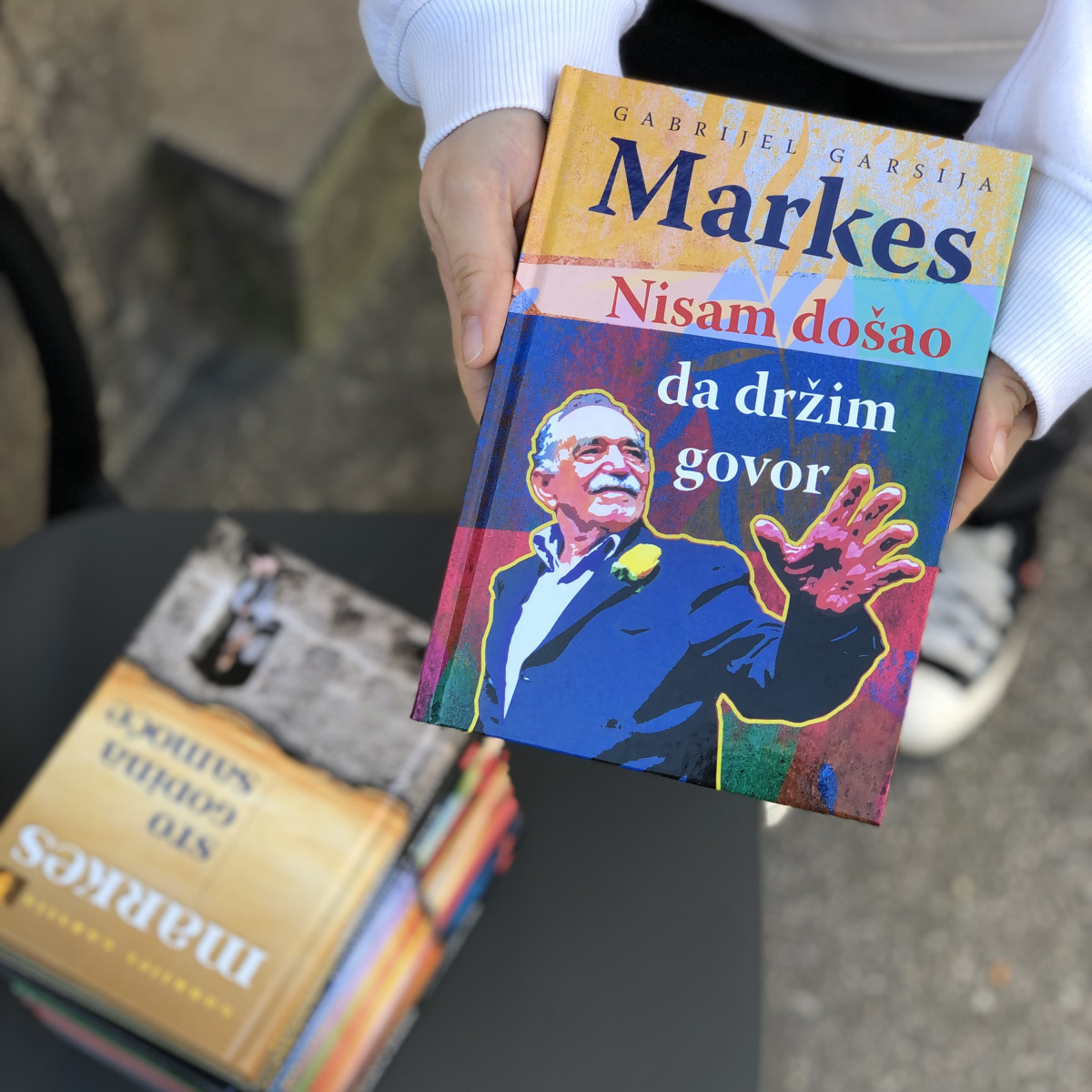
Photo: Marijana Matijević
Gabriel Garcia Marquez speaks as he writes, very passionately!
The book records the key events in the life of the Colombian great through a series of passionate public appearances over the years. From the speech he gives, as a seventeen-year-old, to his classmates at the awarding of the Nobel Prize.
The collection gives a unique and fascinating insight into the author's long career, his concerns and beliefs, both as a person and as a person. as a writer.
Marquez was loved during his life, but after his death he is celebrated as a true literary genius.
The Wicked Hour
The action takes place in a sultry Colombian city during the 1950s. An unknown perpetrator prowls the streets and places beautiful posters on walls and doors denouncing respectable residents of the community.
For example, one woman was called out because instead of going to the dentist, as she said, she actually went for an abortion. In other cases, some men were accused of
Unfortunately, a murder occurs because of the content of a poster. Fear and panic spread among the citizens.
Prepared by: Marijana Matijević
Biblos Newsletter
For book lovers who enjoy finding the rare
New titles, special copies and quiet recommendations from the antiquarian bookshop.