


Summary
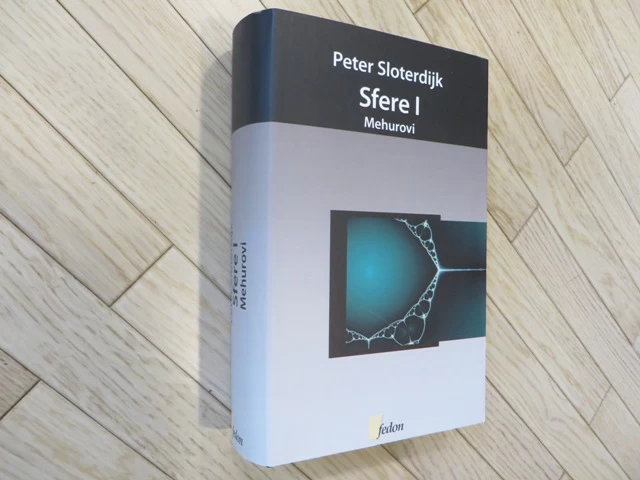
Peter Sloterdijk: Spheres I - Bubbles
Microspherology
Crowned with the glory of his Critique of the Cynical Mind, Peter Sloterdijk in 1998 publishes the first part of his three-volume magnum opus, Spheres, a work that, in the next few years, will contain two thousand pages of text. A writer with a sure and playful hand, an imaginative erudite, always in a symbiotic relationship with art, witty and cheeky, Sloterdijk "modestly" engages in the interpretation of the history of humanity, but in his own way, with the help of the concept and phenomenon of the sphere, spherical shapes, among which bladders are in a prominent place (in German Blasen means bladder, but also bladder). The first book of the three-volume series Spheres has bubbles in its subtitle.
What, in fact, does Sloterdijk want by introducing spheres into the sphere of philosophy? What his great role models Nietzsche, Heidegger, Foucault, Derrida have already tried - to shake the fetishism of substance and metaphysical individualism. In other words, Sloterdijk poses an eminently political question: what is it that holds the human community together, what is the one thing in the community around which the community gathers? Or, perhaps, the human community is already in something that, without it knowing it, gives it shape, maybe it is in the middle of something that, like some kind of bubble, holds it together from the outside? Or, in the end (or at the beginning), the human community is a specific non-physical, curved, spherical space in eternal creation and disappearance - the space of intimacy? It is the idea of intimacy as a specific space that is at the basis of Sloterdijk's book.
(F13)
Biblos Newsletter
New titles, special copies and quiet recommendations from the antiquarian bookshop.