
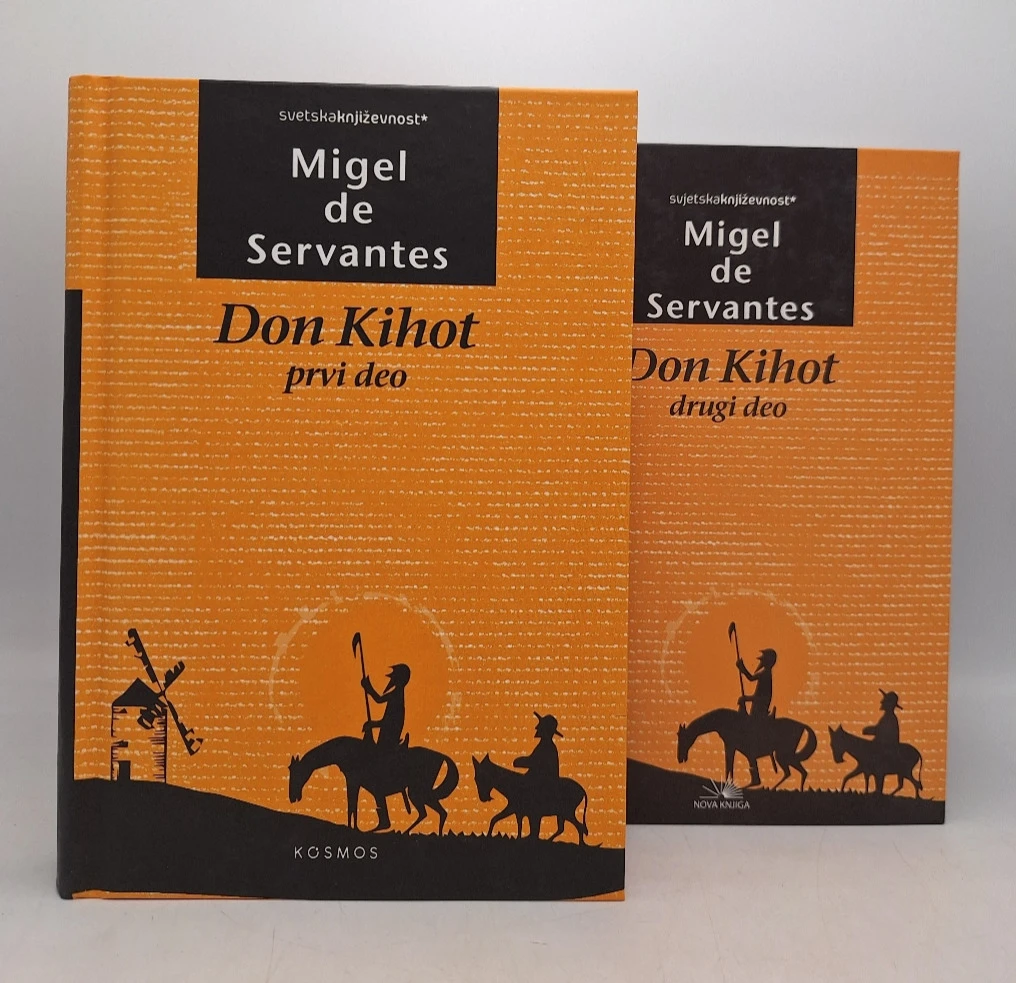
Don Kihot I-II
Basic information
- Author: Cervantes de Miguel
- Publisher: Kosmos - Nova knjiga
- Availability: Available
- Condition: New book
- Code: 83090
Shipping options
Payment methods
Explore more
Don Kihot I-II
Cervantes de Miguel
Summary
Miguel de Cervantes: Don Quixote I-II
The novel with the full title The Bright Knight of Don Quixote of Mancha was published in two parts. The first part was published in 1605, and the second part ten years later, in 1615. In the first part of the novel, we follow the elderly, fifty-year-old nobleman Alonso, whose surname is Quijada. This nobleman is very fond of reading chivalric novels, which keep him idle all day long. The poor knight got so engrossed in his chivalric novels and understanding their ornate and complex sentences, that he went a little out of his mind. Very quickly, he dares to start a business and comes up with a new name for himself - Don Quixote. He wants to be a knight who removes all difficulties in the world, corrects wrongs and sins, and prevents and avenges evil deeds, just like the knights in the novels he reads. The world in which he embarks on such a venture has not been the world of chivalry that he loves so much for a long time. Because of this, his adventures do not end well. As every knight needs his assistant and squire, he persuades the peasant Sancho Panza to accompany him in his plan. In return, he promises to give him an island that he will surely conquer in his adventures. They go on adventures together, the knight Don Quixote on a horse and Sancho on a donkey. The adventures they experience are many, but they never end well for them. In the second part of the novel, the adventures continue. Everyone is already familiar with Don Quixote, and novels and short stories about his adventures circulate in Spain. The environment pretends that they are really a knight and a squire and thus mocks them. Their adventures end due to fraud. Don Quixote is challenged to a duel, and the knight who defeats him asks him to return home and calm down from his adventures. Don Quixote, like a true knight at heart, listens to the one who defeats him, returns home and dies there. Before that, he regains his sanity, which was clouded by chivalric novels. He realizes what follies he has done. Despite everything, Sancho Panza remains his faithful servant. This novel can be read as an adventure novel, although Cervantes did not have adventure stories in mind when he wrote the novel. The novel was conceived as a critique of then-popular chivalric novels and adventures. The relationships between the characters in the novel take precedence over the plot. Don Quixote and Sancho Panza, two contradictory characters, simultaneously present two types of people of Cervantes' era. Don Quixote is the prototype of a knight, a nobleman who, although he is learned, does not observe the world around him objectively. He approaches everything idealistically, and Sancho, who is a commoner and a peasant, represents the people. He is inclined to folk wisdom and speaks from the point of view of realism. The two of them go on adventures together, almost every one of which ends with Don Quixote being beaten. Although he often gets beaten and never wins a conflict, he always has an explanation for everything that happens (spells, envy, malice) and does not give up on further adventures. Don Quixote represented an inexhaustible source of inspiration for film directors, so several feature films and animated films for children were made based on him, and even operas were sung about him. He also inspired many Spanish painters, of whom the famous Pablo Picasso and Salvador Dali dedicated cycles of works to him. Don Quixote is one of the most important novels that marked the further development of this genre. After the medieval adventure novels, Don Quixote is the first to center on the adventures of a single character who also becomes the protagonist. Because of this, literary theorists often call it the first modern novel of world literature. It is important in that Cervantes does not place a national hero as the protagonist, but a complex character of a caricatured knight who is in conflict with his environment, has a complex character and who questions various social norms and standards of his time.
Additional information
- Author: Cervantes de Miguel
- Publisher: Kosmos - Nova knjiga
- Year of publication:2016
- Place of publication:Beograd | Podgorica
- Pages:429+469
- Dimensions:15x21.5 cm
- Script:Latin script
- Condition:New book
- Binding:Hardcover
Reviews
0 reviewsWrite a review
Share your experience and help other readers choose.
This item has no reviews yet. Be the first to share your experience.
More books by Cervantes de Miguel

More books from Kosmos - Nova knjiga











You may also like






Recently viewed