
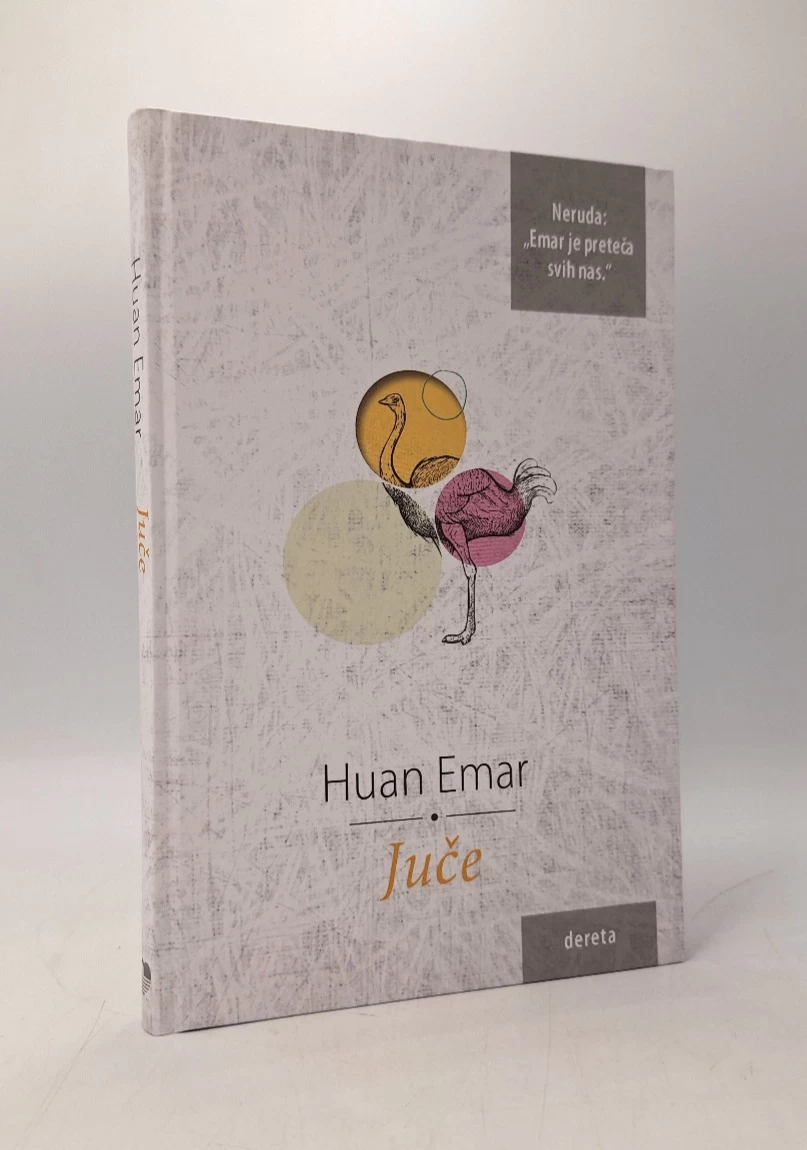
Juče
Shipping options
Payment methods
Explore more
Juče
Emar Juan
Summary
Juan Emar: Yesterday
In the city of San Agustin de Tango, you never know what will happen or who you will meet, it is difficult to distinguish the banal from the real, and danger, delirium or truth lurk around the corner. During the whole day - yesterday - that this novel covers, the main character and his beloved wife witness unusual events: a man is guillotined for preaching the intellectual pleasures of sex, in the zoo an ostrich devours a lioness, and maybe not, because Emar's surrealist world is difficult to reach.
Emar, a contemporary of Pablo Neruda and Vicente Uidobro, wrote mainly during the interwar years. Although the influence of the European avant-garde on him is obvious, it is difficult not to declare him a postmodernist writer, who is almost half a century ahead of his time. Pynchon, Vonnegut, Gaddis and many others follow in his footsteps, inadvertently, and almost certainly did not read it.
It is not difficult to understand why Emar's contemporaries were confused by this novel. Philosophical peregrination never leads anywhere; the absence of political and ideological scaffolding is noticeable, it seems that Emara is more interested in asking questions than answering them.
However, what once seemed like a shortcoming is no longer so. We have long understood the importance of the activity itself, and not the goal, as well as the fact that the search for the ultimate meaning is a naive intention.
Yesterday, then, is a curve from the last century, which somehow seems to be perfectly aligned with our present and probably tomorrow's (dis)opportunities.
Reviews
0 reviewsWrite a review
Share your experience and help other readers choose.
This item has no reviews yet. Be the first to share your experience.
More books from Dereta











You may also like