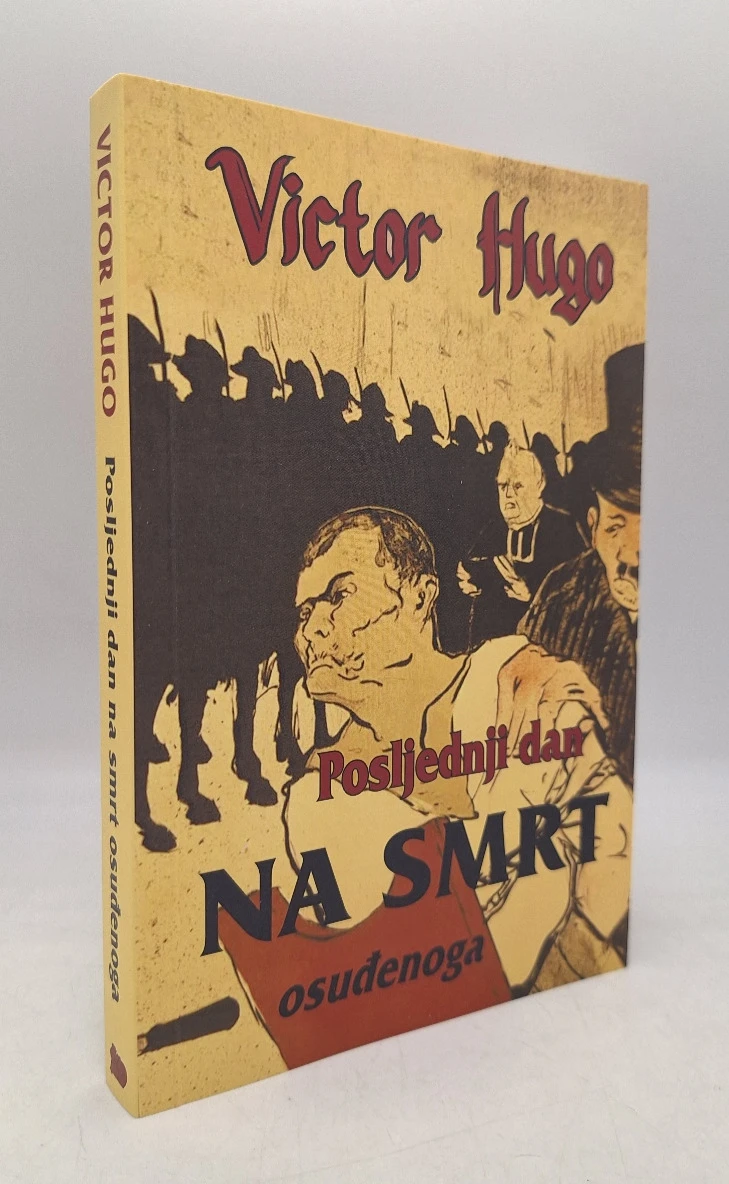

Hugo Victor: Posljednji dan na smrt osuđenoga
€ 13,00
Free delivery in Croatia for orders over EUR 70
Basic information
- Author: Hugo Victor
- Publisher: Šareni dućan
- Availability: Available
- Condition: Nova knjiga
- Code: 65646
Shipping options
GLS Croatia
5€
Delivery
0€
Personal collection at the antique store
0€
GLS parcel machine
3€
Payment methods
Pay on pickup
CorvusPay
By general payment / Virman / Internet banking
Cash on delivery
Posljednji dan na smrt osuđenoga
Hugo Victor
Summary
Victor Hugo: The Last Day of a Man Condemned to Death
An endless crowd, allegedly two million people, gathered at the funeral, in May 1885 in Paris, to say goodbye to one of the greatest Frenchmen and not only of his time, and not only of the French - Victor Hugo, a famous novelist, poet, dramatist, essayist, activist... Disciplinedly writing a hundred verses or twenty pages of prose every morning, Hugo created a grandiose work, absolutely relevant even today. Along with Les Misérables and The Bell Ringer of Notre-Dame Church, a privileged place in his exceptional oeuvre is certainly occupied by the fictitious diary of a young executioner, The Last Day of a Condemned to Death (1829). Addressing it to "everyone who judges", the author openly advocates the abolition of the death penalty, asking his contemporaries: "Isn't there enough air in France for everyone to breathe?" The moving pages of this diminutive pearl of world literature, by their own admission, had a profound impact on literary greats such as Camus, Dickens and Dostoevsky, and the latter rated it as "Hugo's masterpiece".
"What I write may not be useless," confides the condemned man and examines himself, "that journal of my sufferings, hour by hour, minute by minute, pain after pain, if I have the strength to keep it until the moment when it will be physically impossible for me to continue; this story, necessarily unfinished, but as complete as possible, about my feelings, won't it bring with it a great and profound lesson?" These poignant pages, filled with overwhelming fear and dread in the face of merciless inevitability, but also with deep nobility and compassion, were written in the unsurpassed style of a great storyteller!
Additional information
- Author: Hugo Victor
- Publisher: Šareni dućan
- Year of publication:2013
- Place of publication:Koprivnica
- Pages:171
- Dimensions:12.5x18.5 cm
- Script:Latinica
- Condition:Nova knjiga
- Binding:Meki
You may also like







Recently viewed


Biblos Newsletter
For book lovers who enjoy finding the rare
New titles, special copies and quiet recommendations from the antiquarian bookshop.