
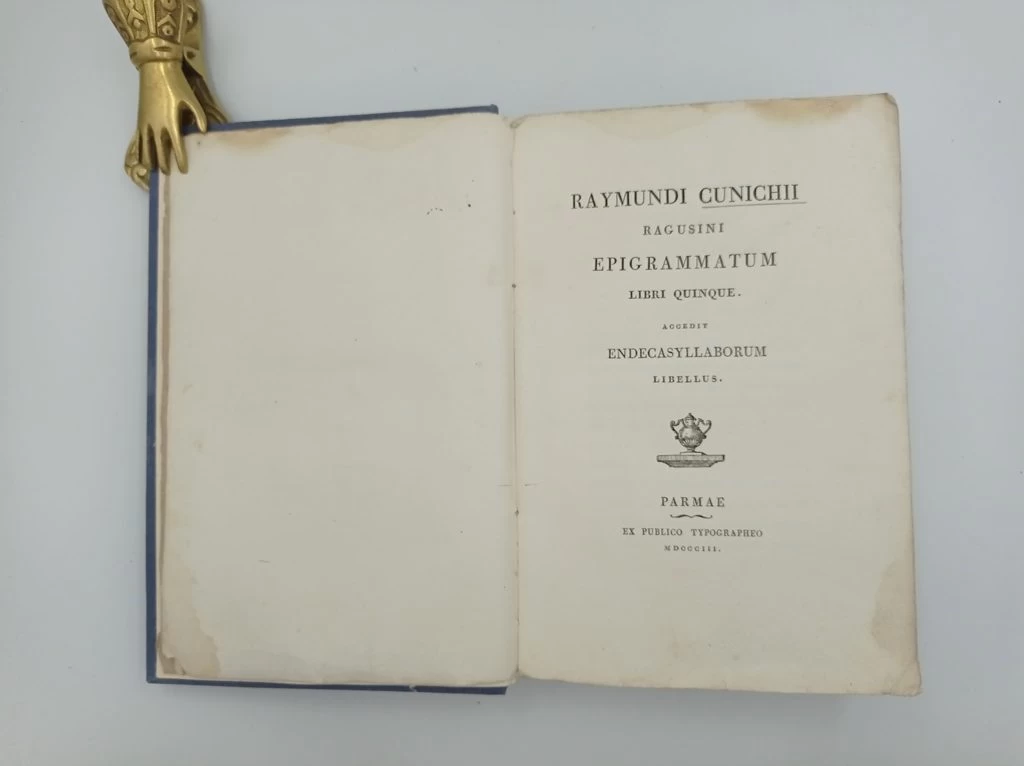
Raymundi Cunichi Ragusini Epigrammatum libri quinque. Accedit Endecasyllaborum libellus.
Basic information
- Author: Kunić Raymund
- Publisher: EX PUBLICO TIPOGRAPHEO
- Availability: Available
- Condition: Very good
- Code: 61076
Shipping options
Payment methods
Explore more
Raymundi Cunichi Ragusini Epigrammatum libri quinque. Accedit Endecasyllaborum libellus.
Kunić Raymund
Summary
Rajmund Kunić: Raymundi Cunichi Ragusini Epigrammatum libri quinque. Accedit Endecasyllaborum libellus.
Kunić, Rajmund (Raymundus Cunichius, Raimondo Cunich), Croatian writer and translator (Dubrovnik, January 24, 1719 – Rome, XI. 22, 1794). He received his first education in his hometown; joined the Jesuits in 1734 in Rome, where he studied philosophy and theology, ordained in 1750. He taught Greek and rhetoric at various Jesuit schools in Italy, including the central one in Rome, where his fellow citizen B. Zamanja was a student; after the abolition of the order in 1773, he continued to teach as a priest. He was a member of the Roman Accademia degli Arcadi (pastoral name Perelaus Megarides).
Among his contemporaries, Kunić gained fame mainly as a translator from Greek to Latin. He translated Hellenistic poets (Theocritus, Callimachus), epigrammatists (Greek Anthology), but he put the most effort into the recitation of the Iliad (1776), which is – according to broad agreement – the best Latin recitation of that Homeric epic; it was used by V. Monti for his classical translation into Italian. As an author, Kunić tried his hand at many poetic genres, but he showed a strong preference for elegy and epigram. In addition to sacral and didactic content, he used elegies in correspondence with friends, often for some literary purpose. In his epigrams, he commented on contemporary artistic production (Mengs, Canova, Cimarosa, Alfieri, Metastasio), marked various occasions (tombstones, laments, commendations), mocked disrespectful behavior, but the central place belongs to the compositions dedicated to the Roman woman Maria Pizzelli (Lidi – Ad Lydam): more than 600 epigrams form the most extensive love canconier in Croatian Latinism. Although a huge part of his oeuvre remained in manuscript - for example, only two fifths of the elegies (20 out of 47) and less than a third of the epigrams (1000 out of 3600) were published in print - the quality and resonance of the published part justifies the assessment that Kunić was one of the most influential European Latinists of the XVIII century. st.
Additional information
- Author: Kunić Raymund
- Publisher: EX PUBLICO TIPOGRAPHEO
- Year of publication:1803
- Place of publication:Parma
- Pages:202
- Dimensions:15.5x23 cm
- Script:Latin script
- Condition:Very good
- Binding:Hardcover
Reviews
0 reviewsWrite a review
Share your experience and help other readers choose.
This item has no reviews yet. Be the first to share your experience.
More books by Kunić Raymund


You may also like