
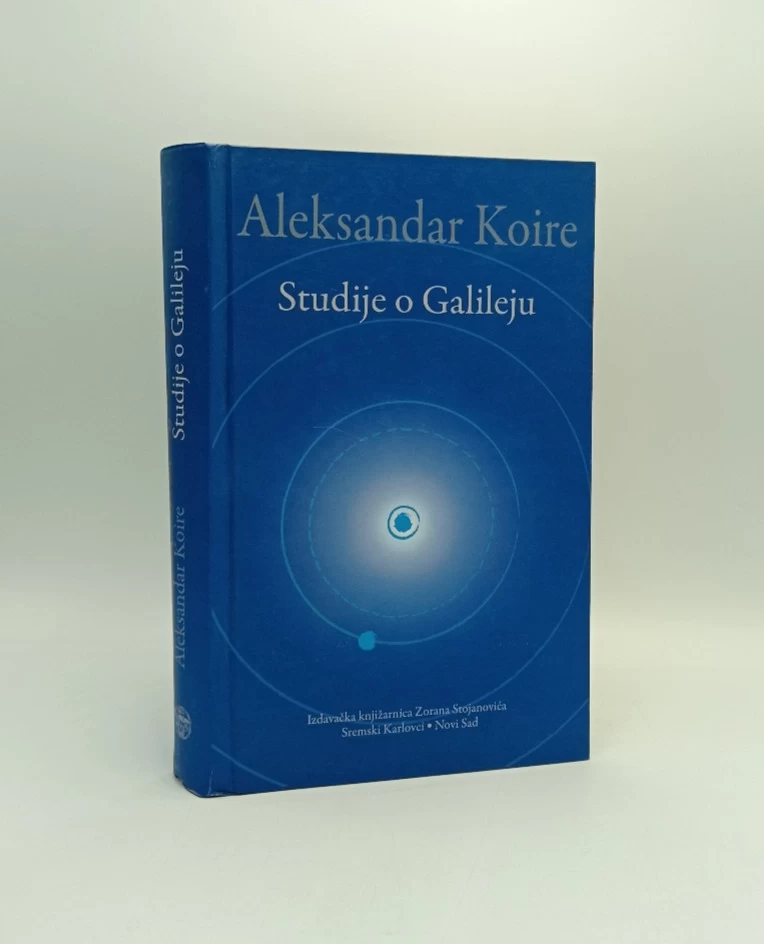
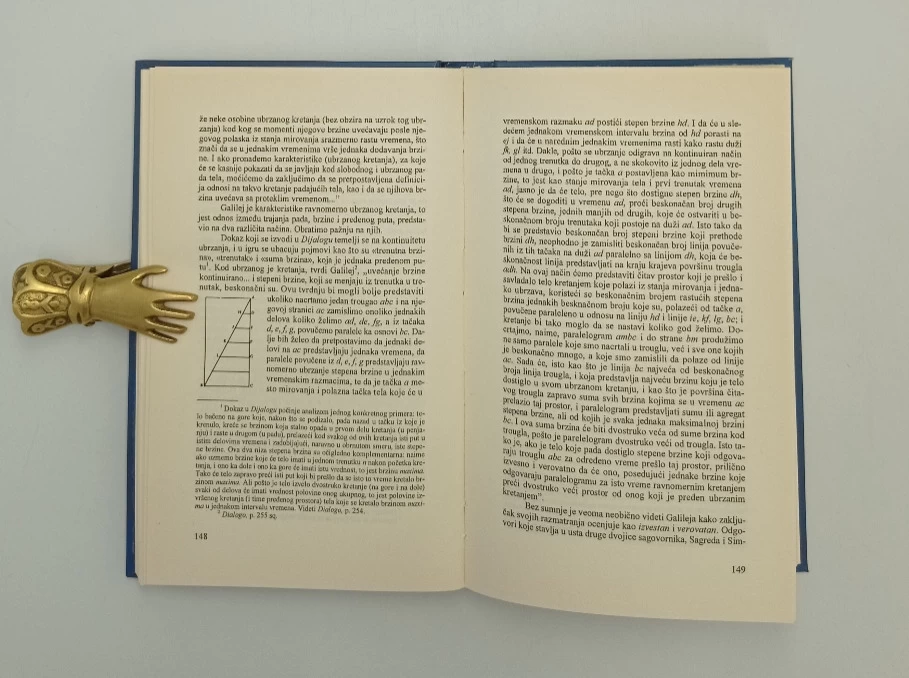
Studije o Galileju
Basic information
- Author: Koyre Alexander
- Publisher: Izdavačka knjižarnica Zorana Stojanovića
- Availability: Available
- Condition: Excellent
- Code: 45791
Shipping options
Payment methods
Explore more
Studije o Galileju
Koyre Alexander
Summary
Alexandre Koyre: Studies on Galileo
The texts that make up this book, first published between 1935 and 1939, represent a breakthrough not only in the interpretation of Galileo's teaching, but also in the entire history of science. From a methodological point of view, they were the first example of serious results achieved with the help of conceptual analysis, which seeks to encompass historical documents with a deep intuition of the author, which goes beyond a purely technical interpretation, an intuition in which its scientific and philosophical and religious aspects cannot be falsely separated. Koyre's analyzes bring to light the deep connections, which were previously only hinted at, and sometimes not even that, between modern science and metaphysics. Koyre, namely, rejects the interpretations of Galileo (and the entire science of the sixteenth century) which are the result of a practical-empirical approach whose roots we find in technical circles. He breaks with all Baconian-type interpretations of modern science, using very difficult words ("Bacon never understood science. He is credulous and devoid of critical spirit"), and no less resolutely rejects efforts to interpret the great novelty and essential contribution to the birth of new science, represented by Galileo's work, with the help of a single scientific term, whether it is the principle of inertia or paying great attention to some other physical quantity. Galileo's greatness, according to Koyre, rests on to a deep intuition, an intuition that goes beyond the interest in experiment or any specific scientific principle, which is the replacement of the concrete pre-Galilean space by the abstract, Euclidean one. To the physically conditioned space of ancient and medieval science, in which bodies move under the influence of forces that depend on a certain cosmic order, and to natural places determined in accordance with their material nature, Galileo contrasts a purely geometric space, whose arrangement does not depend on cosmophysics, but only from Euclid's theorems. In this space, bodies move under the influence of gravity. It was this deep intuition about space that made the experiments so useful. In carrying out this complex operation, Koyre really insisted on this. He, however, went so far as to develop the statics of geometric "irreal" bodies and the movement of geometric figures and by attributing to them the force of gravity, founded a dynamic. However, we must not forget how, thanks to Archimedes, he was able to develop this intuition that allowed him to surpass the Aristotelians. Archimedean abstract science, for its part, finds its inspiration in Platonic philosophy. Other authors spoke about Plato's influence on Galileo, but only Koyre points to Galileo's "deep and self-conscious" Platonism and points out how Plato influenced his entire oeuvre, including here the dialogic form of his works. For him, even Archimedes is a Platonist, despite all those who saw in him, above all, a great engineer. By studying Galilean texts, Koyre tries to prove his essential thesis: the role of theory is more important than the role experimentation, and the latter is not given a little space. He even goes so far as to doubt that Galileo wasted any time on conducting experiments at all. From the youthful researches devoted to motion, through the dynamics of the oblique plane to the struggle for the Copernican system, the entire development of Galilean thought is subject to the same key: the principle of inertia, the law of the fall of heavy bodies, all this could not be imagined if Galileo had not previously abandoned the world of real bodies and concrete space and Plato and Archimedes, he climbed into the world of ideal bodies (perfect spheres, perfect planes) and geometric space.
Additional information
- Author: Koyre Alexander
- Publisher: Izdavačka knjižarnica Zorana S...
- Year of publication:2014
- Place of publication:Novi Sad
- Pages:338
- Dimensions:15x23 cm
- Script:Latin script
- Condition:Excellent
- Binding:Hardcover
Reviews
0 reviewsWrite a review
Share your experience and help other readers choose.
This item has no reviews yet. Be the first to share your experience.
More books by Koyre Alexander
More books from Izdavačka knjižarnica Zorana Stojanovića