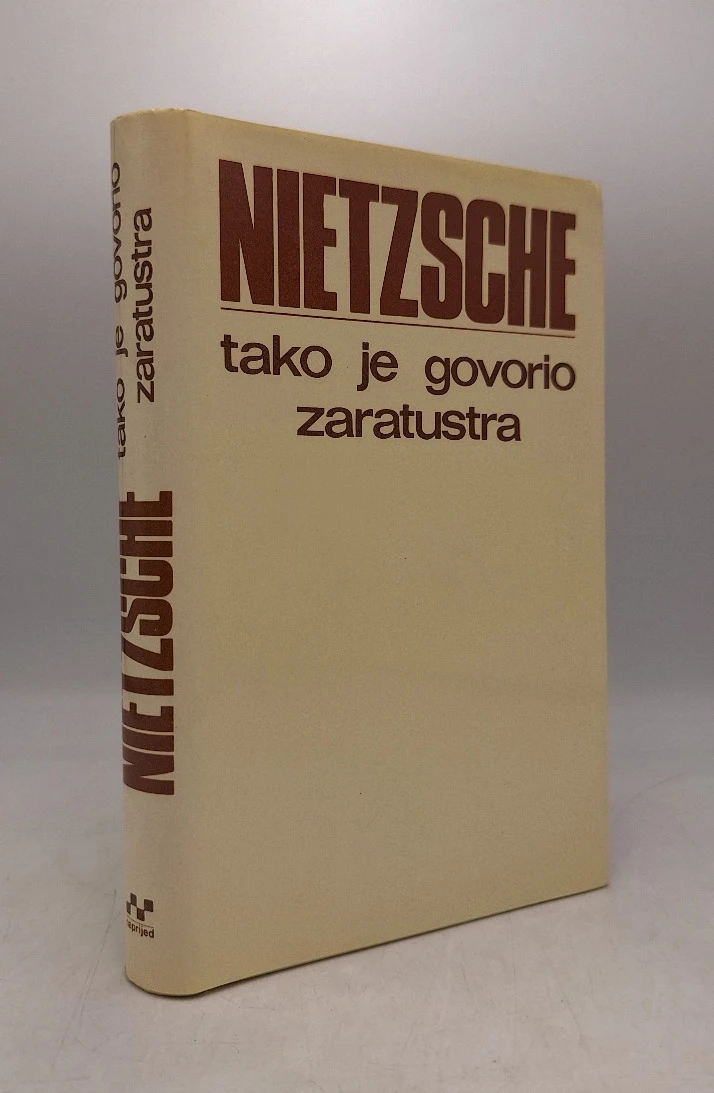


Tako je govorio Zaratustra
€ 18,00
Free delivery in Croatia for orders over EUR 70
Basic information
- Author: Nietzsche Friedrich
- Publisher: Naprijed
- ISBN: 8634902528
- Availability: Available
- Condition: Excellent
- Code: 30710
Shipping options
GLS Croatia
Delivery time: 1-2 working days (RH)
Delivery is made via the GLS delivery service.
5,00 €
Delivery
Delivery time: 3-21 working days
We send the delivery price via email within 24 hours.
Price on request
Personal collection at the antique store
Palmotićeva 28, 10000 Zagreb
Free
GLS parcel machine
Delivery time: 1-2 working days
Delivery is made to the selected GLS package machine.
3,00 €
Payment methods
Pay on pickup
CorvusPay
By general payment / Virman / Internet banking
Cash on delivery
Explore more
Tako je govorio Zaratustra
Nietzsche Friedrich
Summary
Friedrich Nietzsche: Thus spoke Zarathustra
translation and afterword by Danko Grlić
Probably in the history of the human spirit, there was no person like Friedrich Nietzsche who, with almost demonic passion, testified that philosophy is not just a mere area of thought but, above all and above all, a way of life. It can be said of him that he did not have philosophy, but that philosophy had him. And not only philosophy but also art. His work is a unity of art and philosophy or, rather, poetry and philosophy, which is mostly confirmed by the book Thus Spoke Zarathustra. And who is Nietzsche's Zarathustra? Zarathustra is the teacher of the superman and the advocate of the eternal repeated advent of equals, but above all a preacher of the will to power and thus the last chord of a magnificent symphony of poetic thought that has been left to us as a legacy as a symbol and as a burden: the power of the spirit as the spirit of power. Zarathustra is Nietzsche's life's work and nowhere else has its author managed to reach such heights of linguistic mastery. It is not an exaggeration to say that the highest level of German linguistic expression was reached with this book and that Nietzsche was not mistaken when he said that before him "it was not known what could be done with the German language". Because, even the poetry of the greatest German poets pales in front of Zarathustra, and even today the greatest philosophers do not manage to think poetically like Nietzsche. , but despite this, he finds no objection to life, or even against its eternal return, that is, its eternal repeated coming. On the contrary, it finds one more reason to be an eternal Yes to all that is, an immeasurable, unlimited saying of Yes and Amen. Everything is controversial in Thus Spoke Zarathustra, everything is contradictory and the intentions are ambiguous. Each of his compositions contains "a thousand and one goals" and the whole work is more music than anything else: the angelic music of the meaning of the cosmos alternates with the quietest moment, the quietest hour. Three "ontological" leitmotifs are the basis of Zarathustra's music: the superman, the eternally repeated arrival of the equal, and the will to power. They constitute the hidden unity of Nietzsche's opinion against philosophy as (Platonic) metaphysics, Christianity as religion and (civil) morality as the most corrupt theater in the world. Even the kind of poetry sung by Rilke or George pales in front of Zarathustra, and the greatest philosophers even to this day do not manage to think poetically like Nietzsche. Although the translation can by no means replace the charm of the original, any attempt to once again express in the Croatian language the torrents and waterfalls of thoughts, songs and curses that Zarathustra sings seems very justified. In this explosive book, everything is teeming with unusual thoughts, unexpected proverbs and enigmatic sayings, which spill over one another. Exclamations are hidden under calm affirmations, explanations sink into parables, and these swell and splash with over-excited parables. The dialogue suddenly turns into a ravishing lyrical song, shrouded in a shimmering fog of prophetic visions. Passionate prayer merges with angry mockery, apotheosis (superman) next to caricature (man). And all this rolls from page to page. Of course, our language would look different today if one Nietzsche wrote on it. Therefore, with every attempt to translate Zarathustra, one can see, among other things, the extent to which our team, for many, can express in a "poor" language what, in all probability, no one has ever uttered in it.
Additional information
- Author: Nietzsche Friedrich
- Publisher: Naprijed
- Year of publication:1991
- Place of publication:Zagreb
- Pages:351
- Dimensions:13x19.5 cm
- Script:Latin script
- Condition:Excellent
- Binding:Hardcover with dust jacket
Reviews
0 reviewsWrite a review
Share your experience and help other readers choose.
This item has no reviews yet. Be the first to share your experience.
More books by Nietzsche Friedrich





More books from Naprijed






You may also like




Biblos Newsletter
For book lovers who enjoy finding the rare
New titles, special copies and quiet recommendations from the antiquarian bookshop.