
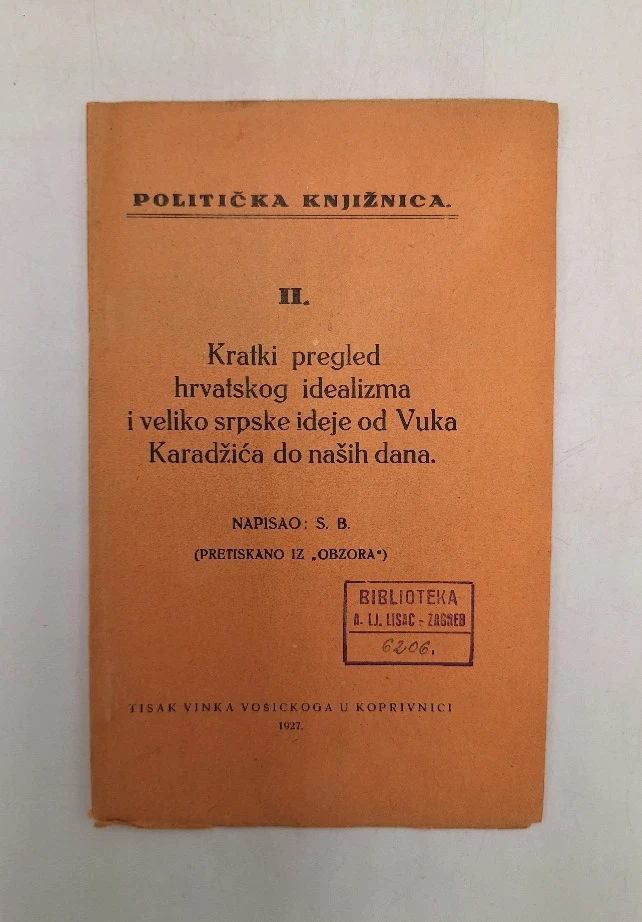
Kratki pregled hrvatskog idealizma i veliko srpske ideje od Vuka Karadžića do naših dana
Basic information
- Author: Banović Stjepan
- Publisher: Vinko Vošicki
- Availability: Available
- Condition: Very good
- Code: 23756
Shipping options
Payment methods
Explore more
Kratki pregled hrvatskog idealizma i veliko srpske ideje od Vuka Karadžića do naših dana
Banović Stjepan
Summary
Stjepan Banović: A brief overview of Croatian idealism and the great Serbian idea from Vuk Karadžić to our days
(reprinted from "Obzor")
BANOVIĆ, Stipan, folklorist and writer (Zaostrog, 6. III. 1884 — Naples, 28. VIII. 1961). He comes from a wealthy family of Mije and Ana, b. Kosovic. He attended elementary school in Zaostrogo (1891–1895), the Franciscan junior high school in Sinj (1895–1899), and a teacher's school in Arbanasi near Zadar (1899–1905). After passing his high school diploma (1905) and his final exam (1908), he was the manager of an elementary school in the village of Kotezi near Vrgorac for a year, then a teacher in Zaostrog (1909–1911) and Koljani near Vrlica (1911–1918). He spent the first war year in the Austro-Hungarian army. From 1918 to 1923 he was a teacher in Drvenik, and until 1925 in Mokro Polje near Knin. He retired after the state elections in 1925, and at the request of the people he was reactivated (1926) first as the administrator of the municipality of Gornje Primorje, and then in Zagreb. He was the prefect of the vocational school boarding school (until 1930), then a teacher of the school at Sveti Duhu (1931). He worked in the University Library for six years, from 1937 to 1941 he was an educational officer in the Banska administration, and until 1944 he worked in HIBZ. — He published the first poem Pojam svijeta in Pobratim (1902–1903, 4). He collaborated with poems and stories in Croatian circle (1910), Crvena Hrvatska (1911), Narodno list (Zadar 1917), Pokreta (Split, Šibenik 1918), Hrvatska rijeka (1921), Narodnoj vescivat (1921), To the Home and the World (1922), Vijenc (1923, 1924), Omladini (1924–1925, 1926–1927), Hrvatsko radisi (1925–1927), Svijetu (1927), Zori (1931), National Wave (1938). The newspaper Omladina (1926, 2–4) published his animal epic Fox Gospel (reworked as Dog epic in 1955). He is the author of two stories about peasant life (Vukodlak and Didove gazete); he wrote novels and travelogues. He used the pseudonyms: Argus and Hrvat Dalmatinac. In 1902 and 1903, he collected a collection of 7,000 verses of folk songs from his native region for the Matica hratovska (manuscript preserved in the Matica hratovska). His first scientific work on folkloristics is Gundulić's Osman i folk song (Hrvatsko kolo, 1906, 2). His discussion on the Jekavian and Ekavian literary dialects (Hrvatsko kolo, 1929) is also well known. B. was especially concerned with determining the historical background of events and persons that appear in folk songs (Zbornik za narodni život i cuusene Južn Slavenih, 1921 and 1928). He also collected a wealth of information about folk heroes from Muslim folk epics. His works on P. Preradović (1927), A. Palmović (1927, 1949), S. S. Kranjčević (1949), and A. Kačić Miošić (1962) were published in Građa za povijest književnosti Croatian. More important is the discussion Motives from the Odyssey in the Croatian folk song from the Makarska primorj (Collection of the folk life and customs of the South Slavs, 1951, 35), and the work on the previously unknown variant of the Hasanaginica (Collection of the folk life and customs of the South Slavs, 1962). He published professional and scientific contributions in: Hrvatska kola (1906, 1910, 1929–1931), Glasnik of the National Museum in Bosnia and Herzegovina (1912), Smotra dalmatinska (1913), Collection of folk life and customs of the South Slavs (1918, 1921, 1924–1936, 1940, 1951, 1954, 1962, 1964), Radu JAZ (1920, 1923, 1952), Hoffiller's collection (1937–1940), Mogućnosti (1954), Zadarska revija (1956, 1958, 1959), JAZU Chronicle (1960). A collection of folk pornography (Naprdaljka) remained in the manuscript. — B. was evaluated as a valuable collector of folk treasures of Dalmatia and the author of treatises on epic poetry (V. Žganec).
Additional information
- Author: Banović Stjepan
- Publisher: Vinko Vošicki
- Year of publication:1927
- Place of publication:Koprivnica
- Pages:22
- Dimensions:12.5x20.5 cm
- Script:Latin script
- Condition:Very good
- Binding:Softcover
Reviews
0 reviewsWrite a review
Share your experience and help other readers choose.
This item has no reviews yet. Be the first to share your experience.
More books from Vinko Vošicki


You may also like