
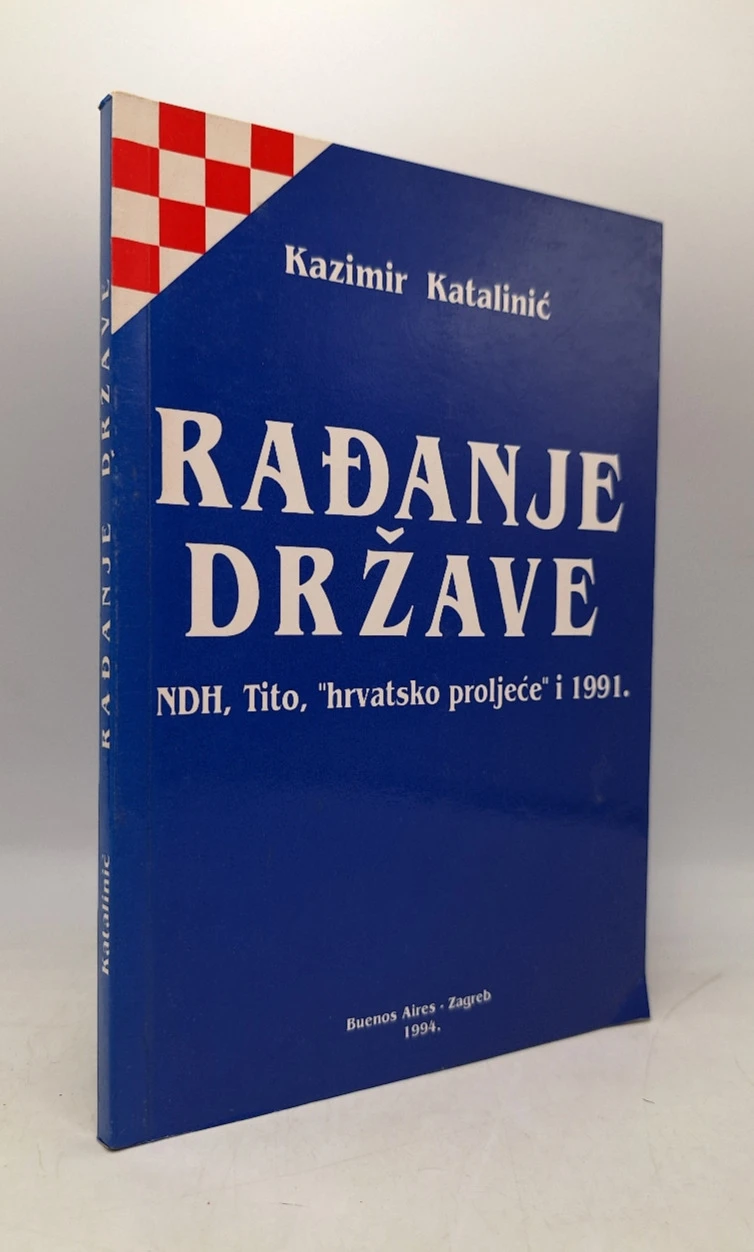
Rađanje države: NDH, Tito, "hrvatsko proljeće" i 1991.
Basic information
- Author: Katalinić Kazimir
- Publisher: Časopis Republika Hrvatska
- Availability: Available
- Condition: Very good
- Code: 35537
Shipping options
Payment methods
Explore more
Rađanje države: NDH, Tito, "hrvatsko proljeće" i 1991.
Katalinić Kazimir
Summary
Kazimir Katalinić: The Birth of the State: NDH, Tito, "Croatian Spring" and 1991.
*Dedication of Kazimir Katalinić
KATALINIĆ, Kazimir, politician and publicist (Sušak, 4 March 1927). He went to high school in Sušak, Senja and – after escaping to Italy in 1945 – in the Ferma camp and graduated in 1947 in Rome, and graduated in chemistry in 1960 in Buenos Aires. He settled in Argentina, where he was a clerk in the Ministry of Public Works in 1948–60, an analyst in its laboratory, then laboratory manager at the "Santiquin" companies in Buenos Aires in 1963–64. and "Reysol" in Zarate in 1964–67. Most recently, he was a chemistry, physics and math teacher in high schools in Florida and Merlo. Year In 1954, he joined the Croatian Republican Party (HRS) of I. Oršanić, in which he was a member of the General Assembly (from 1957), secretary (from 1958) and – after it was registered in the Republic of Croatia as the Croatian Republican Union – president from 1991–96. He published most of his articles in the magazine Republika Hrvatska (Buenos Aires 1957–62, 1964–77, 1979–91, Zagreb 1993–96, 1998–2001; co-editor from 1983 and editor-in-chief 1994–96), and many of them - somewhat modified - were collected in books (Birth of the State; Arguments) or printed as brochures in Buenos Aires (Pluralism in foreign policy, 1970; The purpose and duties of emigration, 1973; Croats and Serbs. Enemies or good neighbors?, 1982; Was the Independent State of Croatia a Nazi-Fascist creation?, 1987, edited in Spanish and English, 1941-1945; Experiences in the struggle, 1991. In them, he presented the party's and his own views that the NDH - despite its shortcomings - was an expression of the aspirations of the Croatian people; the partisan movement, on the other hand, made a crucial mistake in not overthrowing the regime, but the state, creating Yugoslavia, which could only be maintained by non-democratic rule. For this reason, among others - according to his judgment - the Croats (including Bosnian Muslims) in II. suffered the greatest losses during the World War and the Second World War, and emigration was tasked with maintaining political pluralism and, at an opportune moment, helping the armed establishment of an independent democratic state with an eastern border on the Drina, which, since the end of the 1980s, was imagined as a union of the Republic of Croatia and Bosnia and Herzegovina. On this track, he condemned the statement of a part of emigrant Croatian intellectuals in September 1968 in Granvillard. As a representative of the HRS in 1974, he lobbied for the Croatian National Council (HNV) to be founded as a supra-party association, in which the vice-presidential positions in the IO would go to the HSS and the Croatian Liberation Movement (HOP); later he was elected three times as a member of the HNV Parliament, and was also its secretary (1977; on the coalition list of HRS, Bruno Bušić's group and Muslim representatives HOP) and president of the Supervisory Board in 1982–83 (the activities of the HNV were described in Bože Vukušić's book, pp. 64–81). He also wrote in the periodicals Libera (Buenos Aires 1959), Hrvatska misao (Buenos Aires 1961, 1968), Naš put (Toronto 1962–72; Hrvatski put, 1972–75; 1977–79), Rakovica (Buenos Aires 1976–78; editor), Croatian Future (Canoga Park 1983–90), Journal of Croatian Studies (New York 1987–88), Studia Croatica (Buenos Aires 1987–88), Croatian Emigration Collection (1995–96), Marulić (1999). in Hrvatska borba (Washington), Hrvatska tjednik (Saint Albans), Imotska krajina and Vjesnik and in the anthologies 50 years of Bleiburg (Zagreb 1995) and International Scientific Meeting "Bleiburg 1945-1995" (Zagreb 1997). In Buenos Aires, he edited Oršanić's book Vision of Freedom (1979; abridged ed. Chicago and Stuttgart 1990) and compiled the Organizational Manual of the Croatian Republican Party (1974, Sydney 1975; according to these instructions in the 1980s, he particularly developed promotional activities with audio cassettes) and brochures Croatian Republican Party (1973), Do we need parties? (1973), Bridge to the Homeland< /i> (1976) and Vjenceslav Čižek. The Blind Dissenter (Windsor 1983; French, German and Russian eds.).
Additional information
- Author: Katalinić Kazimir
- Publisher: Časopis Republika Hrvatska
- Year of publication:1994
- Place of publication:Zagreb
- Pages:141
- Dimensions:15x22 cm
- Script:Latin script
- Condition:Very good
- Binding:Softcover
Reviews
0 reviewsWrite a review
Share your experience and help other readers choose.
This item has no reviews yet. Be the first to share your experience.