
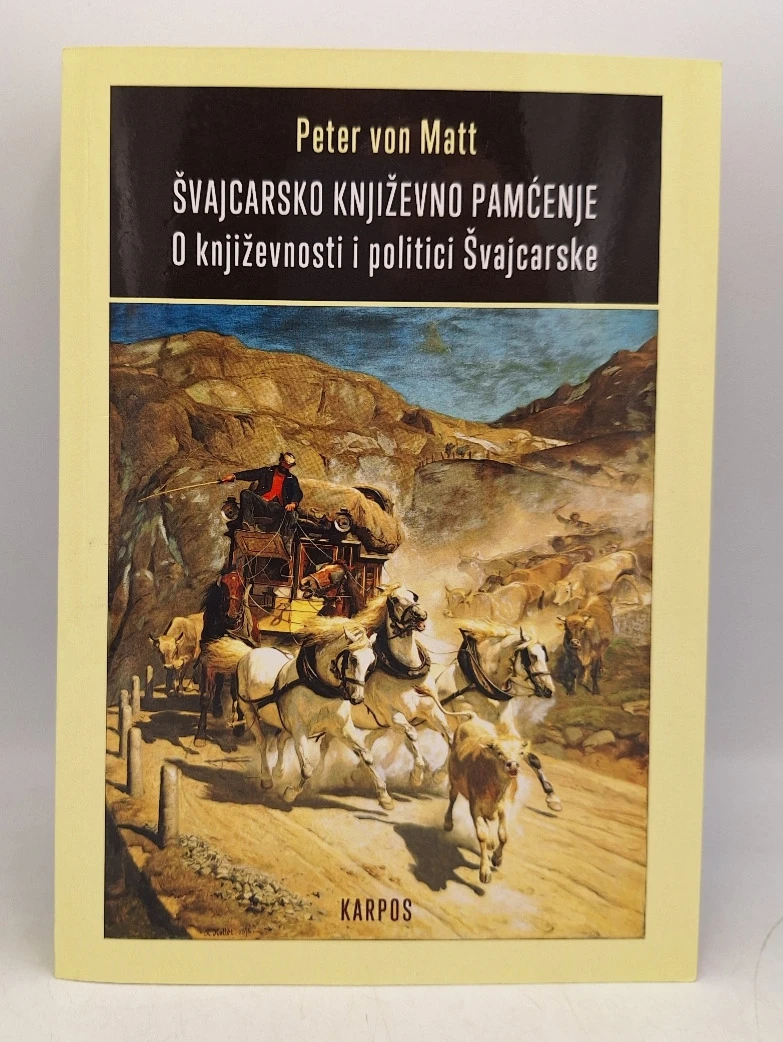
Švajcarsko književno pamćenje
Basic information
- Author: Von Matt Peter
- Publisher: Karpos
- Availability: Available
- Condition: New book
- Code: 53137
Shipping options
Payment methods
Explore more
Švajcarsko književno pamćenje
Von Matt Peter
Summary
Peter Von Matt: Swiss Literary Memory
On the Literature and Politics of Switzerland
In these essays dedicated to Swiss Germanophone writers, Peter von Matt, a long-time professor of new German literature at the University of Zurich, does not explain individual writers from the point of view of the literary trends or generations they belonged to, the poetics they followed or the influence exerted on them by their predecessors. He most often deals with them in the context of themes important to the literature of the German-speaking world: the theme of the returnee to the homeland, the spiritual guide (mentor) and his student, the relationship to modernity, progress and emerging social changes, etc. Max Frisch and Friedrich Dürrenmatt, for example, are the most clear to us through the prism of their relationship to liberalism and conservatism, as well as numerous other writers, since, as Peter von Matt claims, the Swiss writer is political. The Swiss writer also played a key role in creating the myth about the origin and exceptionality of Switzerland and the Swiss; myths for him are not simply good or bad, they are inevitable for constructing a nation, and are real or true by the real or true effects they produce. Peter von Matt also deals with literary memory. It is not easy to maintain it in a country where there is a strong impulse of anti-intellectualism and where, as he says, a whale would sooner appear in the place where the national daily is broadcast than a Swiss writer would be mentioned in it (which is not a problem when it comes to the news of the transfer of a soccer player, and in general about sports, which has a much more important place in the lucrative entertainment industry and as part of the state's ideological apparatus than literature).
Peter von Mattan's essays are imbued with refined with wit and wise remarks, in his language, rich in images, there is a fighting charge that does not spoil the elegant and uniform style. Although he is one of the most respected contemporary researchers and connoisseurs of modern German literature and its themes, his vast knowledge is not an obstacle, as it can be, to enjoying the text, but is exactly what it should be - an accomplice. All of these are excellent prerequisites for these 23 essays to show us in the clearest and most interesting way a world that is only partially known to us: from Albrecht von Haller, Ulrich Bräker, J.C. Lavater in the 18th century, through Jeremias Gotthelf, Gottfried Keller, J.C.F. Meyer in the 19th century, to Robert Walser, Max Frisch, Friedrich Dürrenmatt, Otto F. Walter, Hugo Lötscher, Peter Bichsel, Urs Widmer and others in the 20th century. The special merit of his strategy lies in the fact that he "deprovincialized" the Swiss authors, placing them in broader thematic frameworks, moved them and included them in the broader streams of German and thus European literature, and in the fact that he asked them questions that can be inspiring to the reader or literary scholar in the context of questioning their own literary and historical memory.
Additional information
- Author: Von Matt Peter
- Publisher: Karpos
- Year of publication:2018
- Place of publication:Loznica
- Pages:280
- Dimensions:15x21 cm
- Script:Latin script
- Condition:New book
- Binding:Softcover with dust jacket
Reviews
0 reviewsWrite a review
Share your experience and help other readers choose.
This item has no reviews yet. Be the first to share your experience.
More books from Karpos