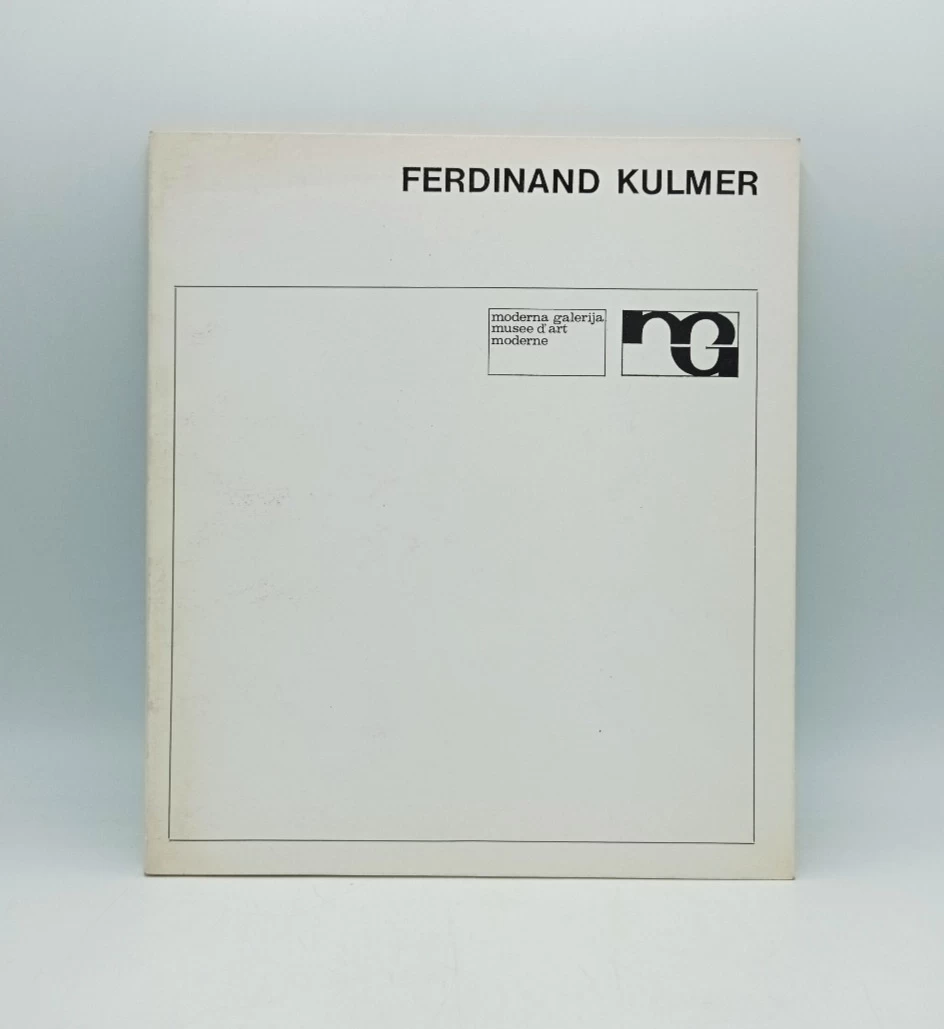
Ferdinand Kulmer
Basic information
- Author: Grum Željko
- Publisher: Moderna galerija
- Availability: Available
- Condition: Very good
- Code: 21748
Shipping options
Payment methods
Explore more
Ferdinand Kulmer
Grum Željko
Summary
Ferdinand Kulmer
Editor: Željko Grum
The book comes as a catalog of the exhibition held in Zagreb's Modern Gallery in 1976 and contains reproductions of many of Kulemr's paintings created between 1953 and 1976.
Kulmer, Ferdinand, Croatian painter (Cap Martin, France, January 29, 1925 – Zagreb, November 11, 1998). One of the main protagonists of Croatian abstract painting, who created one of the most diverse painting works of late modernism with constant changes of motifs and expressions, rounding it off at the end of the century with the current postmodernist return to figuration.
He got his first inspiration while traveling in 1938-39. in Greece, Egypt and the USA with his father, the nobleman Alexander Kulmer. He studied at art academies in Budapest 1942–45 (Rezsö Burghardt) and Zagreb, where he graduated in 1948 (Omer Mujadžić, Đuro Tiljak), then attended Tiljko's painting course until 1950 and was an associate of Krsto Hegedušić's Master Workshop until 1957, and from 1961 until his retirement in 1990 he worked at the Academy of Fine Arts (from 1975 as a full professor). From the 1950s, he perfected his skills in Rome, Venice, Florence and Paris, where he directly came into contact with contemporary world currents and their drivers.
After the initial phase of stylized figuration, close to Fauvism (Pink House, 1953, MSU), the abstract period begins with the painting Admiral (1957, MSU); at first he experimented with Tashist techniques (Red and green, 1958), then with thick relief layers of color and rich textures he created monochrome, material-rich compositions close to informal (Blue painting, 1959/60, NMMU, Grey painting I, 1960, MSU; Brown painting, 1960, Tate Gallery in London) and soon turned to expressionist abstraction (Black and white, 1960, Light and dark, 1962), achromatic compositions and dynamic movement, close to the gestural painting of Hans Hartung and Pierre Soulages (Black in motion and Pompeii II, 1963; Smeđa okomica, 1964), while in the cycle Encounters (1966) he experimented with the method of dripping. In the following period, he creates calligraphies of a meditative atmosphere in oil, ink and acrylic (Argonauts, 1965, Slika na svili II, 1968; May I, 1969, MSU). Soon he finds his own "letter" (Lipanjski triptych, Structures of repetition, 1970) and covers the canvas with living calligraphic characters (Polychrome II, Ovoid, 1971). The print briefly becomes denser and more dynamic, but in the mid-1970s it becomes independent and increases arabesque (1974–75, Calligraphy on Golden Silk, 1975), stimulating heraldic associations (Unicorn – Pegasus, 1976, Heraldic calligraphy, 1977). He developed the expression to its peak in the so-called zigzag phase, in which he flooded the compositions (Barbarosa, 1975, MSU; Igra u gradu / Hula-hup u Ulica st. Denis, 1979, Afternoon of tongues, 1983), often with characters that will "emerge" to the surface (Griffon broken heart, 1978). Experience in researching expressions and techniques resulted in an original combination of abstraction and figuration, spontaneous gesture and coded arabesque, which culminated in the anthology painting Garden of Pegasus (1981, MNNU).
Returning among the first figuration, he announced a new painting. With narrative, expressive cycles with mythological and heraldic themes, he followed up on the current postmodernist stylization (Lady with a Unicorn, 1983; Judgment of Paris, 1984; In the Garden of Torment, Three Masks of Zeus, Stunts of Ganymede, all 1985, Gryphon's tenderness, 1986, MSU; Pathetic Triptych and Pegasus, 1988). At the end of the 1980s, he also quoted or reinterpreted with a touch of irony created the works of modern authors (Vila misterija, 1989, Flower for Casimir, 1990), finally returning to the sign (Sunčani grad, 1996).
He is the author of graphic maps 8 serigraphs (Zagreb 1958, MSUZ), Weaving of Time. Uzdarje Ivan Gundulić (essay Josip Bratulić, 1989) and Transformation of Ferdinand Kulmer (text Tomislav Ladan, 1990), illustration in the books The Wonderful Adventures of Hlapić's Apprentice by Ivana Brlić-Mažuranić, Fairy Tales and Priče by J. and W. Grimm (all 1961–62) and notable costumes for the films Peasant Revolt 1573 by Vatroslav Mimica (1975) and The Man Who Needs to be Killed by Veljko Bulajić (1979).
Many European art critics wrote about his work, including Michel Tapié, who organized several solo exhibitions for him (Turin, Paris, Milan). 1969–73). He exhibited independently in Zagreb (from 1961, 1990 retrospective; posthumously in the Mimara Museum 1999), Paris (1991 retrospective; Grand Palais 1987), Chicago, Milan, Belgrade, Ljubljana, Tokyo and Antibes (1991 retrospective), participated in numerous group exhibitions: International Graphic Biennale in Ljubljana (1957, 1959, 1961), International Print Exhibition (Santiago 1957), Zagreb Print Exhibition (1960, 1962, 1992), Belgrade Triennale (1961–70, 1988), Zagreb Salon (1972 and 1981 – prizes, 1984 – Grand Prize), Mediterranean Biennale in Alexandria (1966), World Exhibition in Montreal (1967). He represented contemporary Yugoslav art in Paris in 1959 and 1961, painting in Seoul in 1990.
He was a member of the Mart group (since 1957), one of the founders of Forum Gallery in 1969, and a regular member of HAZU since In 1991, he won the "Vladimir Nazor" Award for Lifetime Achievement in 1990.
Additional information
- Author: Grum Željko
- Publisher: Moderna galerija
- Year of publication:1976
- Place of publication:Zagreb
- Pages:85
- Dimensions:20.5x23.5 cm
- Script:Latin script
- Condition:Very good
- Binding:Softcover
Reviews
0 reviewsWrite a review
Share your experience and help other readers choose.
This item has no reviews yet. Be the first to share your experience.
More books by Grum Željko

More books from Moderna galerija
You may also like



Recently viewed