
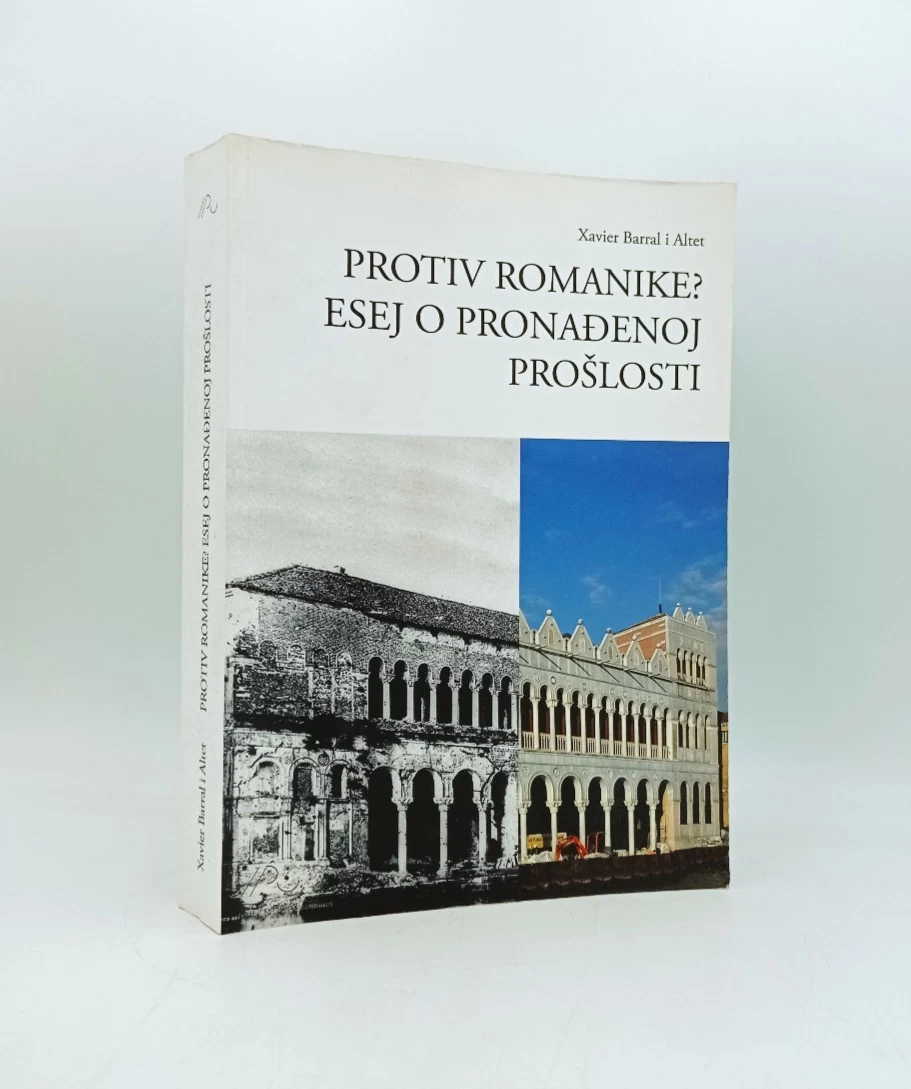
Protiv romanike? Esej o pronađenoj prošlosti
Basic information
- Author: Barral Xavier
- Publisher: Institut za povijest umjetnosti
- Availability: Available
- Condition: Excellent
- Code: 21758
Shipping options
Payment methods
Explore more
Protiv romanike? Esej o pronađenoj prošlosti
Barral Xavier
Summary
Xavier Barral and Altet: Against Romanesque? Essay on the Found Past
For the last few decades, Romanesque art has been in vogue. It is observed from an archaeological point of view, it is studied using modern philological methods, it is even visited on organized trips. He is attracted by her dignified austerity, her essence understood as a sign of strong religiosity, her bare, stripped, sober facies. But are the basilica in Ripoll or the Fondaco dei Turchi in Venice really Romanesque buildings? Are the domes of the cathedral in Périgueux or the facade of the cathedral in Le Puy really from the Middle Ages? Were the wooden sculptures depicting the Virgin Mary and Christ with a black face really that ugly and bare? Does Romanesque art as we see it today really correspond to medieval art?
In this book, the very concept of Romanesque and Romanesque art is questioned, its roots are explored, and above all its historiographical genesis is placed in the peculiar cultural context of the first half of the 19th century, when artistic production was discovered for the first time in the whole of Europe, almost suddenly, which preceded the appearance of the architectural style that Vasari defined as German or Gothic. In those decades marked by the Napoleonic wars and the Congress of Vienna, between neoclassicism and romanticism, European countries decided to re-appropriate their own national past by inventorying, restoring, studying, but also reconstructing the fundamental art of each nation: Romanesque.
The book analyzes the historiographical and nationalistic elaboration of the term Romanesque and deconstructs its fabrications and errors, emphasizing some controversial issues such as popularity artists, the role of women in the misogynist artistic universe of that period or the rich polychromy of buildings. At the same time, it reveals the true personality of the Romanesque Middle Ages, from France to Italy, from England to Catalonia, comparing architectural and artistic ideas and models in a dialogue that in those centuries must have been much more lively and vital than we usually think today.
Xavier Barral i Altet is an honorary professor of the history of medieval art at the University of Rennes in France, director of the National Museum of Catalan Art (MNAC) in Barcelona and the French Historical Mission in Germany in Göttingen, curator of major international exhibitions and member of various international academies and cultural institutions. He is one of the most prominent European art historians, and his books have been translated into numerous languages.
Additional information
- Author: Barral Xavier
- Publisher: Institut za povijest umjetnost...
- Year of publication:2009
- Place of publication:Zagreb
- Pages:432
- Dimensions:17x23.5 cm
- Script:Latin script
- Condition:Excellent
- Binding:Softcover
Reviews
0 reviewsWrite a review
Share your experience and help other readers choose.
This item has no reviews yet. Be the first to share your experience.
More books from Institut za povijest umjetnosti
You may also like



Recently viewed