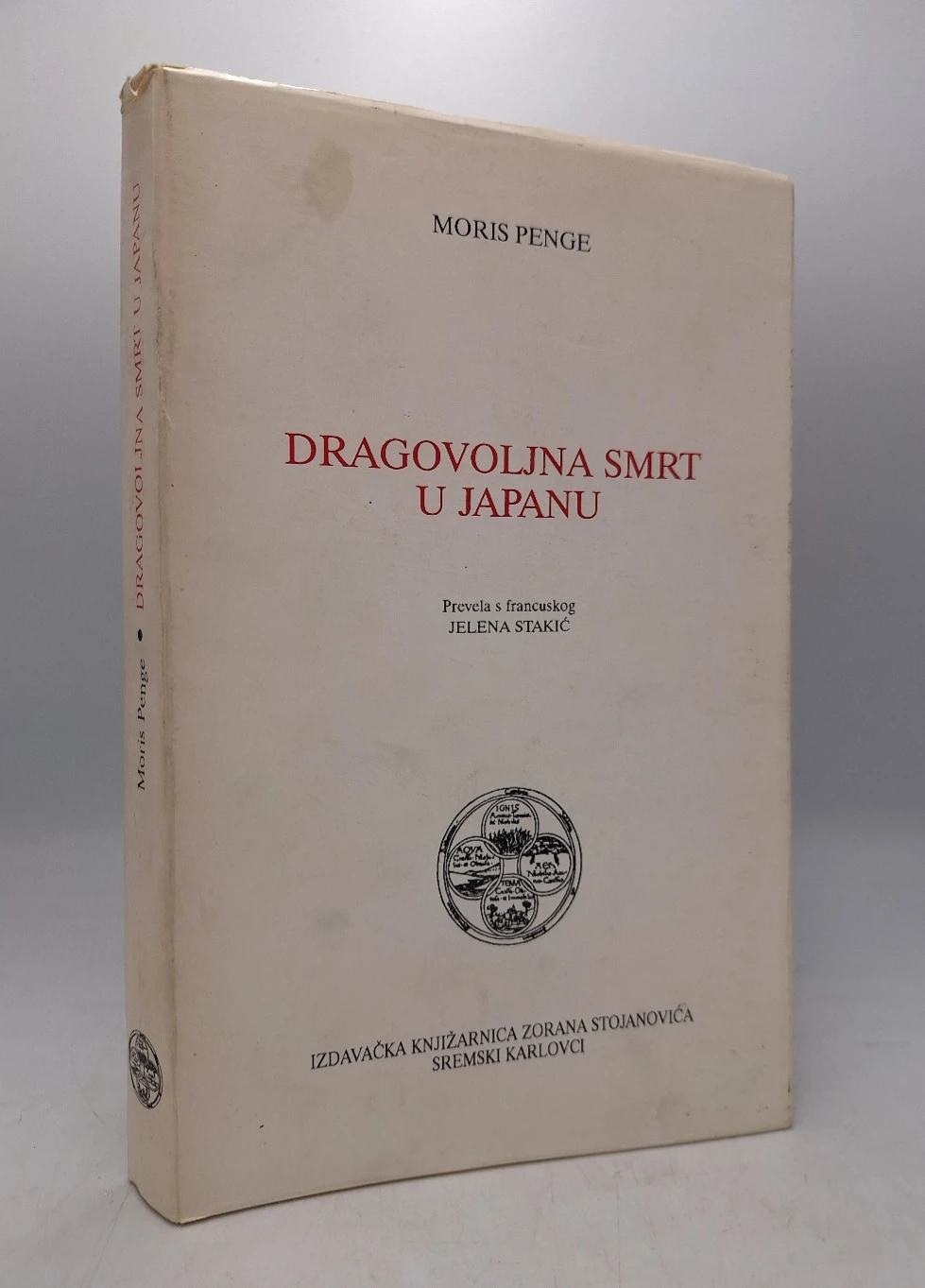

Pinguet Maurice: Dragovoljna smrt u Japanu
€ 27,00
Free delivery in Croatia for orders over EUR 70
Basic information
- Author: Pinguet Maurice
- Publisher: Izdavačka knjižarnica Zorana Stojanovića
- Availability: Available
- Condition: Vrlo dobro
- Code: 81587
Shipping options
GLS Croatia
5€
Delivery
0€
Personal collection at the antique store
0€
GLS parcel machine
3€
Payment methods
Pay on pickup
CorvusPay
By general payment / Virman / Internet banking
Cash on delivery
Dragovoljna smrt u Japanu
Pinguet Maurice
Summary
Maurice Pinguet: Voluntary death in Japan
What can voluntary death tell us about Japanese society today, when we understand it as a symptom, in the forest of statistics?
But nothing exists - unless it has become: sociological research follows the starting line of genealogy. From one century to another, it is a journey through the land Nietzsche speaks of: "a vast, distant and so mysterious land of morality - a morality that really existed and was truly lived", exploring through documents the diverse practice of voluntary death in Japan: as the apotheosis of a warrior's career, as the horizon of Buddhist separation, as the capstone of a feudal system, as a test of love, as sacrificial elevation, as the conclusion of despair and eradication.
Each time, the choice of voluntary death illuminates the human environment from which its meaning comes, and little by little, the entire Japanese past reveals itself in its contradictions, in its mistakes, and in its broken hearts.
Additional information
- Author: Pinguet Maurice
- Publisher: Izdavačka knjižarnica Zorana S...
- Year of publication:1990
- Place of publication:Srijemski Karlovci
- Pages:331
- Dimensions:14x22 cm
- Script:Latinica
- Condition:Vrlo dobro
- Binding:Tvrdi s ovitkom
You may also like










Recently viewed



Biblos Newsletter
For book lovers who enjoy finding the rare
New titles, special copies and quiet recommendations from the antiquarian bookshop.