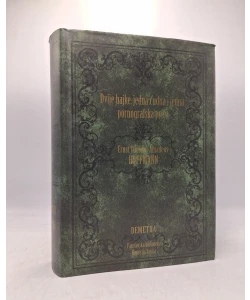


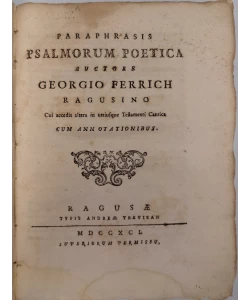
Ad clarissimum virum Joannem Muller Georgii Ferrich Ragusini epistola. Huic accedunt Illyricae linguae poematia triginta septem latinis carminibus ab eodem reddita.
Basic information
- Author: Ferić Ðuro
- Publisher: Trevisan
- Availability: Available
- Condition: Very good
- Code: 11754
Shipping options
Payment methods
Explore more
Ad clarissimum virum Joannem Muller Georgii Ferrich Ragusini epistola. Huic accedunt Illyricae linguae poematia triginta septem latinis carminibus ab eodem reddita.
Ferić Ðuro
Summary
Ðuro Ferić: Ad clarissimum virum Joannem Muller Georgii Ferrich Ragusini epistola. Huic accedunt Illyricae linguae poematia triginta septem latinis carminibus ab eodem reddita.
Ðuro Ferić, (Gvozdenica; Dubrovnik, 1739 - Dubrovnik, 1820), poet and translator. He comes from a poor merchant family from Dubrovnik. He was educated by the Jesuits and became a member of their Society, obtained a doctorate in philosophy, was ordained a priest in 1762, and after the abolition of the order he was a professor at the Dubrovnik gymnasium, and then chancellor at the French consulate. Appointed canon and then elected archpriest. From 1815 until his death, he was vicar general of the Archdiocese of Dubrovnik. He was a member of the Roman Academy of Arcadia. Started writing late. He collected folk proverbs and sayings and translated them into Latin following the example of Aesop, Phaedrus and La Fontaine. About folk (oral) songs, he exchanged a well-known epistle in verses with the German historian Johannes Muller from Vienna, to whom he sent 37 songs in Latin, including the famous Hasanaginica. He also sent such poetic epistles to other contemporaries: M. Denis and J. Bajamonti. He published his translations of Aesop's and Phaedrus' fables in Croatian (1813). This led him to a stronger interest in local history, oral tradition, and folklore. His Latin poem Description of the Dubrovnik coast ( Periegesis orae Rhacusanae 1803.) is of greatest value. It is equally a poetic travelogue about the coast and islands of the Republic of Dubrovnik, but also an enlightening-mercantilist treatise on the customs, economy and history of the Dubrovnik region. He reworked the sayings (Apophthegmata) of Erasmus of Rotterdam, but that work, like many others, remained in manuscript.
Ex libris Ivo Dubravčić.
Additional information
- Author: Ferić Ðuro
- Publisher: Trevisan
- Year of publication:1798
- Place of publication:Dubrovnik
- Pages:64
- Dimensions:12x17.5 cm
- Script:Latin script
- Condition:Very good
- Binding:Softcover
Reviews
0 reviewsWrite a review
Share your experience and help other readers choose.
This item has no reviews yet. Be the first to share your experience.
More books by Ferić Ðuro

More books from Trevisan

You may also like