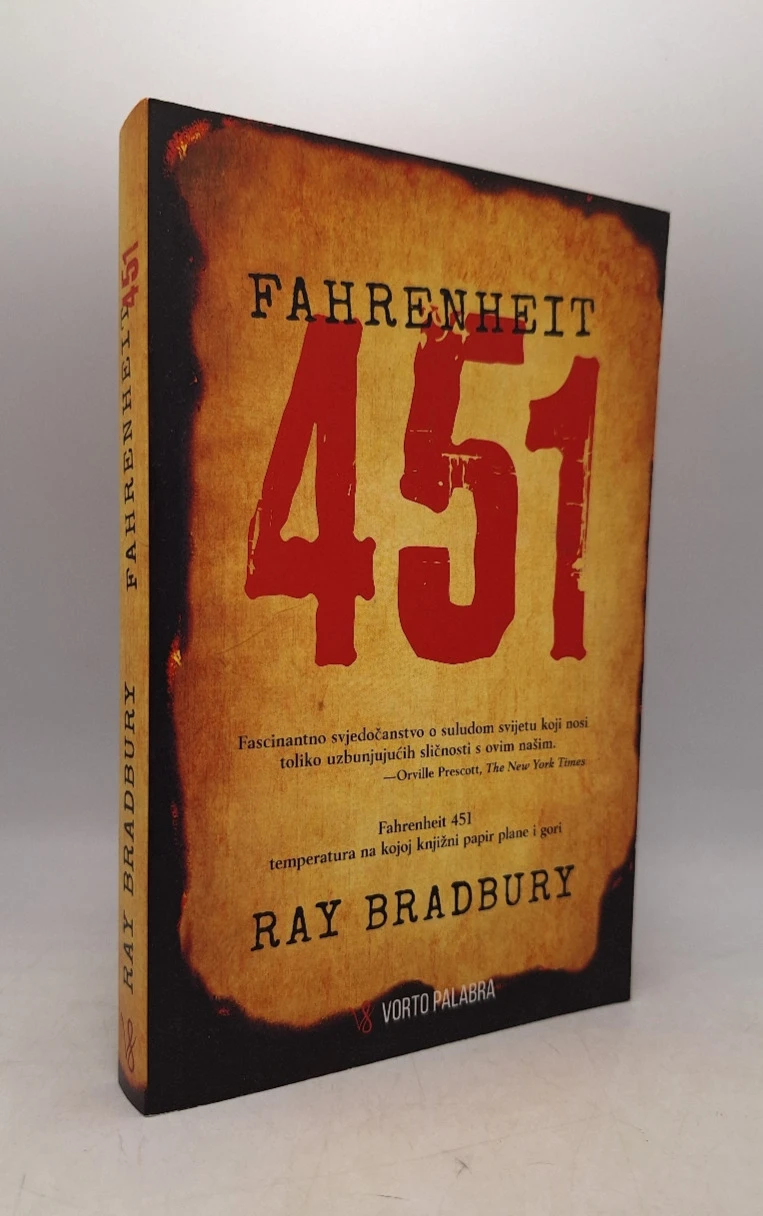


Fahrenheit 451
€ 8,00
Free delivery in Croatia for orders over EUR 70
Basic information
- Author: Bradbury Ray
- Publisher: Vorto Palabra d.o.o.
- Availability: Available
- Condition: Excellent
- Code: 72265
Shipping options
GLS Croatia
Delivery time: 1-2 working days (RH)
Delivery is made via the GLS delivery service.
5,00 €
Delivery
Delivery time: 3-21 working days
We send the delivery price via email within 24 hours.
Price on request
Personal collection at the antique store
Palmotićeva 28, 10000 Zagreb
Free
GLS parcel machine
Delivery time: 1-2 working days
Delivery is made to the selected GLS package machine.
3,00 €
Payment methods
Pay on pickup
CorvusPay
By general payment / Virman / Internet banking
Cash on delivery
Explore more
Fahrenheit 451
Bradbury Ray
Summary
Ray Bradbury: Fahrenheit 451
Guy Montag is a special kind of fireman. In his world, a hypothetical and undefined future ("after 1960"), in which television reigns and literature is on the verge of extinction, firefighters prefer to set fires
instead of putting them out. Their job is to destroy the most illegal things, printed books, along with the houses where they are hidden. Montag never questions his work, he does it every day and then returns home to his empty life and his wife Mildred, who spends her days with her television family. The authorities, in fact, use television programs to completely control society. For this purpose, everyone must use television exclusively in order to be informed, but also to live deprived of interpersonal relationships.
However, Montag will one day meet his eccentric young neighbor, Clarisse, who will reveal to him a past in which people did not live in fear, and a present in which the world is viewed through ideas derived from books, and not through endless murmuring from television screens.
Written back in 1953, then a futuristic science fiction novel, "Fahrenheit 451" today perfectly corresponds to reality.
Bradbury's vision of the future is almost prophetic - today's world and the one Bradbury wrote about so many years ago are shockingly similar.
Welcome to the society of entertainment and oblivion, where people are left to the rule of elites who unwittingly lead them to ruin.
This jubilee edition of "Fahrenheit 451" is expanded with the previously unpublished short story "Dragon".
Translation: Anja Majnarić
Additional information
- Author: Bradbury Ray
- Publisher: Vorto Palabra d.o.o.
- Year of publication:2019
- Place of publication:Zagreb
- Pages:206
- Dimensions:13.5x20 cm
- Script:Latin script
- Condition:Excellent
- Binding:Softcover
Reviews
0 reviewsWrite a review
Share your experience and help other readers choose.
This item has no reviews yet. Be the first to share your experience.
More books from Vorto Palabra d.o.o.


You may also like








Recently viewed

Biblos Newsletter
For book lovers who enjoy finding the rare
New titles, special copies and quiet recommendations from the antiquarian bookshop.