

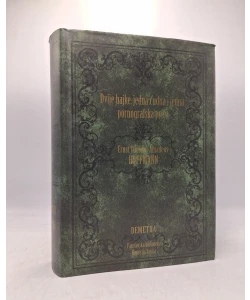
Godina kuge
Basic information
- Author: Defoe Daniel
- Publisher: Šareni dućan
- Availability: Available
- Condition: Excellent
- Code: 59198
Shipping options
Payment methods
Explore more
Godina kuge
Defoe Daniel
Summary
Daniel Defoe: The Year of the Plague
Even the casual reader, who only knows about Daniel Defoe from the obligatory "Robinsonian" reading, will already be clear after a few pages of The Year of the Plague that it contains a unique testimony about the great scourge of the "Black Death" in 1665 in England and that the descriptions of the epidemiological situation at the time correspond intriguingly with the measures during the contemporary, caused
In short: the first epidemiological measure was to leave the city for the countryside, as far as possible from the epicenter of the infection, and the district borders could only be crossed with a valid certificate of "good health"... The next measure was to maintain social distance, most public gatherings were prohibited and shops and markets were closed... The main measure, however, was quarantine: some self-isolated, while others were locked in their houses with guards for surveillance... Protective measures were brought by a kind of "civil protection headquarters" under the leadership of the London mayor...
Nevertheless, despite all the measures, about 100,000 people, roughly a quarter of the city's population, died from this terrible "black plague" in London alone. The dead and terminally ill were everywhere, they were bought from the streets and houses, mostly at night, and buried in mass graves. It was said that "the end of the world" was on the horizon, and the author states that the situation was so terrifying that "it is impossible to vividly present it to someone who did not witness it... but I wrote down all the details carefully because maybe one day they will be important to those who come after me, if the same trouble befalls them." welcome..
Translation by DOMAGOJ ČAVRAK and DENIS PERIČIĆ
Additional information
- Author: Defoe Daniel
- Publisher: Šareni dućan
- Year of publication:2021
- Place of publication:Koprivnica
- Pages:262
- Dimensions:15x21 cm
- Script:Latin script
- Condition:Excellent
- Binding:Hardcover
Reviews
0 reviewsWrite a review
Share your experience and help other readers choose.
This item has no reviews yet. Be the first to share your experience.
More books by Defoe Daniel


More books from Šareni dućan









You may also like









Recently viewed